Just another day, just another dame, just another dream, just another drama

Why no, these aren’t sick, twisted, mentally-ill freaks we’re talking about. They’re every bit as normal and well-adjusted as anyone else. I’m shocked you’d even for a moment think otherwise. SHOCKED!™, I say!

‘Next To The Eggs’: Transgender Person Sues Ex To Get Back Testicles Allegedly Stored In Fridge
A transgender-identifying person in Pontiac, Michigan, is suing his ex-boyfriend for allegedly keeping his testicles in a jar in the fridge and refusing to return them, the Detroit News reports.

“Defendant retains possession of my surgically extracted testicles, preserved in (a) Mason jar, kept in (the) fridge next to the eggs. Demand immediate return of my human remains specimen and damages of $6,500,” Brianna Kingsley, a 40-year-old biological man who identifies as a woman, said in an affidavit, according to the outlet.

Kingsley made the claims against 37-year-old William Wojciechowski in Pontiac’s 50th District Court in a two-page affidavit Thursday. Wojciechowski says he sees the affidavit as a continuation of his ex’s prolonged pattern of harassment and threats against him.

From the sound of it, I’d say these two perfectly ordinary people deserve each other. Further explication, with pictures, of these paragons of mundane normalcy:

A Michigan man who identifies as both transgender and Muslim has filed a legal claim against his ex-boyfriend demanding the return of his amputated testicles which he says are being kept in a jar in the refrigerator.

Brianna Kingsley, 40, filed the claim against William Wojciechowski, 37, in Pontiac’s 50th District Court on Thursday. In a handwritten affidavit, Kingsley wrote: “Defendant retains possession of my surgically extracted testicles, preserved in [a] Mason jar, kept in [the] fridge next to the eggs. Demand immediate return of my human remains specimen and damages of $6,500.”

Kingsley is also known as Zahrah Bri-Zee Muharib on social media, an Arabic name, and appears to have recently converted to Islam.

In April, Kingsley uploaded a video to his TikTok account titled “The Unboxing of Dee’s Nutz,” which depicts him removing a clear bag with a biohazard label while wearing a lace veil and a pink dress.

The video is captioned, “Transgender woman unboxes her surgically extracted lady balls that was [sic] packaged by the Hospital that performed her gender-affirming bottom surgery.” Smiling and laughing, Kingsley holds up the bag containing his testicles before returning them to the box and performing a curtsy. In the background behind him, a painting of a nude woman with testicles can be seen.

See what I mean? Nothing shocking, appalling, or repulsive about any of that, right down to the home-decor choices. In fact, I think I remember seeing a print of that exact same painting on the sitting-room wall at my family church’s rectory when I went with my parents to visit the minister as a child. No big deal, right?

“I’m still moving forward with the charges against Brianna Kingsley. She violated the PPO I have on her by taking my dogs,” Wojciechowski stated the following month after having recovered the animals.

“She needs to be held accountable for her actions no matter what. The dogs are OK, but they do show more fear and aggression since they were taken. Especially Butch. He keeps pulling his head up and away when I try to pet under his chin. Which tells me that his whining and barking triggered Brianna and she punished him for it,” Wojciechowski said.

Gee, wonder how zhe/zhrrr/zhim might have gone about doing that. Maybe you should sue him/her/it to retrieve the head of “her” cock, which is no doubt now properly and securely pickled for posterity in a Mason jar in the fridge, right next to your Ziploc L’il Bag O’ Nutsack®. Complete with the little-doggie teethmarks, naturally.

According to his Facebook profile, Kingsley organized a “queer night” event in 2019 where he performed at a strip club in Ypsilanti. The event, titled “First Fully Nude Transsexual Stripper,” was held in October that year and co-hosted by a local burlesque dancer.

Again: all perfectly in order, run of the mill, and above-board, nothing indicative of mental/psychological/emotional disorder and/or dysfunction. Nothing to see here, folks, let’s all just move on, shall we?

Oh, shall we ever.

(Via Ace)

Moar purty zoom-zooms!

Another trip down one of the best Innarnuts rabbit-holes there is, and one of the hardest to extricate oneself from: early jet fighters and/or fighter-bombers. Consider it a knock-on effect of yesterday’s Eyrie post, maybe.

I started off my day browsing through some of the other good ol’ 50s and 60s vintage aircraft, like the Convair Delta Dart and Delta Dagger, the F101 Voodoo, and another McDonnell product you just might have heard about already: one of the most fantastically successful military aircraft ever produced by this or any nation, the McDonnell F4 Phantom II.

The main impetus for this post would be Convair’s F106A Delta Dart, upon which hangs a wild and crazy tale.

The F-106 all-weather interceptor was developed from the Convair F-102 Delta Dagger. Originally designated F-102B, it was redesignated F-106 because it had extensive structural changes and a more powerful engine. The first F-106A flew on December 26, 1956, and deliveries to the Air Force began in July 1959. Production ended in late 1960 after 277 F-106As and 63 F-106Bs had been built. The F-106 used a Hughes MA-1 electronic guidance and fire control system. After takeoff, the MA-1 can be given control of the aircraft to fly it to the proper altitude and attack position. Then it can fire the Genie and Falcon missiles, break off the attack run and return the aircraft to the vicinity of its base. The pilot takes control again for the landing.

The aircraft on display was involved in an unusual incident. During a training mission from Malmstrom Air Force Base on Feb. 2, 1970, it suddenly entered an uncontrollable flat spin forcing the pilot to eject. Unpiloted, the aircraft recovered on its own, apparently due to the balance and configuration changes caused by the ejection, and miraculously made a gentle belly landing in a snow-covered field near Big Sandy, Mont. After minor repairs, the aircraft was returned to service. It last served with the 49th Fighter Interceptor Squadron before being brought to the museum in August 1986.

Bizarre, no? Well, just check this out:

Like I said: crazy, man, crazy. As MAJ Foust notes, the “Cornfield Bomber” should really have been called the “Wheatfield Fighter,” just for accuracy’s sake. But hey, once a nick has been generated, it tends to stick like glue, and fairness or accuracy be damned. Knowing military pilots as I do, I think it entirely safe to assume that the amount of crap MAJ Foust caught in the ready room for the rest of his career would have been measurable in container-ship loads: “Hey, Foust, guess we know now where the real failure point was—that plane flew better with you OUT of it than IN it!”

Heh.

Anyways, the above-mentioned McDonnell F101 Voodoo is yet another of my faves, one I also consider to be a good-looking aircraft. A few of the deets:

The McDonnell F-101 Voodoo is a supersonic jet fighter designed and produced by the American McDonnell Aircraft Corporation.

Development of the F-101 commenced during the late 1940s as a long-range bomber escort (then known as a penetration fighter) for the United States Air Force’s (USAF) Strategic Air Command (SAC). It was also adapted as a nuclear-armed fighter-bomber for the USAF’s Tactical Air Command (TAC), and as a photo reconnaissance aircraft based on the same airframe. On 29 September 1954, it performed its maiden flight. The F-101A set a number of world speed records for jet-powered aircraft, including fastest airspeed, attaining 1,207.6 miles (1,943.4 km) per hour on 12 December 1957.

Delays in the 1954 interceptor project led to demands for an interim interceptor aircraft design, a role that was eventually won by the F-101B Voodoo. This role required extensive modifications to add a large radar to the nose of the aircraft, a second crew member to operate it, and a new weapons bay using a rotating door that held its four AIM-4 Falcon missiles or two AIR-2 Genie rockets hidden within the airframe until it was time to be fired. The F-101B entered service with USAF Air Defense Command in 1959 and the Royal Canadian Air Force (RCAF) in 1961. While the Voodoo was a moderate success, it may have been more important as an evolutionary step towards its replacement in most roles, the F-4 Phantom II, one of the most successful Western fighter designs of the 1950s; the Phantom would retain the twin engines, twin crew for interception duties, and a tail mounted well above and behind the jet exhaust, although it was an evolution of the F3H Demon while the Voodoo was developed from the earlier XF-88 Voodoo.

The Voodoo’s career as a fighter-bomber was relatively brief, but the reconnaissance versions served for some time. Along with the US Air Force’s Lockheed U-2 and US Navy’s Vought RF-8 Crusaders, the RF-101 reconnaissance variant of the Voodoo was instrumental during the Cuban Missile Crisis and saw extensive service during the Vietnam War. Interceptor versions served with the Air National Guard until 1982, and in Canadian service, they were a front line part of NORAD until their replacement with the CF-18 Hornet in the 1980s. The type was operated in the reconnaissance role until 1979. US examples were handed off to the USAF Air National Guard where they were operated until 1982. The RCAF Voodoos were in service until 1984.

Pretty? You tell me:

F101Voodoo

I‘d say she was pretty, yeah. Note some of the commonalities with the F4, which we’ll be delving into a bit more in just a sec, so hold yer dang horses, aiight? Low-mounted twin engines, tandem seating for two aircrew, tail section above and well aft of the exhaust, etc. Now for the justly-renowned F4 Phantom II.

The McDonnell Douglas F-4 Phantom II is an American tandem two-seat, twin-engine, all-weather, long-range supersonic jet interceptor and fighter-bomber originally developed by McDonnell Aircraft for the United States Navy. Proving highly adaptable, it entered service with the Navy in 1961 before it was adopted by the United States Marine Corps and the United States Air Force, and by the mid-1960s it had become a major part of their air arms. Phantom production ran from 1958 to 1981 with a total of 5,195 aircraft built, making it the most produced American supersonic military aircraft in history, and cementing its position as a signature combat aircraft of the Cold War.

The Phantom is a large fighter with a top speed of over Mach 2.2. It can carry more than 18,000 pounds (8,400 kg) of weapons on nine external hardpoints, including air-to-air missiles, air-to-ground missiles, and various bombs. The F-4, like other interceptors of its time, was initially designed without an internal cannon. Later models incorporated an M61 Vulcan rotary cannon. Beginning in 1959, it set 15 world records for in-flight performance, including an absolute speed record and an absolute altitude record.

The F-4 was used extensively during the Vietnam War. It served as the principal air superiority fighter for the U.S. Air Force, Navy, and Marine Corps and became important in the ground-attack and aerial reconnaissance roles late in the war. During the Vietnam War, one U.S. Air Force pilot, two weapon systems officers (WSOs), one U.S. Navy pilot and one radar intercept officer (RIO) became aces by achieving five aerial kills against enemy fighter aircraft. The F-4 continued to form a major part of U.S. military air power throughout the 1970s and 1980s, being gradually replaced by more modern aircraft such as the F-15 Eagle and F-16 Fighting Falcon in the U.S. Air Force, the F-14 Tomcat in the U.S. Navy, and the F/A-18 Hornet in the U.S. Navy and U.S. Marine Corps.

The F-4 Phantom II remained in use by the U.S. in the reconnaissance and Wild Weasel (Suppression of Enemy Air Defenses) roles in the 1991 Gulf War, finally leaving service in 1996. It was also the only aircraft used by both U.S. flight demonstration teams: the United States Air Force Thunderbirds (F-4E) and the United States Navy Blue Angels (F-4J). The F-4 was also operated by the armed forces of 11 other nations. Israeli Phantoms saw extensive combat in several Arab–Israeli conflicts, while Iran used its large fleet of Phantoms, acquired before the fall of the Shah, in the Iran–Iraq War. As of 2021, 63 years after its first flight, the F-4 remains in active service with the air forces of Iran, South Korea, Greece, and Turkey. The aircraft has most recently been in service against the Islamic State group in the Middle East.

Over its long and illustrious career, the Phantom II has proven to be one of the most capable, versatile, and deadly planes in ANY nation’s inventory, period. She was large and quite heavy for a fighter/interceptor, but her operators overcame those disadvantages quite handily. Fast? Oh, you betcher; like lightning, this old gal was fast.

World records
To show off their new fighter, the Navy led a series of record-breaking flights early in Phantom development: All in all, the Phantom set 16 world records. Five of the speed records remained unbeaten until the F-15 Eagle appeared in 1975.

  • Operation Top Flight: On 6 December 1959, the second XF4H-1 performed a zoom climb to a world record 98,557 ft (30,040 m). Commander Lawrence E. Flint Jr., USN accelerated his aircraft to Mach 2.5 (2,660 km/h; 1,650 mph) at 47,000 ft (14,330 m) and climbed to 90,000 ft (27,430 m) at a 45° angle. He then shut down the engines and glided to the peak altitude. As the aircraft fell through 70,000 ft (21,300 m), Flint restarted the engines and resumed normal flight.
  • On 5 September 1960, an F4H-1 averaged 1,216.78 mph (1,958.16 km/h) over a 500 km (311 mi) closed-circuit course.
  • On 25 September 1960, an F4H-1F averaged 1,390.24 mph (2,237.37 km/h) over a 100 km (62.1 mi) closed-circuit course. FAIRecord File Number 8898.
  • Operation LANA: To celebrate the 50th anniversary of Naval aviation (L is the Roman numeral for 50 and ANA stood for Anniversary of Naval Aviation) on 24 May 1961, Phantoms flew across the continental United States in under three hours and included several tanker refuelings. The fastest of the aircraft averaged 869.74 mph (1,400.28 km/h) and completed the trip in 2 hours 47 minutes, earning the pilot (and future NASA Astronaut), Lieutenant Richard Gordon, USN and RIO, Lieutenant Bobbie Young, USN, the 1961 Bendix trophy.
  • Operation Sageburner: On 28 August 1961, a F4H-1F Phantom II averaged 1,452.777 kilometers per hour (902.714 miles per hour) over a 3 mi (4.82 km) course flying below 125 feet (38.1 m) at all times. Commander J.L. Felsman, USN was killed during the first attempt at this record on 18 May 1961 when his aircraft disintegrated in the air after pitch damper failure.
  • Operation Skyburner: On 22 November 1961, a modified Phantom with water injection, piloted by Lt. Col. Robert B. Robinson, set an absolute world record average speed over a 20-mile (32.2 km) long 2-way straight course of 1,606.342 mph (2,585.086 km/h).
  • On 5 December 1961, another Phantom set a sustained altitude record of 66,443.8 feet (20,252 m).
  • Project High Jump: A series of time-to-altitude records was set in early 1962: 34.523 seconds to 3,000 m (9,840 ft), 48.787 seconds to 6,000 m (19,700 ft), 61.629 seconds to 9,000 m (29,500 ft), 77.156 seconds to 12,000 m (39,400 ft), 114.548 seconds to 15,000 m (49,200 ft), 178.5 s to 20,000 m (65,600 ft), 230.44 s to 25,000 m (82,000 ft), and 371.43 s to 30,000 m (98,400 ft). All High Jump records were set by F4H-1 production number 108 (Bureau Number 148423). Two of the records were set by future distinguished NASA astronaut LCdr John Young.

On the bathroom wall at the H-D shop I used to wrench at, my old boss had a framed photo from his days as a Gyrine jet mechanic: him back-seating a check-flight on an F4—a reward from his superiors for being named USMC Mechanic Of The Year a cpl years running. The canopy is up as the aircraft taxis back over to the hangar area, after doing a high-speed pass at extremely low altitude over the base runway.

In the photo—shot by a fellow Marine from ground-level-right of the aircraft as it rolled smoothly by—Goose’s flight helmet is still on, strap undone and hanging loose, as he flashes two thumbs waaaay up. The woozy grin smeared all over his face is as wide and beatific as one would expect to see on someone who had just been personally introduced to Einstein, Beethoven, Chuck Yeager, and Jesus Christ Himself, all at the same party.

Now, here’s another vidya I ran across, of a matched set of MiG 29s taking fullest possible advantage of the vectored-thrust concept.

The real action starts at around 1:35 in, with the two MiGs standing on their tails only a few feet above the tarmac as if they’d been hung on a string from the ceiling of some kid’s bedroom. Guess we know now where at least some of that super-duper-top-secret UFO tech might’ve ended up.

Greatest meme EVAR?

I know I’ve said that several times before, but this one just might top them all to permanently retire the crown.

FokkerVsFucker

Heh. Fuckers.

Update! I knew of Bader from all the Battle of Britain histories and historical fiction I’ve read over lo, these many years, but went poking around for more info on him. And BOY, did I ever find it. To wit (bold mine throughout):

Group Captain Sir Douglas Robert Steuart Bader, CBE, DSO & Bar, DFC & Bar, DL, FRAeS (/ˈbɑːdər/; 21 February 1910 – 5 September 1982) was a Royal Air Force flying ace during the Second World War. He was credited with 22 aerial victories, four shared victories, six probables, one shared probable and 11 enemy aircraft damaged.

Bader joined the RAF in 1928, and was commissioned in 1930. In December 1931, while attempting some aerobatics, he crashed and lost both his legs. Having been on the brink of death, he recovered, retook flight training, passed his check flights and then requested reactivation as a pilot. Although there were no regulations applicable to his situation, he was retired against his will on medical grounds.

After the outbreak of the Second World War in 1939, however, Douglas Bader returned to the RAF and was accepted as a pilot. He scored his first victories over Dunkirk during the Battle of France in 1940. He then took part in the Battle of Britain and became a friend and supporter of Air Vice Marshal Trafford Leigh-Mallory and his “Big Wing” experiments.

In August 1941, Bader baled out over German-occupied France and was captured. Soon afterward, he met and was befriended by Adolf Galland, a prominent German fighter ace. Despite his disability, Bader made a number of escape attempts and was eventually sent to the prisoner of war camp at Colditz Castle. He remained there until April 1945 when the camp was liberated by the First United States Army.

Bader left the RAF permanently in February 1946 and resumed his career in the oil industry. During the 1950s, a book and a film, Reach for the Sky, chronicled his life and RAF career to the end of the Second World War. Bader campaigned for disabled people and in the Queen’s Birthday Honours 1976 was appointed a Knight Bachelor “for services to disabled people”. He continued to fly until ill health forced him to stop in 1979. Bader died, aged 72, on 5 September 1982, after a heart attack.

A truly remarkable man, no? His legs were amputated after that ill-advised aerobatics attempt, one BTK (ie, Below The Knee) and one ATK (Above etc), in amputee jargon (mine was ATK, just so’s ya know). Baden was flying a Bristol Bulldog, a single-seat, unequal-wingspan (ie, lower wing shorter in length than the upper) biplane of some renown and excellent reputation at the time. His logbook entry after the crash was a true masterpiece of dry, laconic, British stiff-upper-lip understatement:

Crashed slow-rolling near ground. Bad show.

— Douglas Bader

In 1932, after a long convalescence, throughout which he needed morphine for pain relief, Bader was transferred to the hospital at RAF Uxbridge and fought hard to regain his former abilities after he was given a new pair of artificial legs. In time, his agonising and determined efforts paid off, and he was able to drive a specially modified car, play golf, and even dance.

Daring, dauntless, utterly without fear and indomitable, Sir Douglas Bader was outstanding even amongst an entire generation of real, true men; clearly, the words “quit” or “give up” simply were no part of his vocabulary. We shan’t see his like again, to our incalculable cost. Lots more great, great stuff at the link, of which you should damned-skippy read the all.

Ironically enough update! As it happens, Leigh-Mallory and Bader’s “Big Wing” theory, along with the resultant political battles with Air Vice-Marshall Keith Park, was recounted in great depth in one of those historical-fiction novels I’ve always been so fond of, namely Vol 2 of John Rhodes’ gripping Breaking Point series (highly recommended, if you’re into that sort of thing at all). “Big Wing,” while still controversial, was nonetheless pretty much a disaster.

After the Battle of Britain Leigh-Mallory never really had a chance to use the Big Wing defensively again, and it quickly mutated from a defensive to an offensive formation—Bader would eventually lead one of these new wings on massive fighter sweeps over France. To this day there is debate over the effectiveness of the “Big Wing” as it was used during the Battle. Although Leigh-Mallory and Bader argued it was a great success, post-war analysis suggests the actual number of German aircraft shot down by the wing was probably a fraction of those claimed (the claims for the Big Wing were never credible even at the time. On 15 September 1940, the Big Wing was scrambled twice against incoming raids and claimed 52 kills, eight probables and others damaged. (German records showed that six aircraft were lost). Some senior officers like Leigh-Mallory and Sholto Douglas wanted to believe these claims so that they could use the Big Wing as a political tool against Dowding. This would seem to support the idea that, for a “Big Wing”, there were “not enough enemy to go around”; the Wing had too high a concentration of aircraft in the same air space looking for targets.

It could be argued that 12 Group had more time to get fighters into position but even then it failed to do so. When 11 Group was stretched to its limits and required support, due to the delay imposed by 12 Group, 11 Group airfields were left undefended. This was due not only to time wasted in forming up the Big Wing but also due to 12 Group commanders not following 11 Group’s instructions and thus arriving in the wrong place. Not only did 12 Group fail to support 11 Group, they left their own airfields undefended; a large portion of UK airspace was left undefended while Leigh-Mallory and Bader tested their Big Wing theory. The time taken to form a Big Wing also wasted fuel and combined with the limited range of the fighters, reduced time over the combat zone. When 10 Group was asked to provide cover for 11 Group in similar circumstances, it was provided and 11 Group airfields defended.

Casualties for the “Big Wing” were significantly lower than in the smaller formations—suggesting that they did indeed benefit from protection in numbers. The “Big Wing” invariably joined combat with the enemy over Northern London, where the German fighter escort was at the very limit of its range and effectiveness. Consequently, the Big Wing also made very few interceptions, and as a result lower casualties would be expected on both sides. Park’s tactics (which had included the occasional use of two- and three-squadron wings) were correct for the conditions he had to fight under. The most powerful argument against the Big Wing in the Battle of Britain is that without a clear idea of a target as a raid assembled over France, it was impossible for the Big Wing to get airborne and form up in time to meet it.

Not all of the problems with “Big Wing” can be attributed to the concept itself; as always, the 7P Rule (Proper Previous Planning Prevents Piss Poor Performance) axiom comes into play. That, in concert with the unavoidable influence of Murphy’s Law and the proverbial “fog of war,” all had their own part in things, also.

Catch ya on the flip, Pee-wee

One of the most unique and original comedians ever, Paul Reubens, dead at 70.

Reubens began his brilliant comedic career as a member of The Groundlings improv and sketch troupe in Los Angeles. His legendary character, Pee Wee Herman, was Reubens’ biggest sensation, though he flexed some serious acting muscle in “Buffy the Vampire Slayer” and “Gotham” as well as television shows such as “The Blacklist.”

Reubens was notoriously arrested in a Sarasota, Fla., porn theatre (you can read why he was arrested here) back in 1991. Some believed he planned to get arrested to shake off the Pee-wee Herman character, but it was later revealed that he got busted during a random police raid.

After the arrest, Pee-wee Herman jokes became all the rage, such as this one: What are Pee Wee Herman’s favorite baseball teams? The Expos and the Yankees.

Reubens withdrew for months as the humor flew. He re-appeared as his Pee-wee Herman character on an MTV awards show — to thunderous applause — and quipped, “Heard any good jokes lately? So funny I forgot to laugh.”

On Instagram, Reubens thanked his fans and apologized for not revealing that he had been fighting cancer. “Please accept my apology for not going public with what I’ve been facing the last six years. I have always felt a huge amount of love and respect from my friends, fans and supporters. I have loved you all so much and enjoyed making art for you,” he posted.

So sorry to hear about this. I was an avid fan of the reliably brilliant Pee-wee’s Playhouse TV show right from the beginning, whatever Reubens’ personal foibles may have been. Then again, though, getting caught spanking it in a pRoN theater? Meh; trite, piffling, mundane stuff. Hell, that sort of thing has become the fabric of everyday life in the Bribem White(bag) House nowadays—that, and much worse to boot. Enjoy this happy little song, and brace yourself for a little something UNEXPECTED!™ afterwards.

As you may or may not know (I confess, I didn’t until just now), the fella playing the role of Kowboy Kurtis above is one of our verymost talented actors of any race, creed, color, or national origin: Laurence Fishburne, who, as it turns out, caught one of his first big breaks on Pee-wee’s Playhouse. Nope, not even joking about that, folks:

It might sound like the stuff of Hollywood urban legends but it was a role on the kids’ TV show Pee-wee’s Playhouse as Cowboy Curtis that helped make award-winning actor Laurence Fishburne a star. Pee-wee’s Playhouse was by no means Fishburne’s first rodeo, of course. He’s been acting since he was a child and counts the 1975 film Cornbread, Earl And Me and a 12-episode stint on soap opera One Life To Live among his early credits.

After lying about his age, a 14-year-old Laurence Fishburne landed a part in Francis Ford Coppola’s Vietnam War epic Apocalypse Now as young G.I. Tyrone ‘Mr. Clean’ Miller which led to roles in other Coppola films including Rumble Fish and The Cotton Club during the 1980s. Bit parts in Steven Spielberg’s Oscar-nominated film The Color Purple and TV shows like Hill Street Blues and Miami Vice followed but his recurring role on Pee-wee’s Playhouse introduced Fishburne to a wider audience and helped put him on the map.

Fishburne wasn’t the only young talent to get their start on Pee-wee’s Playhouse either. Actors including Sons Of Anarchy star Jimmy Smits, Russian Doll co-creator and star Natasha Lyonne and Golden Globe-winner S. Epatha Merkerson all had parts on the show. Behind the scenes, metalhead and future horror movie director Rob Zombie worked as a production assistant and future filmmaker John Singleton – then a student – worked as a security guard.

Quite the resume Fishburne has going, no? All this, mind, before even getting around to his Morpheus star-turn in the Matrix flicks, too. And to think, it all started with Paul Reubens’ truly inspired Pee-wee Herman character.

Fare thee well, Pee-wee, wherever your irrepressible spirit may roam. Those of us who loved your work won’t soon forget you.

Crossfire hurricane

Another Jimi Hendrix thang from Quora Digest, one part of which I especially dig (in bold, natch).

Was Jimi Hendrix a significantly better guitarist than his contemporaries?
Yes, with some very minor reservations which I’ll get to in a minute.

Hendrix raised the bar and changed the game, when it came to electric guitar. Jazz musicians like to talk about a musician’s ‘conception’, meaning that musician’s general approach to the instrument, and to making music. Another musician might find it difficult to play with someone whose conception they couldn’t understand. (Ornette Coleman sometimes had this problem, until he attracted musicians like Ed Blackwell, Don Cherry and Charlie Haden, who grasped his conception very well.)

The recorded evidence shows that, in terms of his conception—his understanding of what the electric guitar was good for, and could be made to do—Hendrix was simply head and shoulders above his peers. He effortlessly incorporated controlled noise and feedback into his playing, when his peers were tentatively mucking about with them. He was a superb rhythm player: most of the other guitar heroes of his generation were at best workmanlike rhythm players, and not even the best rhythm players of the time (Townshend, Page) could match the fury and precision of Hendrix’s part on ‘Killing Floor’—there’s a reason why he chose that song to introduce himself to American audiences at the Monterey festival. His leads were almost endlessly inventive and expressive: listen to what he can do with just one chord in ‘Voodoo Chile (Slight Return)’. His expressivity on guitar was supreme. Other guitarists, like Clapton, took a plank of wood and an amp the size of a fridge, and in the words of Philip Norman, made it sound like some kind of strange but haunting wind instrument, but Hendrix made it sound like a whole orchestra, playing in a hurricane.

With all respect to other answers to this question, and their authors, many of whom are people whose other answers I have enjoyed and admired, I have to laugh when I see Hendrix being considered as if he belonged in the same company as players like Clapton, Mike Bloomfield or even Jeff Beck. They belong in each other’s company; they do not belong in his.

VERY well said, sir. I chose not to put that last line in boldface as well, but it was a near-run thing, and a difficult decision indeed.

Five German dances

One of my personal-fave Schubert compositions is his “Five German dances in C Major, D90”—a lilting confection showcasing all the lovely, melodic tunefulness for which the incomparable Franz Schubert is so justly renowned. But that isn’t the main reason I’m embedding this next vid of the piece; no, that would be for the delightful way the conductor, Matthias Foremny, umm, conducts himself in front of the orchestra.

Folks, that there is the living embodiment of what we mean by the phrase “a man who truly enjoys his work.” His illimitable passion; his zest; his pure heart-swelling glee comes through in every goofy facial expression, every broad smile. The way he stands nearly stock-still for extended periods, then suddenly starts leaping about, gesticulating frantically, as if someone had slipped a live scorpion down the front of his trousers, waving and grimacing, is just too damned funny. You gotta love it…which, I most certainly do. Maestro Foremni, I am definitely a fan, sir.

Pure GENIUS

Who says good old American ingenuity, know-how, and the can-do spirit is dead? ‘Cause clearly, they’re wrong about that.


What can one possibly say but: Heh.

Update! Another excellent example from the same ONT post.


I repeat: heh. Weird Dave has a shit-ton more of them over at the Ace place, too.

Memezapoppin’

Over the past week or two, I’ve been collecting memes, downloading like a fiend every time I see a good ‘un and adding them to the hoard against some far-off future day when they might come in useful around here. Thus, the following meme-dump. No links back to where I originally found them, because pain in the fecking ass, that’s why. Also, I don’t recall where most of ‘em came from anyway. Enjoy.

JustBeThere

MorpheusDisneyIrony

ObeyOrdersObeyGunLaws

Sharting

TuckerTheReaper

WillNotComply

Man, if I keep this up I’m gonna need to buy an external hard drive just to store these things.

Update! Just found an absolutely brilliant one over at Ken Lane’s joint.

ZZPaul

HAAA! I never woulda imagined Paul could be so self-aware and humble.

Hellacious update! Dammit dammit DAMMIT, meant to include this one originally, then in the course of putting the post together I forgot it. No worries though, it’ll be worth the wait.

SatanStoryHour

Heh.

How the sausage is made

I’ve never been in the habit of watching videos linked or embedded by other bloggers; don’t know why that would be, I’m by no means opposed to it, and I certainly hope CF readers will watch the ones I embed. Hypocritical of me, perhaps, but hey, it is what it is. Don’t hate me ‘cause I’m beautiful, to swipe one of my favorite Little Richard quotes.

That said, though, for some odd reason I felt compelled to watch one MisHum included with last night’s ONT, the first half of it anyway. And in so doing, I learned something I didn’t know before, namely the backstory of how a great ‘70s classic-rock tune came to be.

“No Sugar Tonight/New Mother Nature” is a medley by the Canadian rock band The Guess Who. It was released on their 1970 album American Woman, and was released on the B-side of the “American Woman” single without the “New Mother Nature” section. The single was officially released as “American Woman/No Sugar Tonight” and peaked at #1 on the RPM magazine charts and #1 on the Billboard Hot 100, for three weeks on both charts. In Cash Box, which at the time ranked sides of singles independently, “No Sugar Tonight” reached #39.

According to Randy Bachman, the inspiration for the song arose after an incident when he was visiting California. He was walking down the street with a stack of records under his arm, when he saw three “tough-looking biker guys” approaching. He felt threatened and was looking for a way to cross the street onto the other sidewalk when a little car pulled up to the men. A woman about 5 feet tall got out of the car, shouting at one of them, asking where he’d been all day, that he had left her alone with the kids, didn’t take out the trash, and was down here watching the girls. The man was suddenly alone when his buddies walked away. Chastened, he got in the car as the woman told him before pulling away: “And one more thing, you ain’t getting no sugar tonight”. The words stuck in Bachman’s memory.

Bachman then wrote a short song in the key of F♯ called “No Sugar Tonight”. When he presented the song to Burton Cummings and RCA, he was told that the song was too short. Bachman and Cummings expanded the song by adding to it a song Cummings had written that was also in the key of F♯, “New Mother Nature”.

The narrator of the vid over at the Ace place goes on to relate the tale of how the A-side of which “No Sugar” was the B, “American Woman,” was put together as well, and it’s a doozy in its own right.

The music and lyrics of the song were improvised on stage during a concert in Southern Ontario (the guitarist, Randy Bachman, recalled it being at a concert in Kitchener, although Burton Cummings, the lead singer, said it was at the Broom and Stone, a curling rink in Scarborough). Bachman was playing notes while tuning his guitar after replacing a broken string, and he realized he was playing a new riff that he wanted to remember. He continued playing it and the other band members returned to the stage and joined in, creating a jam session in which Cummings improvised the lyrics. They noticed a kid with a cassette recorder making a bootleg recording and asked him for the tape. They listened to the tape and noted down the words that Cummings had extemporized, and which he later revised.

The song’s lyrics have been the matter of debate, often interpreted as an attack on U.S. politics (especially the draft). Cummings, who composed the lyrics, said in 2013 that they had nothing to do with politics. “What was on my mind was that girls in the States seemed to get older quicker than our girls and that made them, well, dangerous. When I said ‘American woman, stay away from me,’ I really meant ‘Canadian woman, I prefer you.’ It was all a happy accident.”

Heh. Upon the single’s release “American Woman” quickly raced to number one on the Billboard chart, moving on from there to worldwide commercial success and writing the Guess Who into the hitmaker-history book forever.

The music biz is just brim-full of fascinating, fun stories like those; that’s among many other factors that attracted me so intensely from a very early age, inspiring me to devote my entire life to chasing that most beautiful of dreams. Plenty of barbed hooks to be found in the briny deeps of the musician’s world, I assure you, and once they’re set in ya there just ain’t no wriggling off of ‘em. As I recently said in a comments-section response to a Quora query concerning the cons of playing the guitar:

The biggest “con” of all: it’s TOTALLY addictive. Back when I was taking students, if it was a newbie first thing I’d tell them was, “sell the guitar now and walk away. Otherwise, it’ll get in your blood and you’ll never have a pot to piss in for the rest of your life.” None of them took my sage advice, go figure.

With the guys who already knew how to play and just wanted me to teach them my own particular style, I didn’t bother saying anything. I knew they were lost already, and would never, ever recover. 😉

S’truth, and I know whereof I speak on this one. Learning to play; training yourself up to proficiency; screwing up the nerve to climb up onto a stage and play before an audience for the very first time; getting used to committing that unnatural act until you’ve reached the point where the stage is the one and only place in all the world where you feel truly alive, truly yourself—tougher to kick than heroin, that is, but a WAY better, more enjoyable high. Plus, there’s not all that puking right after you geeze up to contend with, either.

Yep, it’s a sickness, that’s what it is.

Poesy

In comments to the Horatius/Trump post SteveF mentions a certain pome with which I was heretofore unfamiliar. So I looked it up and MY, but it’s a dandy, albeit long as an afternoon suffering all the tortures of the dentist’s art. A bit more of it, then.

XXVI
But the Consul’s brow was sad,
    And the Consul’s speech was low,
And darkly looked he at the wall,
    And darkly at the foe.
‘Their van will be upon us
    Before the bridge goes down;
And if they once may win the bridge,
    What hope to save the town?’

XXVII
Then out spake brave Horatius,
    The Captain of the gate:
‘To every man upon this earth
    Death cometh soon or late.
And how can man die better
    Than facing fearful odds,
For the ashes of his fathers,
    And the temples of his Gods,

XXVIII
‘And for the tender mother
    Who dandled him to rest,
And for the wife who nurses
    His baby at her breast,
And for the holy maidens
    Who feed the eternal flame,
To save them from false Sextus
    That wrought the deed of shame?

XXIX
‘Hew down the bridge, Sir Consul,
    With all the speed ye may;
I, with two more to help me,
    Will hold the foe in play.
In yon strait path a thousand
    May well be stopped by three.
Now who will stand on either hand,
    And keep the bridge with me?’

XXX
Then out spake Spurius Lartius;
    A Ramnian proud was he:
‘Lo, I will stand at thy right hand,
    And keep the bridge with thee.’
And out spake strong Herminius;
    Of Titian blood was he:
‘I will abide on thy left side,
    And keep the bridge with thee.’

XXXI
‘Horatius,’ quoth the Consul,
    ‘As thou sayest, so let it be.’
And straight against that great array
    Forth went the dauntless Three.
For Romans in Rome’s quarrel
    Spared neither land nor gold,
Nor son nor wife, nor limb nor life,
    In the brave days of old.

XXXII
Then none was for a party;
    Then all were for the state;
Then the great man helped the poor,
    And the poor man loved the great:
Then lands were fairly portioned;
    Then spoils were fairly sold:
The Romans were like brothers
    In the brave days of old.

XXXIII
Now Roman is to Roman
    More hateful than a foe,
And the Tribunes beard the high,
    And the Fathers grind the low.
As we wax hot in faction,
    In battle we wax cold:
Wherefore men fight not as they fought
    In the brave days of old.

Rings all too familiar in the modern ear, no? Especially those last two stanzas, which encapsulate the current situation in Amerika v2.0 pretty thoroughly. Proving once again that, in art as in life itself, some things really never DO change, and that the same can truly be said of eternally-immutable human nature—the shitlib conceit of malleable, perfectible Progressivist Man notwithstanding.

Much, much more rich, buttery epic-poetic goodness at the link, incredibly enough, which you should read if you’re inclined in that direction, finally clocking out at an eye-bulging Stanza LXX. Pity the poor shoolkids who had to memorize the entire pome way back in the Aulden Thymes, if Pournelle’s claim is to be believed.

Inside baseball side note: Man. A. LIVE, but what a right royal pain in the ass formatting that was! Thanks to the abject failure of the MarsEdit find-and-replace function to do its ONE FUCKING JOB, replacing all the paragraph HTML tags with line-breaks throughout the above excerpt of the pome by hand was a most arduous task indeed. Necessary though, to keep things all clean, tidy, and looking as they should around here. I swear, the things I do for you people…

Ahem. And now, to get cracking on tomorrow’s Substackery.

The Four Big Things

Which, according to Mike’s Iron Law #4,689, one should never, ever try to bargain-shop for, looking for the cheapest possible alternative: shoes, meat, doctors, and tattoos*. Free? Thanks, but…NO.

FourThings

Wouldn’t work anyhow, the target audience isn’t the least bit interested in showering.

(Via Arthur Sido)

* That first one, shoes, I can’t honestly claim as my own; that one was an Iron Law of my dad’s

What if…?

You’ll never in a million years guess who the author of this brilliantly-conceived and -written piece is. I mean, never.

The quaint conceit of imagining what would have happened if some important or unimportant event had settled itself differently has become so fashionable that I am encouraged to enter upon an absurd speculation. What would have happened if Lee had not won the Battle of Gettysburg?

Once a great victory is won it dominates not only the future but the past. All the chains of consequence clink out as if they never could stop. The hopes that were shattered, the passions that were quelled, the sacrifices that were ineffectual are all swept out of the land of reality. Still it may amuse an idle hour, and perhaps serve as a corrective to undue complacency, if at this moment in the twentieth century—so rich in assurance and prosperity, so calm and buoyant—we meditate for a spell upon the debt we owe to those Confederate soldiers who by a deathless feat of arms broke the Union front at Gettysburg and laid open a fair future to the world.

It always amuses historians and philosophers to pick out the tiny things, the sharp agate points, on which the ponderous balance of destiny turns; and certainly the details of the famous Confederate victory of Gettysburg furnish a fertile theme. There can be at this date no conceivable doubt that Pickett’s charge would have been defeated if Stuart with his encircling cavalry had not arrived in the rear of the Union position at the supreme moment. Stuart might have been arrested in his decisive swoop if any one of twenty commonplace incidents had occurred.

If, for instance, General Meade had organized his lines of communication with posts for defence against raids, or if he had used his cavalry to scout upon his flanks, he would have received a timely warning. If General Warren had only thought of sending a battalion to hold Little Round Top the rapid advance of the masses of Confederate cavalry must have been detected. If only President Davis’s letter to General Lee, captured by Captain Dahlgren, revealing the Confederacy plans had reached Meade a few hours earlier, he might have escaped Lee’s clutches.

Anything, we repeat, might have prevented Lee’s magnificent combinations from synchronizing and, if so, Pickett’s repulse was sure. Gettysburg would have been a great Northern victory. It might have well been a final victory. Lee might, indeed, have made a successful retreat from the field. The Confederacy, with its skilful generals and fierce armies, might have another year, or even two, but once defeated decisively at Gettysburg, its doom was inevitable. The fall of Vicksburg, which happened only two days after Lee’s immortal triumph, would in itself by opening the Mississippi to the river fleets of the Union, have cut the Secessionist States almost in half. Without wishing to dogmatize, we feel we are on solid ground in saying that the Southern States could not have survived the loss of a great battle in Pennsylvania and the almost simultaneous bursting open of the Mississippi

However, all went well. Once again by the narrowest of margins the compulsive pinch of military genius and soldierly valor produced a perfect result. The panic which engulfed the whole left of Meade’s massive army has never been made a reproach against the Yankee troops. Everyone knows they were stout fellows. But defeat is defeat, and rout is ruin. Three days only were required after the cannon at Gettysburg had ceased to thunder before General Lee fixed his headquarters in Washington. We need not here dwell upon the ludicrous features of the hurried flight to New York of all the politicians, place hunters, contractors, sentimentalists and their retinues, which was so successfully accomplished. It is more agreeable to remember how Lincoln, “greatly falling with a falling State,” preserved the poise and dignity of a nation. Never did his rugged yet sublime common sense render a finer service to his countrymen. He was never greater than in the hour of fatal defeat.

But, of course, there is no doubt whatever that the mere military victory which Lee gained at Gettysburg would not by itself have altered the history of the world. The loss of Washington would not have affected the immense numerical preponderance of the Union States. The advanced situation of their capital and its fall would have exposed them to a grave injury, would no doubt have considerably prolonged the war; but standing by itself this military episode, dazzling though it may be, could not have prevented the ultimate victory of the North. It is in the political sphere that we have to look to find the explanation of the triumphs begun upon the battlefield.

Curiously enough, Lee furnishes an almost unique example of a regular and professional soldier who achieved the highest excellence both as a general and as a statesman. His ascendancy throughout the Confederate States on the morrow of his Gettysburg victory threw Jefferson Davis and his civil government irresistibly, indeed almost unconsciously, into the shade. The beloved and victorious commander, arriving in the capital of his mighty antagonists, found there the title deeds which enabled him to pronounce the grand decrees of peace. Thus it happened that the guns of Gettysburg fired virtually the last shots in the American Civil War.

…If Lee after his triumphal entry into Washington had merely been the soldier, his achievements would have ended on the battlefield. It was his august declaration that the victorious Confederacy would pursue no policy towards the African negroes, which was not in harmony with the moral conceptions of Western Europe, that opened the high roads along which we are now marching so prosperously.

But even this famous gesture might have failed if it had not been caught up and implemented by the practical genius and trained parliamentary aptitudes of Gladstone. There is practically no doubt at this stage that the basic principle upon which the colour question in the Southern States of America has been so happily settled owed its origin mainly to Gladstonian ingenuity and to the long statecraft of Britain in dealing with alien and more primitive populations. There was not only the need to declare the new fundamental relationship between master and servant, but the creation for the liberated slaves of institutions suited to their own cultural development and capable of affording them a different yet honourable status in a common wealth, destined eventually to become almost world-wide.

Let us only think what would have happened supposing the liberation of the slaves had at that time been followed immediately by some idiotic assertion of racial equality, and even by attempts to graft white democratic institutions upon the simple, gifted African race belonging to a much earlier chapter in human history. We might have seen the whole of the Southern States invaded by gangs of carpet-bagging politicians exploiting the ignorant and untutored coloured vote against the white inhabitants and bringing the time-honoured forms of parliamentary government into unmerited disrepute. We might have seen the sorry farce of black legislatures attempting to govern their former masters. Upon the rebound from this there must inevitably have been a strong reassertion of local white supremacy. By one device or another the franchises accorded to the negroes would have been taken from them. The constitutional principles of the Republic would have been proclaimed, only to be evaded or subverted; and many a warm-hearted philanthropist would have found his sojourn in the South no better than “A Fool’s Errand.”

Read on to find out who the author of this sagaciously prescient essay is, then go grab a look at the fascinating backstory of how it came to be written in the first place, including a piercing prefatory quote from no lesser a light than Shelby Foote his own self. From the previously mentioned backstory article, a shimmering vision of a nascent Utopia is proposed, in stark juxtaposition with something a good deal…less felicitous, shall we say.

The reader is invited to see, from that surprisingly utopian perspective, our own world as both dystopian and implausible. The narrator mentions Jan Bloch’s once-famous book, The Future of War, which predicted with what proved remarkably accurate military detail the devastation that would attend war between major European states. But Bloch drew from this prediction the conclusion that such a war would never happen. (The author) asks: Suppose it had? A prostrate Europe might have descended into depression, unemployment, Bolshevism and fascism. Why, today in Britain the income tax might even be 25%! (In actuality, of course, all those things happened.)

Parenthetical aside in the penultimate sentence courtesy of moi, so as to preserve the secret of our mystery-author’s identity and thereby avert spoiling the surprise for you folks.

Taken for all in all, the whole thing is dispiriting enough to call to mind the wise words of John Greenleaf Whittier from his “Maud Muller” pome:

Of all sad words of tongue and pen
The saddest are these, “It might have been.”

Le sigh. Ah well, as I said yesterday, it all went the way it went—and so, here we all are. Whether that’s for better or for worse, I leave to the reader to determine.

Be sure to read both these fine works in their entirety, and in the order I linked ‘em. I won’t go quite so far as to say you’ll enjoy them, necessarily; in fact, parts of the first piece are almost painful to read, for reasons which I’ll refrain from going into now because spoilers again, but which will quickly become apparent. That said, both are thought-provoking and conversation-inspiring enough that I think you’ll find them very rewarding nonetheless.

Independence Day placeholder post

As I’ve been repeating for lo, these last several years, in my opinion July 4th should properly be a national day of mourning, not of celebration. But honestly, I can’t help but be of two minds (at least) on that. Yes, we have utterly failed in our duty to uphold the documents of America’s Founding, the Declaration and the Constitution. That being the case, however, it does NOT necessarily follow that the ideals, the principles, the bedrock definitional values of the Founding are not themselves worth celebrating, each and every year from now until Doomsday. Yes, even when we have a senile, corrupt old grifter roosting in the Oval Office.

So over the last cpl-three days I’ve been engaged in an internal tug of war over which direction I should take with this year’s Independence Day offering, both here and over at the Eyrie—which, in the usual run of things, I would’ve already finished by now.

So whilst we’re all waiting for me to figure out whether I want to be the gloomiest of all possible Guses this year, as has become my habit, or to ignore certain current, ugly realities in favor of a less topical post extolling certain eternal verities everyone here should be quite familiar with by now—never wasted time, IMHO—enjoy this wonderfully engaging and inspirational scene from what I always thought was a wildly underrated movie.

And yes, of COURSE I have an up-close-and-personal story involving Moscow On The Hudson, in particular a certain popular NYC news anchor who makes a brief cameo appearance therein. Maybe I’ll just say heck with it all and write about that.

CF Archives

Categories

Comments policy

NOTE: In order to comment, you must be registered and approved as a CF user. Since so many user-registrations are attempted by spam-bots for their own nefarious purposes, YOUR REGISTRATION MAY BE ERRONEOUSLY DENIED.

If you are in fact a legit hooman bean desirous of registering yourself a CF user name so as to be able to comment only to find yourself caught up as collateral damage in one of my irregularly (un)scheduled sweeps for hinky registration attempts, please shoot me a kite at the email addy over in the right sidebar and let me know so’s I can get ya fixed up manually.

ALSO NOTE: You MUST use a valid, legit email address in order to successfully register, the new anti-spam software I installed last night requires it. My thanks to Barry for all his help sorting this mess out last night.

Comments appear entirely at the whim of the guy who pays the bills for this site and may be deleted, ridiculed, maliciously edited for purposes of mockery, or otherwise pissed over as he in his capricious fancy sees fit. The CF comments section is pretty free-form and rough and tumble; tolerance level for rowdiness and misbehavior is fairly high here, but is NOT without limit.

Management is under no obligation whatever to allow the comments section to be taken over and ruined by trolls, Leftists, and/or other oxygen thieves, and will take any measures deemed necessary to prevent such. Conduct yourself with the merest modicum of decorum, courtesy, and respect and you'll be fine. Pick pointless squabbles with other commenters, fling provocative personal insults, issue threats, or annoy the host (me) and...you won't.

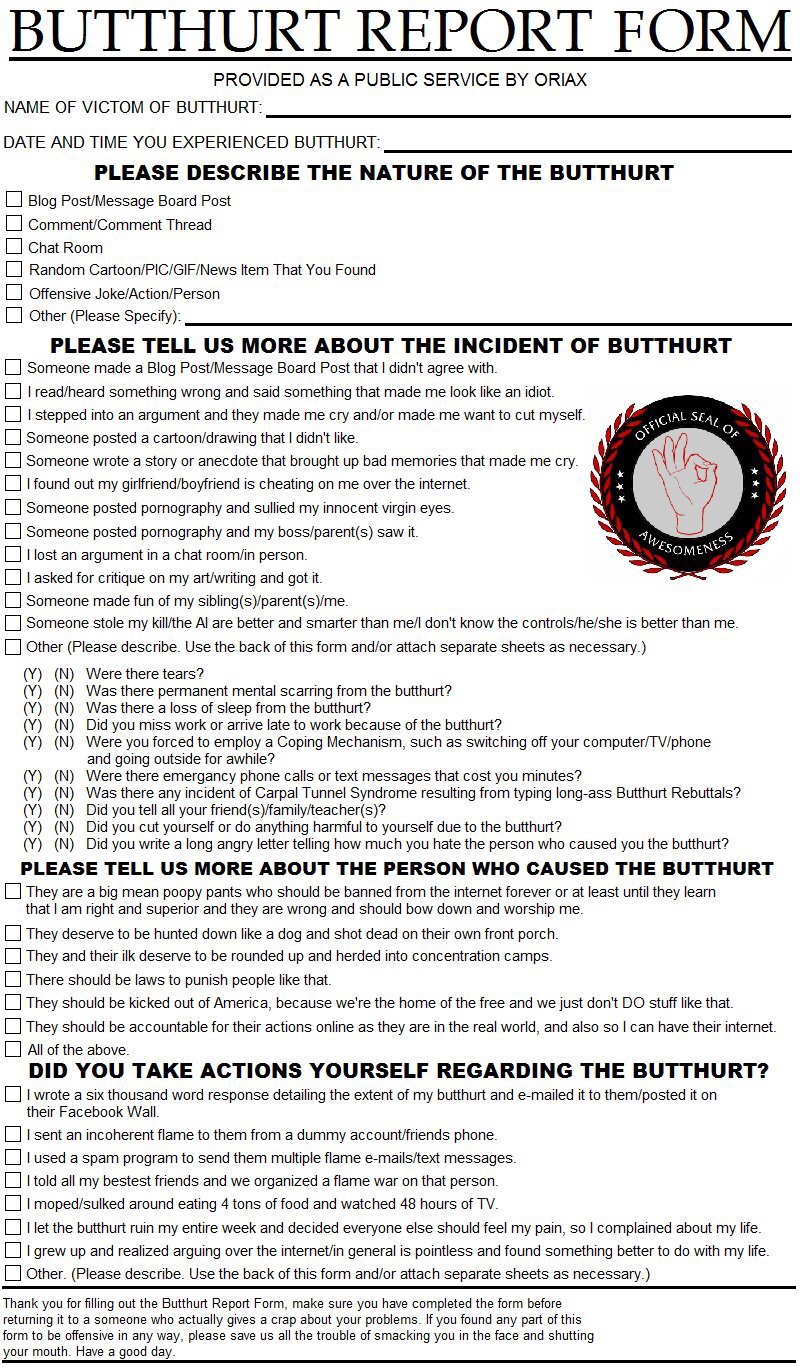
Should you find yourself sanctioned after running afoul of the CF comments policy as stated and feel you have been wronged, please download and complete the Butthurt Report form below in quadruplicate; retain one copy for your personal records and send the others to the email address posted in the right sidebar.

Please refrain from whining, sniveling, and/or bursting into tears and waving your chubby fists around in frustrated rage, lest you suffer an aneurysm or stroke unnecessarily. Your completed form will be reviewed and your complaint addressed whenever management feels like getting around to it. Thank you.

CF Glossary

ProPol: Professional Politician

Vichy GOPe: Putative "Republicans" who talk a great game but never can seem to find a hill they consider worth dying on; Quislings, Petains, Benedicts, backstabbers, fake phony frauds

Fake Phony Fraud(s), S'faccim: two excellent descriptors coined by the late great WABC host Bob Grant which are interchangeable, both meaning as they do pretty much the same thing

Mordor On The Potomac: Washington, DC

The Enemy: shitlibs, Progtards, Leftards, Swamp critters, et al ad nauseum

Burn, Loot, Murder: what the misleading acronym BLM really stands for

pAntiFa: an alternative spelling of "fascist scum"

"Mike Hendrix is, without a doubt, the greatest one-legged blogger in the world." ‐Henry Chinaski

Subscribe to CF!

Support options

Shameless begging

If you enjoy the site, please consider donating:

Correspondence

Email addy: mike-at-this-url dot etc

All e-mails assumed to be legitimate fodder for publication, scorn, ridicule, or other public mockery unless specified as private by the sender

Allied territory

Alternatives to shitlib social media: A few people worth following on Gab:

Fuck you

Kill one for mommy today! Click to embiggen

Notable Quotes

"America is at that awkward stage. It's too late to work within the system, but too early to shoot the bastards."
Claire Wolfe, 101 Things to Do 'Til the Revolution

Claire's Cabal—The Freedom Forums

FREEDOM!!!

"There are men in all ages who mean to govern well, but they mean to govern. They promise to be good masters, but they mean to be masters."
Daniel Webster

“When I was young I was depressed all the time. But suicide no longer seemed a possibility in my life. At my age there was very little left to kill.”
Charles Bukowski

“A slave is one who waits for someone to come and free him.”
Ezra Pound

“The illusion of freedom will continue as long as it’s profitable to continue the illusion. At the point where the illusion becomes too expensive to maintain, they will just take down the scenery, they will pull back the curtains, they will move the tables and chairs out of the way and you will see the brick wall at the back of the theater.”
Frank Zappa

“The right of a nation to kill a tyrant in case of necessity can no more be doubted than to hang a robber, or kill a flea.”
John Adams

"A society of sheep must in time beget a government of wolves."
Bertrand de Jouvenel

"It is terrible to contemplate how few politicians are hanged."
GK Chesterton

"I predict that the Bush administration will be seen by freedom-wishing Americans a generation or two hence as the hinge on the cell door locking up our freedom. When my children are my age, they will not be free in any recognizably traditional American meaning of the word. I’d tell them to emigrate, but there’s nowhere left to go. I am left with nauseating near-conviction that I am a member of the last generation in the history of the world that is minimally truly free."
Donald Sensing

"The only way to live free is to live unobserved."
Etienne de la Boiete

"History does not long entrust the care of freedom to the weak or the timid."
Dwight D. Eisenhower

"To put it simply, the Left is the stupid and the insane, led by the evil. You can’t persuade the stupid or the insane and you had damn well better fight the evil."
Skeptic

"There is no better way to stamp your power on people than through the dead hand of bureaucracy. You cannot reason with paperwork."
David Black, from Turn Left For Gibraltar

"If the laws of God and men, are therefore of no effect, when the magistracy is left at liberty to break them; and if the lusts of those who are too strong for the tribunals of justice, cannot be otherwise restrained than by sedition, tumults and war, those seditions, tumults and wars, are justified by the laws of God and man."
John Adams

"The limits of tyranny are prescribed by the endurance of those whom they oppress."
Frederick Douglass

"Give me the media and I will make of any nation a herd of swine."
Joseph Goebbels

“I hope we once again have reminded people that man is not free unless government is limited. There’s a clear cause and effect here that is as neat and predictable as a law of physics: As government expands, liberty contracts.”
Ronald Reagan

"Ain't no misunderstanding this war. They want to rule us and aim to do it. We aim not to allow it. All there is to it."
NC Reed, from Parno's Peril

"I just want a government that fits in the box it originally came in."
Bill Whittle

Best of the best

Finest hosting service

Image swiped from The Last Refuge

2016 Fabulous 50 Blog Awards

RSS feed

RSS - entries - Entries
RSS - entries - Comments

Boycott the New York Times -- Read the Real News at Larwyn's Linx

Copyright © 2026