Success story

It ain’t all that common, really, but there’s a fair number of bands with a similar backstory.

When Kansas got signed…
In 1974, Kansas had one shot to impress a record producer. The meeting was set in the tiny town of Ellinwood, Kansas – population around 800. They needed a full house. So they came up with a simple plan: offer free beer to everyone who came to the show. The room was packed. The energy was electric. And the producer (Don Kirshner) was impressed enough to sign them to a record deal.

A little free beer, a lot of loud music, and a career that was just getting started. Kirshner financed the band out of his own pocket through four albums. When they released ‘Carry on wayward son’, they finally hit gold and the rest is history. A version of the band still tours to this day…

Kinda reminds me just a smidge of a certain hit song from Ye Aulden Thymes.

Back when the BPs were on Miami-based Teen Rebel Records, I remember the owner/proprietor/sole employee of said label giving us the low-down on the inner workings of major-label A&R departments (Artists and Repertoire, ie the folks whose job it is to go out to shows; evaluate unsigned artists and/or their commercial potential, if any; and, ideally, arrange recording contracts for the likelier prospects).

According to our boy Teen Rebel Tony, A&R staff could be broken down into two basic types:

  1. Those who have “the power of NO” (which is pretty much every single one of any given label’s employees)
  2. The exalted few endowed with “the power of YES,” by which Tony meant those authorized to sign an artist entirely on their own initiative, without ever having to beg permission in advance or ask forgiveness later from anybody…well, at least until several of those independently-signed recording artists end up A) bombing badly with their first three (3) releases; B) slaughtering each other in the recording studio over some random, unfathomable dispute; C) becoming crackheads; or D) are caught in bed with one or more same-sex children

In plain words, then, the Category Twos are in effect the only folks in A&R who truly matter.

99 times out of a hundred, the “power of NO” types would notify you well in advance, with inordinate pridefulness and braggadocio, that they’d be coming to check out your show at Club Shithole on such and such a date. Said notification enabled them to luxuriate in feeling like Big Shots whom the band, the supporting act, the venue staff, and basically all and sundry within a five-mile radius would want to suck up to, buy drinks for, introduce their hot girlfriends to, shamelessly flatter, and other such-like industry inanities.

These useless pustules to be compared/contrasted to the “power of YES” people, who disdain to give any kind of notice at all, to anybody, of anything. In fact, you’d usually never even know they were in the joint unless/until they A) approached you after the show; B) introduced themselves and explained who they worked for, in what capacity and why they’d come; and C) expressed at least some interest, albeit slight, in offering you a contract with the label they work for.

Ironically enough, it’s the latter category of A&R rep, rather than the former, that the smart performer with knowledge and experience in such matters will be interested in schmoozing, flattering, and buying cocktails for. Tony also called these the “power of the pen” people—a somewhat more apt and directly descriptive appellation of who they are and what they do, perhaps.

In sum, then, the “power of NO” kids are basically popinjays, pricks, and douchetools. The “power of YES” guys, on the other hand, are professionals who take their roles, their industry, and their artists seriously, with no use for fumble-fucking around, preening, posturing, or obnoxious self-indulgence. Said pros are the crucial first step in the long, wearying slog of getting the music recorded, packaged, and released into the wider world—where it will then stumble or soar on wings the A&R rep provides.

A&R people are in the main unacknowledged and unheralded, even wholly unknown to the world outside of the music biz. Even so, they’re nonetheless bona fide heroes for all that, at least to those of us on the “talent” side of the business.

Understand: this is the old, traditional music industry we’re speaking of here. What with internet sales, streaming, and downloads dominating everything these days, the once-untrammeled power of the major labels such as Sony, Columbia, Epic, Atlantic, &c has diminished greatly, as have their profits, influence, and credibility. Which, if you think about it, would in turn make the job of the Category 2 A&R guy tougher than it’s ever been before.

Over lo, these many years, I’ve personally known far too many of the Cat One types, as well as far too few examples from Cat Two. It’s been years and years since I moved in those circles, alas; I can only wonder what became of them all, and where they are today.

Happy happy joy joy

What better lead-in to the 4th of July holiday weekend than some good old all-American music?

The Aaron Copland-inspired theme for The Magnificent Seven was, of course, composed in the Year of Our Lord 1960 (the year of my birth, actually—GOD, I’m old!) by one Elmer Bernstein, who I assume from the surname is one of them dirty, filthy, genocidal ***(((JooJooJooJOOOOOZ!!)))***

Update! Just gotta inclusde this: what has to be my personal all-time favorite cover version, a surf-twangy instro laid down by the aptly named John Barry Seven.


WHOA, that’s good squishy!

When a throwaway song…isn’t

GREAT story from a great artist, the late, lamented Tom Petty.

Bugs, a roadie who’s been with us since the day we started, bought me this Yamaha keyboard. I said, Man, why’d you buy that? It’s expensive! He said, If you write one song on it, it’ll pay for itself. So he charged it for me and left it there.

Jeff Lynne was over one night and I started playing with it. I played…

[Petty hums the opening chords of Free Fallin’]

Jeff goes, Wait. What was that? Just play that first part over and over. Okay, I did. And Jeff’s just sitting there smiling and he says, Go on, sing something.

So just to make Jeff smile I sang, [in a nasal voice with an exaggerated Southern accent] She’s a good girl, loves her mama, loves Jesus, and America too… And Jeff said, That’s not funny, Tom, that’s really good. Keep going.

From there I wrote the first and second verses completely spontaneously. We were smart enough to have a cassette on.

Jeff said, Go up on the chorus, take your voice up a whole octave, what’ll that sound like? I said, What do I sing? Jeff said, I’m free falling. So I sang, I’m freeee… He said, Whoa, there’s power in that, that’s good.

I wrote the third verse after he left and brought it in and showed it to him the next day. It all fit together and we were really excited.

[After the song came out,] Axl Rose called and asked me, Where did you get that line about the vampires in the valley? When I’m driving I sometimes see these shadowy-looking people just off the sidewalks, around the post office. I always thought of them as vampires for some reason.

Proving once again the unimpeachable veracity of the old saw that every songwriter’s process is different. Back when I was hauling freight all over Hell and half of Georgia, I used to keep a small notepad and pencil right beside me for those not-rare occasions when inspiration would hit as I was choogling down the highway. Yessir, believe it or leave it, but some of the songs I’m proudest of were written from the driver’s seat of a Freightshaker, K-Whopper, or International Pro Sleeper.

New category: Inside the sausage factory.

The SIQ (Song in Question):


1

Ugh, ick, blecchh, YIKES!

I mentioned yesterday not really caring much for Neil Young. The Doors, on the other hand, I positively loathe, to the deepest depths of whatever remains of my very soul. Mark Steyn begs to differ.

Ray Manzarek of the Doors died last week, and, having lived out his three score and ten, will be denied the posthumous celebrity of his prematurely departed bandmate Jim Morrison. But Manzarek played a critical role in the group’s most enduring song. This essay is adapted from Mark’s book A Song For The Season:

It was over 40 years ago today-ish that Sgt Pepper was going on about how it was 20 years ago today. That’s to say, the “Summer of Love” is 46 years old: It’s longer ago today than the summer of flappers and charlestons and bootleg gin was back in 1967. But, boomers being the most self-absorbed generation in history, we’re going to be living with boomer pop culture until the very last one keels over at the age of 130 singing “Give Peace A Chance”. So we might as well get used to it. And, to be honest, there’s one aspect of the Summer of Love I’m quite partial to. What was America’s Number One song in that bright new hazy psychedelic dawn? Oh, come on, baby…

Come on, baby, Light My Fire
Try to set the night on fire…

It set the summer on fire four decades back. The single was edited down to under three minutes, but the disk jockeys played the original seven-minute album track anyway, from the Doors’ eponymous album The Doors. And within a few years it was established as one of those iconic long-form works – “Bohemian Rhapsody”, “Stairway To Heaven”, “A Day In The Life”, “Like A Rolling Stone”, etc – that are regarded as the acme of rock. The crude formula seems to be: Length + psychedelic lyric = art. “Light My Fire” comes in at big hit sound 35 on Rolling Stone’s Top 500 Songs of all time, and places similarly on other lists of all-time blockbusters. But “Light My Fire” can’t be confined to the long-form psychedelia category. For one thing, unlike “Bohemian Rhapsody”, it’s one of the most “covered” songs of the last 50 years. Once upon a time, that was the natural expectation of a hit tune: it would have seemed extraordinarily reductive to say, okay, some guy’s already sung “It Had To Be You” or “The Way You Look Tonight”, we better find something else to do. Yet, in an age of singer-songwriters, the idea of a song being particular to one artist became an iron law and deviations therefrom were regarded as “covers”, the very term indicating something less than an authentic experience. “Light My Fire” must rank as one of the most covered covers of the rock era, and oddly enough it was taken up by the same kind of singers who, a decade earlier, would have been singing standards: the easy listening crowd, the MOR set, the Europop VIP loungers. Who does “Light My Fire”? Everybody. Jose Feliciano. Astrud Gilberto. Jack Jones. Les Brown and his Band of Renown. Trini Lopez, Nancy Sinatra, Al Green, Minnie Riperton, Helmut Zacharias, Etta James, Woody Herman, Mae West, Johnny Mathis, Charo, Horst Jankowski, Edmundo Ros and his Orchestra, Ted Heath and his Orchestra, the Enoch Light Singers, the Burbank Philharmonic… As Mitteleuropean groovers like to say, “Gekommen auf Baby, mein Feuer beleuchten!”

My favorite “cool” version is by Julie London, who’s so blase about the whole business you get the feeling you could be rubbing sticks together all night and never get anywhere near to lighting her fire, notwithstanding the orchestral nudges she’s getting from the flutes and bongos. And my favorite live version is not the Doors in Boston but Shirley Bassey at the Royal Albert Hall in London a few years ago. Dame Shirl first sang it on her album Something back in 1970, and, while I’m not saying that inside every iconic psychedelic rock track is a faintly camp easy-listening classic trying to break out, for a select few of them that’s certainly the case. (By the same token, the all-time greatest version of Queen’s “We Are The Champions” was Liza Minnelli’s at the Freddie Mercury memorial concert at Wembley: unlike all the scruffy rockers, Liza was the only performer who had the size of the song, and of the performer. Likewise, if you’d stuck Freddie in black tights and a fedora, I’m sure he’d have done a passable “Cabaret”.)

Disagree again, sorry Mark: the all-time best version of “We Are The Champions” (another song I don’t much care for, by a band I have no use for whatsoever) has to be the one sung by the incomparable Paul Rodgers (of Bad Co fame, quite probably the best rock ‘n’ roll singer EVER), sitting in for the late Freddy-lad with the rest of the boys and absolutely fucking owning the bloated, overblown piece o’ shite song. To wit:

GOOOOOD squishy!

And now for something completely different.

Although I never was what anybody would call a huge fan of Neil Young—when I was a teenager we used to laugh him off as “Neil DUNG”—I do have tremendous respect for his songwriting skills, which are damned near miraculous; the above is probably the best example of that I know of offhand. “Don’t Let It Bring You Down” has been covered by everybody and his sister’s cat’s grandmother by now, and I do mean EVERYBODY: Annie Lennox, the Cowboy Junkies, Chris Cornell, Guns & Roses (!!!), and Paul McCartney, just to name a few. That constitutes a pretty dang powerful endorsement all on its own, actually.

It’s an achingly lovely, haunting tune, both melodically and lyrics-wise, about which Young himself once sardonicized:

On (CSN&Y’s 1971 live album)  4 Way Street, Young says, “Here is a new song, it’s guaranteed to bring you right down, it’s called ‘Don’t Let It Bring You Down’. It sorta starts off real slow and then fizzles out altogether.” The crowd then roars with laughter.

As well they might’ve. In Korb’s jazz-trio version above, what Salieri said in Amadeus of Mozart’s work is even more apropos: Displace one note and there would be diminishment. Displace one phrase and the structure would fall.

Update! Having recently discussed the vital importance of phrasing to any vocal performance, irrespective of musical genre, I would be remiss not to call Ms Korb’s impeccable style to y’all’s attention. Keep a close ear on that piano break, also.

Mother’s Finest

Excellent ATL band, who I was fortunate enough to see open for Da Nuge twice, and Aerosmith (IIRC) once, back in the mid-70s.

Apparently, that Rockpalast appearance was enough all by itself to catapult them to Euro-stardom.

Mother’s Finest issued its debut album Mother’s Finest in 1972 on RCA; a second album for RCA remained unreleased until it surfaced as bonus tracks on the 2010 Wounded Bird re-issue of Mother’s Finest. The group signed a new contract with Epic Records and released its sophomore effort, also titled Mother’s Finest, in 1976, stirring up controversy with the ironic “Niggizz Can’t Sang Rock ‘n’ Roll”. Riding a wave of success, the band’s next three albums, Another Mother Further (1977), Mother Factor (1978) and Mother’s Finest Live (1979), all went gold, helped along by heavy touring opening for the likes of Ted Nugent, Black Sabbath, The Who, Aerosmith and AC/DC.

In 1978, the band set out for Europe and took part in the Rockpalast concert series at the Grugahalle in Essen, produced by Germany’s WDR television and broadcast to various countries. With only one concert Mother’s Finest put themselves on the map all over Europe where the band still has a dedicated following. The legendary 1978 show was finally released on CD and DVD in 2012 as Mother’s Finest – Live At Rockpalast 1978 & 2003 which also includes the band’s 2003 “Rockpalast” appearance at Satzvey Castle.

Which, as admirable an achievement as that is, is merely a drop in the bucket when it comes to what these guys have accomplished over the years:

After four albums for Epic/CBS in the 70’s, the band signed with Atlantic Records for its heaviest album to date, 1981’s Iron Age. That same year Joyce Kennedy guested with Molly Hatchet on the song “Respect Me in the Morning” from the Take No Prisoners album. Mother’s Finest went on hiatus after 1983’s One Mother to Another, with vocalist Joyce Kennedy pursuing a solo career, releasing the soul/R&B-styled Lookin’ for Trouble album on A&M Records in 1984. She scored a Billboard Top 40 hit with “The Last Time I Made Love”, a duet with Jeffrey Osborne. A year later, Joyce recorded the song “Didn’t I Tell You?” for the soundtrack of the film The Breakfast Club. Drummer Barry Borden, who had joined Molly Hatchet on the No Guts…No Glory album, teamed up with guitarist Moses Mo in the band Illusion, resulting in a pair of albums, Illusion (1985) and I Like It Loud (1986), on Geffen Records. Borden would later join The Outlaws for a pair of albums and has been a member of The Marshall Tucker Band since the late 1990s.

Meanwhile, bassist Wyzard toured with Fleetwood Mac’s Stevie Nicks behind her 1983 album The Wild Heart, including an appearance on Saturday Night Live. Eventually, he and brother/drummer Harold Seay, who had replaced Barry Borden on One Mother to Another, joined Rick Medlocke in a revamped Blackfoot lineup and appeared on 1987’s Rick Medlocke and Blackfoot album.

Daayuummmm…not too shabby, wouldn’t you say? One more vid from these Mothers; can’t possibly go wrong with a funky hard-rocking cover of a Smokey Robinson tune.

Update! Bonus cool points to anybody who figured I’d never be able to resist putting this one up too.

Annnnd the rest of it.

Tell it like it is

At last. At long, fucking last.

KISS Legend Gene Simmons: Celebrities Shouldn’t Lecture Americans About Politics
Legendary KISS bassist Gene Simmons continues to serve as a voice of common sense and reason in an entertainment industry currently experiencing an epidemic of Trump Derangement Syndrome. I already count myself as a huge fan of the band, and I got the opportunity to see them on their last tour, which ended up becoming my son’s first concert experience. Imagine your first show being a KISS concert. What a time to be alive.

Actually, it just so happens that MY first show was a KISS concert as well: in 1976, that was, the CLT date on the band’s Destroyer tour. Somewhere around here, I should still have my advanced-ticket stub from that show, resplendent with the world-famous KISS logo and the price clearly visible underneath: a whopping six (6) bucks. Back over to Gene for more of this incredible story.

The KISS co-founder launched into his rebuke after TMZ asked how he felt about actor and director Ben Stiller calling out President Donald Trump’s White House for allegedly using a clip from one of his movies in a “propaganda machine.” The interviewers then asked the bassist with the world’s longest tongue what he thought about Hollywood stars criticizing Trump. In true rock star fashion, he didn’t hold back.

“Yeah, because everybody in the world should listen to what actors and comedians say — because they’re so qualified,” Simmons said, his tone dripping with sarcasm. He then offered some pretty solid advice for stars in the entertainment field that they would do well to heed. “Basically, shut the f**k up. Do your art and shut up.”

Amen, brother! Look, celebrities can have their opinions on issues of the day. But when you work for the public — and they do — you should keep those thoughts to yourself and the people in your inner circle. Otherwise, you alienate your fanbase and hurt the work you’re trying to produce. We don’t need to hear your opinion on everything. Shocking, right?

Simmons then doubled down on his take, saying, “Nobody’s interested in your opinions — that includes me. Who the f**k do you think you are?”

The rocker added, “People in America work hard for their living and they don’t want to be lectured to by people who live in mansions and drive Rolls Royces.” This. So much this. The vast majority of celebrities are filthy rich and want for nothing. The rest of us “normal” people—the ones who form the spine of the country—have to work ourselves to death just to get by. We don’t want, nor do we need, out-of-touch celebrities telling us who to vote for or which issues matter. We already understand that.

“It’s time for everybody in the entertainment industry to shut their piehole and just do your art,” Simmons said. “Nobody cares what you think — I don’t.” Before the interview wrapped up, Simmons again mentioned Kylie Jenner and actor Mark Ruffalo with dripping sarcasm, highlighting how irrelevant their worldviews are to the public.

Well said, Mr Simmons, sir. The very last word, in accordance with Gene’s stated wishes.

I well remember that frabjous Thanksgiving day: the East Gaston High School band froze its collective keister off marching in the Carolinas Carrousel Parade, a seriously big deal for us in its own right, then everybody made a mad dash to get back on the buses, change back into street duds before we even got rolling, and scrambled on back to the dear old alma mater so we could race to our personal cars and zip back over to the big KISS concert at the old CLT Coliseum, for which the doors opened at 8PM.

Yes, you could fairly say KISS blew me away that night, why do you ask? 😉

1

Meow mix

This Rock & Roar dude is a bona fide all-caps GENIUS.

That one’s gotta be my fave, but R&R has a crapton of these, including Judas Purrst, Slipkcat, Catallica, and this next one.

At last, something AI can do really, really well.

Update! ZOMG, just found this one. My new favorite.

Heh. Go, Angus!

Love song

One of the truly great ones, performed by one of the truly great singers.

Ahh, Nat King Cole. People aways go on and on about Sinatra’s marvelous gift for phrasing, and they’re right to. But for my money, Nat King Cole could go blow-for-blow with Sinatra—hell, with anybody, actually—on any stage you’d care to name and walk out of the venue with his head held high and his self-esteem intact.

Every serious singer knows about phrasing, even those that haven’t been formally schooled in the art and just came by the ability honest, so to speak. In fact, after many long years of paying close attention to this stuff my own bad self it eventually dawned on me that the better at phrasing a singer is, the more likely it is that non-musicians will THINK he’s a good singer. In fact, even if the poor schmuck can’t carry a tune in a bucket, provided he just works a little on his breathing, his pronunciation, how the words come out of his mouth, how to best fit each word together, and I guar-on-tee you he’ll have every paying customer in the joint eating out of the palm of his hand by tthe end of the set.

Especially the hot chicks, natch.

Speaking as a trained vocalist myself, I assure you Cole’s phrasing is nothing short of doggone miraculous. In fact, listening to the man sing just about anything, really, amounts to a PhD-level course in phrasing: why it matters; the vital importance of phrasing when it comes to putting the song across; how to keep your cool and do it properly without going off the rails, etc.

1

Serendipitous find

Just digging on some good old Ramones on YewToob when what to my wondering my eyes should appear but the vid for “Pet Cemetery,” which includes…oh hell, see for yourselves.

See that T-shirt Joey has on? That’s the logo, name, and address of the dear old Pterodactyl Club on Freedom Drive in CLT, an excellent small-to-mid-sized venue the BPs played many times back in the Aulden Thymes. How Joey came up with the shirt or why he decided to wear it in the vid I have no clue, but there you have it.

Update! More on the Pterodactyl from the obit of one of its co-owners, Jeff Lowery.

Charlotte lost a leading member of its musical community this week when Jeff Lowery died.

Lowery, 55, who operated Jeff’s Bucket Shop on Montford Road, was essential to Charlotte’s musical growth during the late 1980s and early `90s. He co-owned and operated the Pterodactyl Club and 13-13, The Milestone Club for a time and Milestone Records on Central Avenue.In recent years he published the Amps 11 local and regional music ’zine.

During their run at The Milestone between 1986 and 1989 he and business partner Tim Blong brought bands like Bad Brains, Southern Culture on the Skids, Flaming Lips, Alex Chilton, and Melissa Etheridge to town and Charlotteans still talk about the shows they booked at the Pterodactyl and 13-13.

“Jeff really was a visionary and ahead of his time, particularly with the 13-13, which hosted a slew of top-notch alternative rock bands well before the genre exploded and those bands graduated to the arenas and amphitheaters,” says writer Kathleen Johnson, who covered the scene for The Observer in the 1990s.

Blong’s records show Jane’s Addiction and Iggy Pop, the Ramones, Alice in Chains, Danzig, Sonic Youth, the Replacements, Dave Matthews Band, Phish, and Widespread Panic – punk legends, alternative rock bands who were peaking early on, and others that would go on to headline arenas.

“Jeff also booked local and regional bands as openers for big shows and gave them their own gigs, which also really helped nurture the city’s original music scene. Those two clubs had a big cultural impact on the town,” adds Johnson.

Did I say “excellent venue” a few minutes ago? Make that effing legendary, please.

Success story

tThe fantastic bluegrass/country music outfit yclept the Dillards, who were astute enough to hitch their wagon to Andy Griffith’s fast-rising star way back in 19 and 63, thereby cementing their fortune and gaining fame under their new name “the Darlings” (lyrics to the embed below here). Taken altogether, the song amounts to an exemplary demonstration of the eternal bluegrass dichotomy: thoroughly depressing lyrics, all about death and grief and sorrow and loss, but set to music so bouncy and joyful it’s simply impossible to feel bad while listening to it.

The Dillards are an American bluegrass and country rock band from Salem, Missouri. They are notable for being among the first bluegrass groups to have electrified their instruments, and they are considered to be pioneers of country rock and progressive bluegrass. In 2022, the band was inducted into the Bill Monroe Bluegrass Hall of Fame.

The band was originally brothers Doug Dillard and Rodney Dillard, plus Mitch Jayne and Dean Webb. They had had some successful singles in Missouri and moved to Los Angeles in 1962. Within weeks of their arrival, they were signed by both Elektra Records and the William Morris Agency, who soon had them booked on The Andy Griffith Show, playing a family of mountain musicians called “The Darlings”. This was a recurring role, running from 1963 to 1966. In 1986, the Dillards reprised the role in the reunion show Return to Mayberry. On the October 1963 episode “Briscoe Declares for Aunt Bee”, the Dillards performed the first wide-scale airing of the 1955 Arthur “Guitar Boogie” Smith composition Feudin’ Banjos (Dueling Banjos). Several albums have since featured songs performed on the show.

The Dillards released four albums in quick succession but, in 1967, Doug wrote and performed the banjo music for the soundtrack of the movie Bonnie and Clyde. That led to an invitation to tour with The Byrds, and he left the band; later, he would release solo albums and form the band Dillard and Clark.

Plenty more yet to this gripping tale, which I encourage y’all to read in full. Meanwhile, I’ll content myself with an embed of my personal favorite Dillards tune: “Dooley.”

I remember very well the day ol’ Dooley died/The women-folks was sorry and the men broke down and cried*. Deep, heady stuff, that, full of rich buttery goodness and all the nutrition a growing boy needs.

* PROGRAMMING NOTE: Yes, I know that my off-the-cuff transcription above differs somewhat from the version I linked to. Having listened to the song for nigh on half a cendtury now, though, I just decided to write ‘em as I’ve always heard ‘em, and straight to Hell with any pedantic eggheads who might be inclined to point and laugh at me over it. I could be bass-ackwards and wrong, probably am in fact. But I don’t care, I like the lyrics that way.

2

Belated birthday wishes

Yesterday was the 270th anniversary of the birth of the greatest composer of orchestral music to ever draw breath: the incomparable Joannes Chrysostomus Wolfgangus Theophilus Mozart. Yeah, yeah, yeah, I can hear you Beethovenn snobs sniffing and pouting and harrumphing from all the way over here. Just pipe down awready; you ain’t ever gonna get me to diss Ludwig Van, I wholeheartedly love his stuff. Bit considering that A) his output is simply not in Mozart’s league just in terms of sheer numbers; let’s see now, Beethoven’s Nine (9) symphonies against Mozart’s forty-one? One (1) Beethoven opera versus twenty-two for Mozart? Granted, Beethoven’s work is all top-notch (except for that one opera, which kinda sucks if you ask me), and Mozart had more active working years than Beethoven did. Mozart began composing seriously as a child, completing his Symphony No 1-—among his best creations, still performed to this day, a mature, fully realized, exquisitely put-togeher work, in no sense the slapdash, hit-and-miss, half-baked product from the mind of a child—at the tender age of eight (8) years!

Somewhat more telling, there’s also B) Beethoven himself was profoundly influenced by Mozart, an influence which is easily discerned in several Beethoven compositions. Ludwig Van maintained deepest respect for his gifted peer, even going so far as to lift  sections from Mozart pieces and insert them, whole and intact, into his own work, even giving official, written credit to Mozart on one of them. Beethoven also wrote some of the all-time best cadenzas for Mozart compositions. Extra-secil fine are the cadenzas for several Mozart piano concertos.

Taken all together, these gestures are indicative of Beethoven’s high regard for Mozart’s creative ability, ingenuity, impeccable taste and sense of style,, and positively uncanny talent. Whenever somebody tried to cop something from one of my songs to use himself, I considered it a tremendous complimen: sincere. honest, and stright from th heart, mo way of faking it. To me, that’s high praise indeed.

Anyhoo, yes, sinçe I was a young kid taking piano lessons I have considered Mozart the absolute best ever, although there quite a few other greats I revere as well: Beethoven, Haydn, Schubert, Tchaikovsky, Dvorak, Chopin, to name but a few. At ay rate, here’s the third movement of the wee tyke’s First Symphony, one of my personal faves since I was about nine (9) my own self. Never tried to write up an arrangement of it for solo piano but I never did, it just never occurred to me until recently and now, with my hands crippled into near-uselessness, it’s too late.

Happy birthday, Wolfgang. We will never forget you.

Der Bingle

A Christmas story for the ages, one that exemplifies courage, character, and unswerving commitment to the non-negotiable demands of personal honor, patriotic duty, and obligation.


“Show more,” my saggy, baggy ass.

Late in Bing Crosby’s life, his nephew Howard asked him a casual question while they were out playing golf together.

“What was the single most difficult thing you ever had to do in your career?”
Howard expected Hollywood stories. Maybe gossip about a demanding director. Perhaps the pressure of a high-stakes film production or a struggle with studio executives.

Bing didn’t have to think about it at all.
December 1944. Northern France. The war in Europe was grinding toward its bloody conclusion.

Bing Crosby was on a USO tour, performing for American GIs and British soldiers far from home during the coldest, darkest days of winter.
That night, they set up an open-air stage in a field.

Fifteen thousand soldiers gathered to watch. Bing was joined by Dinah Shore and the Andrews Sisters.
They sang, they joked, they made the men laugh and holler—a brief moment of joy in the middle of a war zone.
Then came the closing number.
“White Christmas.”

The song had already become an anthem for homesick soldiers since its release in 1942. It played constantly on Armed Forces Radio. Men who hadn’t seen their families in years, who didn’t know if they ever would again, heard those opening notes and thought of snow-covered streets and Christmas trees and the homes they’d left behind.

As Bing began to sing, he looked out at the audience. Fifteen thousand men were crying. He had to finish the song. He had to maintain his composure and his vocal control while 15,000 soldiers wept in front of him. He told his nephew it was the toughest thing he ever had to do in his entire career.

What made Bing Crosby’s USO performances different from his Hollywood appearances were the small choices he made. He refused to wear his toupee. He hated the thing—called it a “scalp doily”-and wore it only when absolutely necessary for films.

But entertaining troops was different. “If I’m entertaining troops,” he said, “I’m not going to wear anything phony like a toupee. Forget it.”

He also insisted that officers and brass could not sit in the front rows. Those seats were reserved for enlisted men. The soldiers who would be on the front lines. The men who faced the greatest danger.

A few days after that performance in the field, those same soldiers were sent into combat. The Battle of the Bulge began on December 16, 1944. It was the largest and bloodiest battle fought by the United States in World War II.

The Germans launched a surprise offensive through the Ardennes Forest in a desperate attempt to split the Allied lines. Many of the men who had wept listening to “White Christmas” in that field in France never came home.

Bing Crosby tried to enlist when the war began. He was told he was too old. General George C. Marshall, the Army’s chief of staff, told him directly:

“Look, Bing, we don’t need you in the front lines. We need you raising money for the war effort.” He wasn’t just an entertainer to them. He was a piece of home. Bing never forgot it. 🙏♥️

Leftists who viscerally hate anything that reminds them of what America once was have smeared Bing Crosby as a nasty, hateful racist, bully, and two-bit tyrant who viciously ran roughshod over others and used his wife and children as punching bags—a distorted, unidimensional portrait which disgracefully omits the man’s finer qualities.

2
1

CF Archives

Categories

Comments policy

NOTE: In order to comment, you must be registered and approved as a CF user. Since so many user-registrations are attempted by spam-bots for their own nefarious purposes, YOUR REGISTRATION MAY BE ERRONEOUSLY DENIED.

If you are in fact a legit hooman bean desirous of registering yourself a CF user name so as to be able to comment only to find yourself caught up as collateral damage in one of my irregularly (un)scheduled sweeps for hinky registration attempts, please shoot me a kite at the email addy over in the right sidebar and let me know so’s I can get ya fixed up manually.

ALSO NOTE: You MUST use a valid, legit email address in order to successfully register, the new anti-spam software I installed last night requires it. My thanks to Barry for all his help sorting this mess out last night.

Comments appear entirely at the whim of the guy who pays the bills for this site and may be deleted, ridiculed, maliciously edited for purposes of mockery, or otherwise pissed over as he in his capricious fancy sees fit. The CF comments section is pretty free-form and rough and tumble; tolerance level for rowdiness and misbehavior is fairly high here, but is NOT without limit.

Management is under no obligation whatever to allow the comments section to be taken over and ruined by trolls, Leftists, and/or other oxygen thieves, and will take any measures deemed necessary to prevent such. Conduct yourself with the merest modicum of decorum, courtesy, and respect and you'll be fine. Pick pointless squabbles with other commenters, fling provocative personal insults, issue threats, or annoy the host (me) and...you won't.

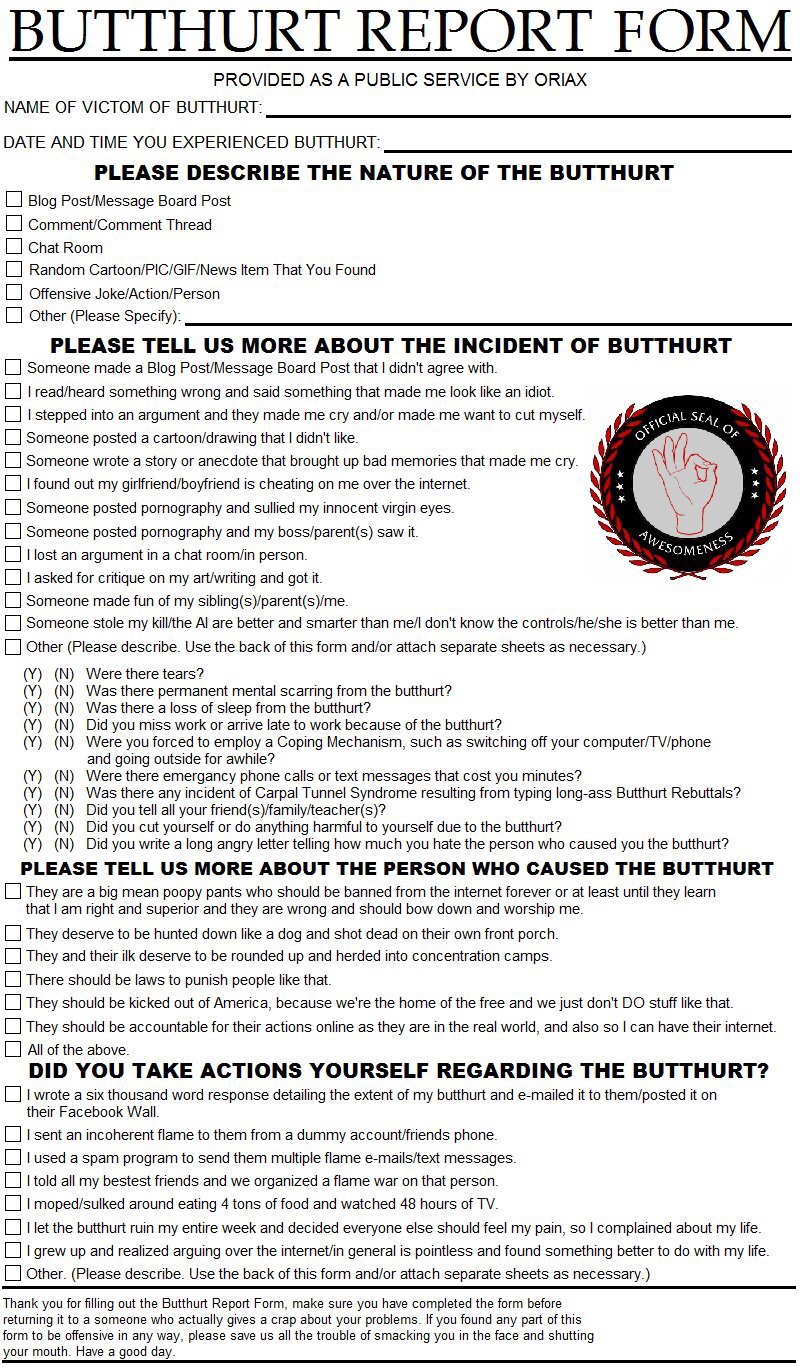
Should you find yourself sanctioned after running afoul of the CF comments policy as stated and feel you have been wronged, please download and complete the Butthurt Report form below in quadruplicate; retain one copy for your personal records and send the others to the email address posted in the right sidebar.

Please refrain from whining, sniveling, and/or bursting into tears and waving your chubby fists around in frustrated rage, lest you suffer an aneurysm or stroke unnecessarily. Your completed form will be reviewed and your complaint addressed whenever management feels like getting around to it. Thank you.

CF Glossary

ProPol: Professional Politician

Vichy GOPe: Putative "Republicans" who talk a great game but never can seem to find a hill they consider worth dying on; Quislings, Petains, Benedicts, backstabbers, fake phony frauds

Fake Phony Fraud(s), S'faccim: two excellent descriptors coined by the late great WABC host Bob Grant which are interchangeable, both meaning as they do pretty much the same thing

Mordor On The Potomac: Washington, DC

The Enemy: shitlibs, Progtards, Leftards, Swamp critters, et al ad nauseum

Burn, Loot, Murder: what the misleading acronym BLM really stands for

pAntiFa: an alternative spelling of "fascist scum"

"Mike Hendrix is, without a doubt, the greatest one-legged blogger in the world." ‐Henry Chinaski

Subscribe to CF!

Support options

Shameless begging

If you enjoy the site, please consider donating:

Correspondence

Email addy: mike-at-this-url dot etc

All e-mails assumed to be legitimate fodder for publication, scorn, ridicule, or other public mockery unless specified as private by the sender

Allied territory

Alternatives to shitlib social media: A few people worth following on Gab:

Fuck you

Kill one for mommy today! Click to embiggen

Notable Quotes

"America is at that awkward stage. It's too late to work within the system, but too early to shoot the bastards."
Claire Wolfe, 101 Things to Do 'Til the Revolution

Claire's Cabal—The Freedom Forums

FREEDOM!!!

"There are men in all ages who mean to govern well, but they mean to govern. They promise to be good masters, but they mean to be masters."
Daniel Webster

“When I was young I was depressed all the time. But suicide no longer seemed a possibility in my life. At my age there was very little left to kill.”
Charles Bukowski

“A slave is one who waits for someone to come and free him.”
Ezra Pound

“The illusion of freedom will continue as long as it’s profitable to continue the illusion. At the point where the illusion becomes too expensive to maintain, they will just take down the scenery, they will pull back the curtains, they will move the tables and chairs out of the way and you will see the brick wall at the back of the theater.”
Frank Zappa

“The right of a nation to kill a tyrant in case of necessity can no more be doubted than to hang a robber, or kill a flea.”
John Adams

"A society of sheep must in time beget a government of wolves."
Bertrand de Jouvenel

"It is terrible to contemplate how few politicians are hanged."
GK Chesterton

"I predict that the Bush administration will be seen by freedom-wishing Americans a generation or two hence as the hinge on the cell door locking up our freedom. When my children are my age, they will not be free in any recognizably traditional American meaning of the word. I’d tell them to emigrate, but there’s nowhere left to go. I am left with nauseating near-conviction that I am a member of the last generation in the history of the world that is minimally truly free."
Donald Sensing

"The only way to live free is to live unobserved."
Etienne de la Boiete

"History does not long entrust the care of freedom to the weak or the timid."
Dwight D. Eisenhower

"To put it simply, the Left is the stupid and the insane, led by the evil. You can’t persuade the stupid or the insane and you had damn well better fight the evil."
Skeptic

"There is no better way to stamp your power on people than through the dead hand of bureaucracy. You cannot reason with paperwork."
David Black, from Turn Left For Gibraltar

"If the laws of God and men, are therefore of no effect, when the magistracy is left at liberty to break them; and if the lusts of those who are too strong for the tribunals of justice, cannot be otherwise restrained than by sedition, tumults and war, those seditions, tumults and wars, are justified by the laws of God and man."
John Adams

"The limits of tyranny are prescribed by the endurance of those whom they oppress."
Frederick Douglass

"Give me the media and I will make of any nation a herd of swine."
Joseph Goebbels

“I hope we once again have reminded people that man is not free unless government is limited. There’s a clear cause and effect here that is as neat and predictable as a law of physics: As government expands, liberty contracts.”
Ronald Reagan

"Ain't no misunderstanding this war. They want to rule us and aim to do it. We aim not to allow it. All there is to it."
NC Reed, from Parno's Peril

"I just want a government that fits in the box it originally came in."
Bill Whittle

Best of the best

Finest hosting service

Image swiped from The Last Refuge

2016 Fabulous 50 Blog Awards

RSS feed

RSS - entries - Entries
RSS - entries - Comments

Boycott the New York Times -- Read the Real News at Larwyn's Linx

Copyright © 2026