Punk AF

So I just spent the last two-plus hours diving deep into yet another musical rabbit hole, this time a first-wave punk rock one. Naturally, inevitably, and as per usual, I enjoyed it enough that I decided it might be worth sharing with you fine folks, via a song apiece from Ulster’s top two local-hero bands: Stiff Little Fingers and the Undertones, two bands that sound nothing whatsoever alike and who, quite famously, did NOT get along At. All.

Next up, my own personal SLF fave.

And now, just to blow right out of the water as self-evidently bogus the most common complaint from the early naysayers of the Punk Rock Revolution, that “all that crap sounds the same”: lads and lassies, I give you The Undertones.

Ahh, my youth; where DID it go, pray tell, and why did it have to be in such an all-fired hurry about leaving?

As even a punk-rock neophyte can readily discern, though these two bands shared not just a common home nation, province, and city (Belfast), but a common freakin’ section of said city, the hard-hitting, dark, and rough-edged sound of Stiff Little Fingers contrasts quite sharply with the Undertones’ brighter, more tuneful power-pop, don’tchathink?

Of course, one of the primary appeals that 70s punk had for devotees of the genre was its tremendous diversity of style, approach, attitude, and sound. They all did have certain things in common to be sure, but still, nobody with an ear and an open mind could possibly have found it the least bit difficult to distinguish betwixt, say, the Sex Pistols, the Ramones, the Jam, the Buzzcocks, Patty Smith, and Television.

Now, about that little conflict I mentioned before.

SLF’s decision to write songs about the experiences of young people growing up in The Troubles proved controversial. Some Northern Ireland punk bands felt songs about the Troubles were exploiting the sectarian conflict. There was also criticism and suspicion over the involvement and influence the management team, especially Gordon Ogilivie, was having on the band. The political differences were reinforced by musical differences as SLF’s rockier punk sound contrasted with the more melodic pop punk of The Undertones and Rudi. Some of the criticism was simply down to band rivalries and jealousy.

There were a number of well-publicised arguments; The Undertones accused Stiff Little Fingers of sensationalising the Northern Ireland conflict, while they retorted that The Undertones ignored it. Michael Bradley, The Undertones bassist, tells of a confrontation in 1979 between The Undertones’ John O’Neill and SLF’s Jake Burns: “He launched into Jake, not physically but verbally. Slagging his records, slagging the journalist writing the songs and slagging the band.” Michael Bradley now describes ‘Suspect Device’ as “a great record, although at the time we weren’t impressed, probably because they’d made a record before us.”

Terri Hooley, Good Vibrations records, also says: “SLF were really starting to make waves beyond Northern Ireland, and I always see them as the ones that got away. I know I have always said I never rated them, but that was probably jealousy on my part. I actually think they are a great band and deserve their success.”

I’d have to say that Bradley and Hooley, by attributing their animosity to simple jealousy, probably had the right of it—eventually, anyway.

One for the Wirecutter

That would be OG blogger Ken Lane, who posted up a link to one of the better Nashville songwriters of this or any other era, the peerless Chris Stapleton.

A damned fine singer too, is our Mr Stapleton. Funny thing about him, he’s a dedicated player of a tragically overlooked guitar, the Fender Jazzmaster. As it happens, my first gee-tar was a 64 Jazzmaster, an extremely high-value axe nowadays (backstory here). Stapleton, of course, was also a founding member of contemporary-bluegrass titans The Steeldrivers, leading us into a bonus CT rip.

Man, if those flawless vocal harmonies don’t raise the chilblains on the back of your neck, I just don’t know how I can possibly be of any help to ya. More on CT’s, shall we say, eccentric gear preferences:

Chris Stapleton’s primary electric guitar for his solo career has been the Fender Jazzmaster. Unlike many country players, who are sworn to the twang and aggression of the Fender Telecaster, Chris has a real soft spot for this Fender timeless classic, telling Rolling Stone that he bought his first one in the mid-2000s. It was a 1962 Jazzmaster reissue in, of all colors, ocean turquoise, far from the elegant sunbursts and denim of most country guitarists. On the color, Stapleton said “It wasn’t a color I looked at and was going, “Oh man, I need that surf guitar!” But I played it and, like with a car, you can meld with things: This is my guitar. That’s how that happened. There is great comfort in knowing what your rig is and then you don’t have to fool with it anymore.”

Fender launched the Jazzmaster in 1958, intending it to be an upmarket version of the Stratocaster, not unlike Gibson’s delineation of their Custom and Standard ranges around the same time. The Jazzmaster, as its name suggests, was marketed at jazz guitarists of the era. However, it was quickly adopted by surf rock guitar players in the early 1960s who highly valued its reduced sustain and unique resonance when compared to other Fender models.

The Jazzmaster sets itself apart from other Fender guitars in several ways. One is its distinctively large body, far bigger and heavier than those of the Stratocaster, Telecaster, or even the similar silhouette of the Jaguar. The Jazzmaster also boasts large, white “soapbar” pickups that bear a striking resemblance to the Gibson P90. This similarity is purely cosmetic, however, with magnetic pole pieces on the Fender soapbar pickup as opposed to the P90’s magnets beneath the coil. The Jazzmaster coil is wound flat and wide, more so than that of the P90, and far more than any other Fender pickup.

Stapleton also developed a close working relationship with Fender, culminating in the Chris Stapleton Signature Model Princeton (!!) amp.

He actually bought his first 1962 Princeton in Ohio during a writing session with Peter Frampton. Of the original Princeton, he said “I use that amp still. That amp was a studio amp of mine for many years before I got hold of another one because I thought I should probably buy another one”.

The 1962 Princeton was initially marketed as a student amplifier, as its diminutive size and lower output would indicate. However, plenty of gigging musicians worked out that the Princeton’s smaller frame meant it could attain saturation and overdrive at lower volumes than many of its competitors. Rock, blues, and country players were particularly enamored of its rich, saturated drive tone as well as the sparkling cleans for which Fender amps are famous.

Chris Stapleton’s signature Princeton was built to the man’s own specifications. The story of this amp’s birth seems deceptively simple. Stapleton told Billboard that “this was borne out of me calling Fender up [and asking them] to build this amp for me…I wanted a new amp that looked like the old amp and worked like the old amp, and that didn’t exist. So we called Fender, and very quickly the conversation escalated to doing something like this”.

The hand-wired Chris Stapleton signature amp is a twelve-watt combo with attractively simple controls, featuring Fender Vintage Blue tone caps, Schumacher transformers, and an output tube-biased tremolo circuit. Its cabinet is made from solid pine, covered with textured brown vinyl. Like the bourbon-barrel Blues Junior, its handle is brown leather, and its dark brown faceplate matches the darker brown control knobs. Two 12AX7 preamp tubes, two 6V6 power tubes, and a single 5Y3 rectifier tube power its Eminence 12” Special Design CS speaker. It also has a built-in tremolo effect.

Never have played a brown Princeton—in fact, I don’t know that I’ve ever even seen one before. I DO know the later (mid-late 60s, pre CBS) blackface Princetons are sweet-sounding little amps, although a bit on the, umm, quiet side to suit my taste.

A becoming humility

Quora provides a sterling example of one of Man’s finer qualities.

Rik Elswit
Musician for 60 years. Professional musician for 55

What are some rock songs that were just filler, but became huge hits?
My band went into the studio to make our fourth album after having had to declare bankruptcy in order to get out of a contract with CBS records where we were getting no support. Nobody would even take our phone calls.

So we signed with Capitol, and went to work at Pacific Recorders. This is where we found out that our manager/producer was of little use in the studio without having the CBS engineers holding his hand for him. We released three singles off it that he was sure would be hits, and they all stiffed. Finally, in frustration, the brass at Capitol actually ordered him to release our cover of Sam Cooke’s “Only 16”, which we’d recorded simply as fill to flesh out the album.

This was a tune that we had begun playing at gigs just because we liked to play it. Our lead singer really got it, and it was just like home. The sort of thing we could do in our sleep. We produced and arranged it ourselves, and it only took a couple hours, total, to get it in the can. We were even breaking up a pound of monstrously good smoke in the drum booth while we were doing the sweetening. I had to hand the scales off to the drummer when they called me out to lay in the guitar solo and fills.

It went gold. We had worked our own way out of bankruptcy on our own, and we made Sam Cooke’s widow very happy.

FOURTH album? Jumping from a contract with CBS over to Capitol, seemingly at will? A gold record the result of said major-label leap? One can only assume that this Rik Elswit fellow must be, or at least once was, a real Somebody in the music biz.

As it turns out, we quickly learn from the comments that one would not be entirely incorrect in one’s assumption.

Neil Matthews
I’d like to give Rik’s answers more upvotes, it’s a glimpse of what Quora could be; informative answers to genuine questions by someone who knows what they are talking about.

Huw Pritchard
No small amount of humility either – I’ll be honest, I ended up googling Rik because I didn’t know his name but figured out it might be an interesting search.

If I was in his shoes I’d start everything I wrote with “I was in Dr Hook for 13 years”, even if it wasn’t relevant to the answer.

Well, I will be dipped in shit, how ’bout that? For those of you out there who are a hell of a lot younger than me, here’s Rik Elswit’s band’s biggest hit—in days of old, when knights were bold, and condoms not invented.

And what the hell, since Rik mentioned pounds of weed, and it popped up after Dr Hook in my YewToob list, PLUS it’s still one of the songs that make me bounce around in my seat the hardest, let’s do this thing.

Man, you might not agree, but in my book that’s about as good as the rock GETS, right there.

Update! Okay, since I’m on something of a roll here and all. Rik mentioned major-label tapeworms refusing to even take the band’s calls back in their darkest days just before the dawn, so what do you suppose that reminded me of? Why, this, of course.

Just occurred to me that, if someone stumbled in here who didn’t know me personally and got a load of these, shall we say, wildly electic musical selections I’m always putting up here, then found out I mostly listened to classical music radio all day long, they’d probably think I was schizophrenic or something.

Says it all update! While we’re on the topic of rock and roll, I hijacked this from shit the great Ken Lane posted on Fakebook.

AC DC3BlocksAway

Really, what more can one say but: Heh.

Strung up, strung out

Yet another excellent Quora digest edition drops into my email inbox.

Why does Billy Gibbons use 7-43 guitar strings? It seems odd.

Billy uses 7–38.

Billy used to use 11s & 12s because he thought that’s what all the blues guys did: Big string = Big sound

He was in the green room of a gig with B.B. King and BB wanted to see Billy’s axe. BB was noodling with Billy’s guitar and asked Billy why he was running such heavy strings? Billy said, “I thought that’s how all you blues guys got your tone.” BB said, “Why do you want to work so hard?” I think Billy dropped down to 9s almost immediately and eventually worked his way down to 7s and 8s, which is what a lot of the classic music of the 50s, 60s, and 70s was done with.

7’s will teach you about control PDQ because they respond so easily. If you want to sound super-tight on 9s or 10s go play on 7s and 8s for while.

.007s? Dang, I don’t think I ever have played with strings that light; in fact, I don’t recall being aware that they even made ‘em that light. My uncle started me out on .008s, a jazz set of his preferred Black Diamonds with the wrapped G (as a snot-nosed punk kid already gravitating heavily towards rock and roll, I didn’t like that worth a damn, believe me; wrapped third strings on electric guitars is definitely a jazzbo thing). Then, once I’d mastered the essential chords, scales, and runs, followed by guitar adaptions of a few old songs, most of which Murray had transposed and committed to staff paper himself (Sweet Georgia Brown*, I remember ye fondly, old girl!), I went out on my own hook from there.

POINTLESS CF DIGRESSION™: I still have one of those jumbo-sized plastic totes crammed full of Murray’s old sheet-music transcriptions in climate-controlled storage over in my friend Wendy’s living room, safely tucked away between her two (2) pianos. It’s all promised to my friend Jeremy, a great player in his own right, who damned near collapsed in stunned but delighted disbelief when I first showed him that plastic-tub treasure trove and spent an evening pawing through it with him. Jeremy took guitar lessons from me back when I was still willing to take on students; he’s probably the best pure musician I’ve ever known, and I’m happy indeed to turn over all that 24-karat musical history to him, knowing as I do how much he’ll love it, and what good care he’ll take of it.

Anyhoo, when I began playing professionally, I had to change strings before every show, either in the green room or at the hotel. I could count on breaking at least one any night I got lazy and didn’t—usually the D or B, don’t know why that would have been. And believe me, I tried like hell to figure it out. It was annoying as hell, but then again all the onstage angst and aggro was easily avoided just by the simple expedient of changing the blasted things.

Uncle Murray, by contrast, only replaced his strings once in a blue moon; he’d boil ‘em when they started to feel limp and flaccid, then put ‘em back on for another year’s worth of abuse. Murray and I never discussed the way I went through strings; I figure he would have been genuinely horrified at the needless waste, the grotesque profligacy of any nephew of his buying strings not by the pack, but by the case. Why, the very idea! Surely he’d taught me better than THAT!

I DO know that Stevie Ray Vaughn famously used strings so painfully heavy they more closely resembled low-register piano strings, or perhaps telephone-pole guy wires. Don’t know how in the world he managed to play the way he did—bending notes with no apparent effort, fingers zooming wildly all over the fretboard like honeybees in a field of wildflowers—on strings that big, night after night after night, for years. But then, that’s why he’s Stevie Ray Vaughan, and I, y’know…ain’t.

My own calluses, laboriously created by set after set of comparatively wimpy D’Addario Jazz/Rock .011 to .049s, are still there, and I haven’t picked up a guitar since 2017. Hell, I can still feel the lip-callus you get from trumpet-playing when I run my tongue across my upper lip; apparently, they never do go away completely. The calluses on Stevie Ray’s left-hand fingertips, then, must have been something to see indeed. By the time he died, his fingertips must have been rutted as deeply as a New Mexico desert valley after a sudden monsoon.

.007 to .038 gauge strings, Gibbons? Ya fuckin’ pussy.

Update! Having mentioned Jeremy up there, please enjoy one of my all-time favorite songs from his surf band nonpareil, the Aqualads.

Great band, great tune. Written by the late, lamented Bob Nelson, may he forever rest in peace.

* I keep thinking of stuff I want to add to this post, so I put in a link to Django Reinhardt and Stephan Grappelli’s version of SGB, just because they were two of Murray’s favorites.

No-so-famous last words

Do we get some sort of weird premonition, some uncanny sense of impending doom, when our death approaches? Sometimes, yeah.

What were Jimi Hendrix last words?
Jimi Hendrix, one of the most influential guitarists of the 1960s, died at Samarkand Hotel in London on September 18. 1970. He was 27 years old.

Cause of death: Asphyxia due to aspiration to vomit, contributed to by barbiturate intoxication.

His last words were “I need help bad, man”.

Aside from that, a poem he wrote was found at his deathbed. This was the last sentence of the poem:

HendrixFinalWords

Thank you.

Kinda creepy, no? Also beautifully poetic, and all too true. But still. Calls for another Hendrix embed, I do believe.

Man, dig that crazy wad o’ homemade pop filter on his mic! As the video shows, it was awfully windy in Howaya that afternoon, which explains it.

Also, note ye well at :29 in the vid, how deftly Jimi steps off the Vox 846 wah pedal and onto the trusty ol’ Fuzz Face, to call forth the legendary Hendrix crunchiness from that pretty white Strat. Then, at around :36 seconds in, watch in humbled awe as he swats the pickup selector switch to fastly transition from the fat, throaty sound of the neck-pickup position to the twangy squall of the wrong-way-tilted (since he was playing a right-handed axe upside down, see) bridge p/u, swapping one trademark Hendrix sound™ for the other in a lightning flash of truly inspired playing.

It’s Billy Cox and Mitch Mitchell for backup, alas, nary a Buddy Miles or Noel Redding in sight. But DAMN, that stage-full of Marshall DSL Pro full-stacks makes me drool.

Chip off the old block

As I’m sure you all know, Foo Fighters drummer Taylor Hawkins passed last year, probably the victim of an OD, after years of struggling with heroin addiction. So marvel as his 16 year old son (!) shows off badass, hard-hitting chops that almost have to be coded in his family’s DNA.

Yep, a hard-hitter for sure, just like the old man. Not my favorite Foo Fighters tune, unfortunately; myself, I wish they’d done “Monkeywrench,” but what the hey. As WeirdDave says:

Not only does he absolutely nail it, I don’t believe I’ve ever seen a drummer play with such emotion. His anger, pain, rage and yes, love could be bagged and sold. The subtle support he’s getting from the rest of the band, “We got you buddy. You’re with family”, take the performance to another level. I’m not even a Foo Fighters fan, but this one put tears in my eyes.

I won’t go quite as far as all that, but it’s certainly something to see nonetheless.

Update! Just now thought to check it, and lo and behold, the BPs video link I left for Aesop in the comments was bad. Fixed now, sorry ‘bout that.

Glen Campbell, overrated?

Not hardly, chump. UNDERrated, if anything.

Was Glen Campbell a highly overrated guitar player? Isn’t it true that country music is the least complex and simplest to play? The man certainly didn’t have the technical skill to play metal or anything more difficult. Do you agree?
When Eddie Van Halen asks for guitar lessons (via comments made directly by Alice Cooper), it’s a pretty good bet you have something significant to offer. Alice said that Eddie Van Halen did exactly that regarding Glen Campbell.

Glen Campbell was beyond impressive and nary a whiff of distortion to hide behind.

Also, you don’t play with the Wrecking Crew if you are overrated. Just sayin’.

True, dat. But who is/was this Wrecking Crew of whom he speaks, you ask? Oh, just this.

The Wrecking Crew were a group of all-purpose, highly revered studio musicians who appeared on thousands of popular records – including massive hits such as “Mr. Tambourine Man” by The Byrds and “California Dreamin’” by The Mamas And The Papas. The instrumental work by this group of session men (and one woman) defined the sound of popular music on radio during the 60s and early 70s, meaning The Wrecking Crew can reasonably lay claim to being the most-recorded band in history.

The exact number of musicians in the loose collective of Los Angeles session musicians known as The Wrecking Crew is not known, partly because of the informal nature of the hiring and also because much of their work went uncredited. Three of their key members were the magnificent session drummer Hal Blaine, bassist and guitarist Carol Kaye (one of the few female session players in that era), and guitarist Tommy Tedesco.

Among the leading musicians who were members at various times were: Earl Palmer, Barney Kessel, Plas Johnson, Al Casey, Glen Campbell, James Burton, Leon Russell, Larry Knechtel, Jack Nitzsche, Mike Melvoin, Don Randi, Al DeLory, Billy Strange, Howard Roberts, Jerry Cole, Louie Shelton, Mike Deasy, Bill Pitman, Lyle Ritz, Chuck Berghofer, Joe Osborn, Ray Pohlman, Jim Gordon, Chuck Findley, Ollie Mitchell, Lew McCreary, Jay Migliori, Jim Horn, Steve Douglas, Allan Beutler, Roy Caton, and Jackie Kelso.

The great James Burton, just to home in one of those many standout names, was Elvis Presley’s lead guitarist for many years, and a total badass he was, too.

Burton plays better and with more precision behind his damned head than most of us do with the guitar in its usual position. Back before joining up with Elvis in the waning days of the King’s glory, of course, Burton also played on all those great old Ricky Nelson hits way back when, among an incredible roster of others. Happily, the Master of the Telecaster is still with us, alive and kicking at 83 years young.

James Edward Burton (born August 21, 1939, in Dubberly, Louisiana) is an American guitarist. A member of the Rock and Roll Hall of Fame since 2001 (his induction speech was given by longtime fan Keith Richards), Burton has also been recognized by the Rockabilly Hall of Fame and the Musicians Hall of Fame and Museum. Critic Mark Deming writes that “Burton has a well-deserved reputation as one of the finest guitar pickers in either country or rock … Burton is one of the best guitar players to ever touch a fretboard.” He is ranked number 19 in Rolling Stone list of 100 Greatest Guitarists.

Since the 1950s, Burton has recorded and performed with an array of singers, including Bob Luman, Dale Hawkins, Ricky Nelson, Elvis Presley (and was leader of Presley’s TCB Band), The Everly Brothers, Johnny Cash, Merle Haggard, Glen Campbell, John Denver, Gram Parsons, Emmylou Harris, Judy Collins, Jerry Lee Lewis, Claude King, Elvis Costello, Joe Osborn, Roy Orbison, Joni Mitchell, Hoyt Axton, Townes Van Zandt, Steve Young, Vince Gill, and Suzi Quatro.

Impressive credentials in anybody’s book—anybody who knows what the hell he’s talking about, anyway. But before I forget, let’s get back to Glen Campbell and his by-no-means-inconsiderable guitar-pickin’ chops.

Yeah, like I said: UNDERrated, if anything. With tasty, countrified-jazz riffage like that in his pocket, ready to be whipped out and sprayed across the landscape anytime he needed ‘em, Glen Campbell was about as “overrated” a guitarslinger as the incomparable Roy Clark was.

They just ain’t making guitar wizards like Glen or Roy anymore, folks, and that’s a crying shame.

Update! Well, I shoulda known such a thing would exist out there, but looky what just popped up coinkydinkally in my YewToob after the Roy Clark vids I was listening to as background music for post-writing were done.

I gots no idea why, but Campbell seemed to favor those weirdo Ovation electrics, like the 12-string he’s working over in the above vid. In fact, it appears that he had a longstanding endorsement deal with Ovation to produce a cpl-three Glen Campbell signature-model guitars. Bizarre, if you ask me. But then, I never have been big on them Ovations, and I damned sure ain’t no Glen Campbell, so what the hell do I know?

“Overrated”? In a pig’s eye. Pull the other one, bright boy, it has a big ol’ bell on it.

Wierderer and wierderer update! That mention of Alice Cooper in the Glen Campbell context above? Yeah, well, just get a load of this right here.

Campbell’s was a remarkable career but was not without its share of tragedy. His popularity both soared and waned. He battled the demons of alcoholism and drug addiction, only to emerge a better man. Illness eventually robbed him of his memory. But through it all, Glen was always revered by other musicians. One of whom was shock rock pioneer Alice Cooper. Campbell and Cooper became friends in the 1980s when both had moved to Phoenix, trying to escape destructive lifestyles. The two men remained friends for the rest of Campbell’s life. In this 2017 interview, Alice Cooper reflects upon the unlikely relationship and beautiful bond he had with his friend Glen Campbell.

“You think of Glen, country; Alice Cooper, rock and roll; we couldn’t have been closer.” Cooper elaborated, “It was unique in the fact that I was so far away from him in music, the character of Alice Cooper, and he was so far into the middle. Really mainstream rock and roll, you know. He could go hang out with the Rat Pack, or he could hang out with Donnie and Marie, or he could hang out with the Beatles or anybody. He was in that middle, he was that sort of all purpose, good-looking kid that could do anything. He was the golden boy. And yet him and I were like this when it came to sense of humor, when it came to golf, when it came to music.”

“It was one of those things where I’d be playing golf with him, and this was when he was in good shape, he was out touring, and he was playing guitar and he was playing golf every day, and he was doing Branson. Every once in a while, he would tell me a joke on the first tee. And then on about the fourth tee, he’d tell me the same joke again. And then about the 16th hole, he would tell me the joke again. And we would all just kind of go ‘well, maybe he’s just forgetful’. We could just see the beginnings of it, of him slipping a little bit.”

“We were telling jokes,” Cooper remembered, “I told him a joke, and he was laughing his head off. Came back about 10 minutes later and he says, ‘Tell me that joke again.’ I tell him the joke. He came back like five times.”

“Yet, you put a guitar in his hand, and he was a virtuoso. You would get him on stage, and he was automatic. I don’t care how much he had slipped; he was there. When it came to that, he was there.”

“We were both songwriters. We were both musicians. We were both in the business 50 years. So, we understood the business.” Alice would go on to say, “I loved being with Glen. I loved playing golf with him. He had a million stories about his world. And I had a million stories about my world. In other words, he would tell me a story about Roger Miller. And Bobby Goldsboro. And this guy, and this guy. And I’d laugh and I’d say, ‘Okay, I’ll tell you a good one on Paul McCartney and Jimi Hendrix’. We could both tell a lot of stories because we were both in those different worlds. And sometimes it crossed over. We did know all the same people. We knew the Sinatras, and we knew Elvis Presley. We both knew the Beatles so a lot of it was just telling stories about the stuff that happened to us. And Glen had some good ones. He got around.”

“I always said as an amateur, 60 yards in, the best player I ever played with. He was a master short game player. We had some really fun times. I played at least one or two times a week with Glen when he lived here.”

“You know if Glen called up and was like, ‘Alice, let’s play tomorrow?’ I’d go, ‘absolutely, let’s go.’” said Cooper. “I loved being with Glen.”

Whodaevvathunkit, huh? What an amazing, heartwarming story. Strange bedfellows, perhaps. But one can only be happy for them that somehow, against all odds, they found each other and developed such a beautiful friendship to gladden their hearts and lighten their burden just that little bit extra.

Deep dive update! Okay, I’m really down the rabbit hole here, but the mention earlier of the Wrecking Crew got me to thinking about some of the great session groups of yore: Booker T & the MGs, the Muscle Shoals Rhythm Section, the Mar-Keys, &c. To wit:

Session musicians (also known as studio musicians or backing musicians) are musicians that are hired to perform in recording sessions and/or live performances. The term sideman is also used in the case of live performances, such as accompanying a recording artist on a tour. Session musicians are usually not permanent or official members of a musical ensemble or band. They work behind the scenes and rarely achieve individual fame in their own right as soloists or bandleaders. However, top session musicians are well known within the music industry, and some have become publicly recognized, such as the Wrecking Crew, the Muscle Shoals Rhythm Section and The Funk Brothers who worked with Motown Records.

Many session musicians specialize in playing common rhythm section instruments such as guitar, piano, bass, or drums. Others are specialists, and play brass, woodwinds, and strings. Many session musicians play multiple instruments, which lets them play in a wider range of musical situations, genres and styles. Examples of “doubling” include double bass and electric bass, acoustic guitar and mandolin, piano and accordion, and saxophone and other woodwind instruments.

Session musicians are used when musical skills are needed on a short-term basis. Typically session musicians are used by recording studios to provide backing tracks for other musicians for recording sessions and live performances; recording music for advertising, film, television, and theatre. In the 2000s, the terms “session musician” and “studio musician” are synonymous, though in past decades, “studio musician” meant a musician associated with a single record company, recording studio or entertainment agency.

Session musicians may play in a wide range of genres or specialize in a specific genre (e.g. country music or jazz). Some session musicians with a Classical music background may focus on film score recordings. Even within a specific genre specialization, there may be even more focused sub-specializations. For example, a sub-specialization within trumpet session players is “high note specialist”.

The working schedule for session musicians often depends on the terms set out by musicians’ unions or associations, as these organizations typically set out rules on performance schedules (e.g. regarding length of session and breaks). The length of employment may be as short as a single day, in the case of a recording a brief demo song, or as long as several weeks, if an album or film score is being recorded.

Thanks to my then-gf’s best friend Neil working out of Hit Factory, I got called in myself for some occasional—VERY occasional, they had plenty of bigger and better names than mine on the in-house Rolodex—session work there when I lived in NYC. It was…demanding, to say the very least. Extremely so, in fact. Nonetheless, I loved every minute of it; the pay was good (union scale, usually, which back then in NYC was 500/hr), and I was hugely flattered to even be asked at all. Quite the compliment it was, really.

As promised

Time for those two excellent vids I mentioned earlier. First, we have your feel-good vidya of the week, featuring what I keep insisting ought to be the end result every time a few pAntiFa fascists dare to venture forth from Mom’s basement.


And yet again, we see the Bastards In Blue dashing to the rescue…on the side of their pAntiFa pals, of course and as usual. Maybe it’s about time they started featuring prominently in some of these beatdown-vids their own selves, just to help them get their heads screwed back on straight.

Next up, the legendary Sister Rosetta Tharpe busts one out for us.

One of the most amazing singing voices ever, and the ol’ gal could really rip on that gloriously Bigsbyfied SG Custom too. Believe you me, cranking out those simpler-is-better blues licks on guitar is way, WAY tougher than it looks. I never could do it worth a damn myself, and I did NOT suck on guitar otherwise, either. Try as I might, and I surely did, Sister Tharpe could’ve easily stomped mudholes in my po’ white ass when it comes to blues pickin’, then backed up and walked ‘em dry.

Note too, that she’s doing the right hand proper: finger picking it, although she DOES cheat just a little bit, using a thumb-pick on there. Ah well, as I always say: pobody’s nerfect, right?

Update! Just remembered something my longtime partner in musical crime, Tom “Mookie” Brill, always told me: “You can’t play blues with a pick, man, it’s just impossible.” Being entirely reliant on the Dunlop yellow Tortex picks my whole life, I can testify that the man was 100% correct on that.

And if you click on the Tommy Brill link above, then on the profile pic therein, yes, that’s me in the pic with him, playing my good ol’ pinstriped Gretch Electromatic reissue. A sweet, sweet git-fiddle my girl was, complete with a full-custom Craig Landau neck carve (the “Hendrix profile,” he named it) and a set of TV Jones Magna’Tron pickups that were bright, glassy, and just ballsy as hell all at once.

The oldest instrument?

In the interest of keeping things somewhat light and pleasant around here on a holiday-weekend Friday night, enjoy something truly gorgeous.

Simplicity itself; just variations on a most basic theme, yet heartbreakingly lovely just the same—calming, elegant, mellow, engaging, and utterly spellbinding. This is one of those pieces that really bring Congreve’s old “music hath charms to soothe the savage breast” adage right on home.

Claudia Antonelli, in case you didn’t know, is generally regarded as one of the world’s best-ever harp virtuosos, and rightly so. If you’ve never seen a harp being played live, it’s a helluva mind-blowing experience. The European pillar harp with pedals, see, is one of what I refer to as a full-body-involvement instrument—fingers, arms, back, legs, feet, all come fully into play for the harpist, as with the pipe organ, say, or the double-neck, ten-string (per neck, that is) pedal-steel guitar. It all depends on which variant of the harp they might be playing at the time; some of the four or five-string handheld harps are so simple and basic they can look downright primitive in comparison. Because, y’know, they are.

Don’t hate it me ’cause it’s beautiful, y’all.

Lightfoot redux

Owing to Mark Steyn’s near-total absence from his SteynOnline site because of his long, slow convalescence from two (2!) heart attacks, I scarcely bother checking up there these days. So I missed his Gordon Lightfoot SteynMusic post, which as per usual is the definitive Last Word on the subject.

On February 18th 2010 Gordon Lightfoot was driving in Toronto en route to the office when he heard on the radio that he had died. In such circumstances, most of us would turn round and go back to bed. But Lightfoot kept on, to the office, and to new tour dates and live albums – for almost another decade-and-a-half. He died, for real, a few days before the Coronation, having been garlanded with every bauble in the gift of his native land – Commander of the Order of Canada, recipient of the Queen’s Diamond Jubilee Medal – and honoured by his peers around the world. Here is what Mark had to say about him on the occasion of his eightieth birthday:

Gordon Meredith Lightfoot Jr was born on November 17th 1938 in Orillia, Ontario, which is a straight shot north of Toronto, although you’ll be driving your Honda Civic through Lake Simcoe if you try it as the crow flies. Gordon Lightfoot Sr owned a large dry cleaner’s, and Mrs Lightfoot thought Junior had the makings of a child star. His first public solo performance was in Grade Four, over the school’s PA system for Parents’ Day, singing “Too-Ra-Loo-Ra-Loo-Ral”, an early example (1913) of a commercial pop song that everybody thinks is a(n) ancient traditional tune, which isn’t bad practice for a chap who’d eventually emerge in the “folk revival” of the early Sixties. He was a boy chorister in Orillia, and by the age of twelve singing in Toronto, at Massey Hall. At eighteen he went to Westlake College of Music in Hollywood to study jazz composition and orchestration, which I can’t honestly say I hear a lot of in his music. At any rate, he missed Canada and came home, and landed a spot in the Singing Swinging Eight, the square-dance group on the CBC’s “Country Hoedown”.

One day a couple of years later Gord thought back to how homesick he’d felt in Los Angeles. So he set down his five-month-old baby in a crib on the other side of the room, and wrote a song about it:

In the Early Morning Rain
With a dollar in my hand
With an aching in my heart
And my pockets full of sand
I’m a long ways from home
And I miss my loved one so
In the Early Morning Rain
With no place to go…

On rainy mornings in Los Angeles, a lonely Lightfoot liked to go to the airport and watch the planes take off. If you try that now at LAX, even if you survive the tasing or shooting, you’ll be on the no-fly list for thirty years. But back then it was different, and so a young songwriter wrote, in effect, a train song for the jet age. Just as Johnny Mercer heard the lonesome whistle blowing ‘cross the trestle, Gordon Lightfoot heard a wistful echo in the 707s on runway nine:

Hear the mighty engines roar
See the silver wings on high
She’s away and westward bound
Far above the clouds she’ll fly…

Except, of course, that there’s no boxcar on Pan Am or TWA:

You can’t jump a jet plane
Like you can a freight train
So I best be on my way
In the Early Morning Rain.

It was on his debut album – the exclamatory Lightfoot! – in 1966, by which time Ian & Sylvia, the Canadian folk act with the arrestingly prosaic name, and the Grateful Dead, the American rock band with the prosaically arresting name, had both recorded the number. And Judy Collins, George Hamilton IV and Peter, Paul and Mary had put it, respectively, on the Billboard album, country and pop charts. “Early Morning Rain” isn’t quite the first song Gordon Lightfoot wrote, but it was the first to get any notice internationally, and I do believe to this day it’s the most recorded of his compositions. Jerry Lee Lewis did it, and Paul Weller from The Jam, and the Kingston Trio, Eva Cassidy, Billy Bragg… oh, and Bob Dylan, on one of his worst received albums (first line of Greil Marcus’s Rolling Stone review: “What is this sh*t?”). It’s a simple song, and for my tastes it can go awry in the wrong key or an insufficient travelin’ accompaniment. The composer likes Elvis’s version, and so do I.

We probably should mention one other take on “Early Morning Rain” – as a marching song for the US Army:

In the Early Morning Rain
With my weapon in my hand
With an aching in my heart
I will make my final stand…

I’m not sure how the author feels about the rewrite, but maybe he could do a Canadian version for the Princess Patricias.

An oldie but goodie, the piece carries on from there in Mark’s usual surpassingly brilliant vein, of which you will surely want to read the all.

How the rock and roll sausage gets made

The sublime and the ridiculous, butting heads with one another.

Jimi Hendrix’s “The Wind Cries Mary”
A Masterwork Conceived, Composed, and Recorded in Less Than 24 Hours

In late September 1966, Jimi Hendrix landed in London, leaving behind the hardscrabble life he’d led in New York City. Within a couple of days he began a relationship with Kathy Etchingham, who worked as hairdresser and part-time DJ. While still in the first blush of romance, Jimi and Kathy discovered that although they’d grown up an ocean apart, in some ways they shared similar backgrounds. They’d both had challenging childhoods with at least one alcoholic parent. Both of their mothers had abandoned the family. Kathy had spent her earliest years in Derby, living in a working-class house without an indoor bathroom. After her mother left, she and her brother were sent to stay with relatives in Ireland. During her teens she was placed in Dublin’s Holy Faith convent boarding school.

Jimi had mostly grown up with his father, James “Al” Hendrix, and, on occasion, his younger brother Leon. They lived in a variety of rented rooms, apartments, and small houses around Seattle. When times got hard for Al, he shuttled Jimi to stay with relatives and friends. “He’d had a very unhappy childhood,” Kathy wrote in Through Gypsy Eyes: My Life, the Sixties and Jimi Hendrix. “He did talk about how he had no food, no shoes, hadn’t got to have a change of clothes, had to go to other people’s houses to be fed, how his dad used to punch him in the face and shave his hair, and how he would run away but had to go back because, of course, he had nowhere else to go. He didn’t really consider that he had a family.”

Throughout Jimi’s initial nine-month stay in London, the couple shared lodgings with Jimi’s discoverer/producer, Chas Chandler, and his Swedish girlfriend, Lotta Null. In December 1966 Ringo Starr offered to sublet them his flat at 34 Montagu Square for £30 a month. They accepted the offer, and on December 6th Chas, Jimi, Kathy, and Lotta moved to Montagu Square. “We were lucky to get it,” Kathy wrote, “as Paul McCartney had just moved out of the flat before us. The neighbors weren’t too happy about having musicians in the flat. Paul had been using it as a [demo] recording studio and I’m sure it wasn’t very soundproof. The elderly lady who lived upstairs could be rather grumpy. She wouldn’t let us have the keys to the communal gardens when the photographer wanted to take some photos of Jimi in the gardens.”

Away from public view, Jimi and Kathy’s life together at 34 Montagu Square was not always peaceful. Chas and Lotta were sometimes taken aback by the volume of the arguments coming from the rooms downstairs. During one disagreement Kathy smashed her foot through the back of an acoustic guitar. Another one led to a broken sitting-room door. For Jimi and Kathy, though, heated arguments were nothing new. “Having rows never worried either of us much,” Kathy explained. “I guess we both had listened to them enough throughout our childhoods not to take them too seriously. We could be shouting and screaming one moment and forgetting about the whole thing the next…. Both of us operated on very short fuses, and neither of us was ever willing to climb down, so we could only end them by one or the other of us storming off – usually me.” At one point, Chas Chandler and Experience manager Michael Jeffery called Jimi into the office and urged him to break up with Kathy. Hendrix told them to mind their own business. In truth, he felt possessive of Kathy, and their most violent exchanges tended to occur when he felt jealous or suspicious of her.

An especially heated argument on January 10th inspired Jimi to write one of his most achingly beautiful songs. As Kathy described, “He was moaning about my cooking again and I felt I had put a lot of effort into whatever it was – mashed potatoes, probably. I didn’t take kindly to being told they were disgusting, so I picked up the plate and smashed it on the floor. ‘Hell – what are you doing?’ he screamed at me, so I picked up a few more plates and threw them around the room as well, yelling back at him. Eventually I turned on my heel and stalked out, crossing the street to find a cab. He followed, trying to persuade me to come back, but I refused to listen. I found a taxi and jumped in, and without letting Jimi hear I told the driver to take me to Angie and Eric [Burdon]’s place in Jermyn Street. When I returned the next day, having cooled down, I asked him what he had done while I was away. ‘I wrote a song,’ he said and handed me a piece of paper with ‘The Wind Cries Mary’ written on it. Mary is my middle name, and the one he would use when he wanted to annoy me. I took the song and read it through. It was about the row we had just had, but I didn’t feel the least bit appeased.”

Lots, lots more here, all of it completely spellbinding for any fan of the great James Marshall Hendrix. Which, of course, I am and always have been. Don’t doubt me on that, people; in fact, when I was a teenager I once took a huge piggy-bank stuffed full of a cpl hundred bucks’ worth of small change to purchase a grotesquely-abused old Fender Strat from a dealer who was a longtime friend of my uncle’s, Carroll Dill, owner and proprietor of Carroll’s Music.

The guitar was a total no-hoper which was so entirely rat-fucked it wouldn’t make a sound when I bought it; the fretboard was actually, literally rutted down its entire length, from nut to body-join. The poor old thing had a blue body with white stars painted on, with a red-and-white striped pickguard. It had been the property of the guitarist for the house band at a venerable old CLT tittybar, the Paper Doll Lounge, still extant after all these years. The Spontanes, they were called, and the American-flag Strat was trotted out for their nightly rock and roll set, in semi-mufti as Harley Hogg and the Rockers.

None of which backstory I gave a tinker’s damn about at the time, of course. Jimi Hendrix played a Strat, so by God I needed me one too. That added up to me trotting off to Carroll’s to trade all those pennies plus my insanely valuable, immaculate 1964 Jazzmaster (the exact same shade of blue as the soon-to-be-spraybombed Stratocaster, it so happens) for a Strat that was incapable of producing so much as an annoying buzz when plugged into an amp, to my uncle’s undying fury.

No shit, he actually rode over to Carroll’s Music to cuss his old friend out for rooking his nephew in such a bald-faced, egregious way after he’d found out what his stupid-ass nephew had gone and done. They’d been good friends for thirty-some-odd years, but Uncle Murray never spoke to Carroll again after he’d cussed him up one side and down the other. Never said word One to me about it; I found out years later, when my Dad told me the whole story with a rueful shake of his head at both his genuinely dangerous big brother and his damnable fool of a teenaged son.

Meanwhile, I proudly hustled my new acquisition home and proceeded forthwith to disassemble it completely, so as to A) investigate the obvious electrical fault that had rendered my poor baby voiceless, and B) spray-paint it bone-white like the one my idol Jimi played. I did just that, too: a rattlecan of Krylon obscured that obnoxious flag-pattern paint job quite nicely, thanks, although for the next several years of wielding that poor old raggedy-ass axe, I was left with a big smudge of white paint smeared all over my right forearm where it rested against the body every time I played it.

Didn’t matter a whit to me; I finally had myself a Jimi Hendrix guitar, dammit, and despite her crippling flaws I loved her all to pieces.

My dear friend and guitar-hero Steve Howard, a fellow Hendrix fan and an extraordinarily talented player in his own right, eventually ended up unwinding one of the Strat’s pickups right down to the magnets, walking around and around and around his house trailing an endless stream of copper single-coil-pickup-wire in a bootless effort to try and suss out what the hell was wrong with the damned thing. No joy, alas; I replaced all three pickups with brand-new DiMarzios, bought new pots and input jack, and rewired the whole damned thing myself, which I had no clue how to go about doing until I, y’know, did it.

NEVER try to stand between a young man’s Hendrix obsession and his quest to requite same, trust me.

Actually, “Mary” was never one of my favorite Hendrix tunes. This, on the other hand, was:

Another of my Hendrix faves, featuring Jimi mercilessly working over a…a…a Gibson SG Custom, of all unexpected, bizarre things? WOW.

I dunno, man; it’s kinda like seeing Stevie Ray flogging a Les Paul, or, say, Charlie Christian wailing away on a Telecaster, or something. It just…doesn’t…compute, somehow.

Be all that as it may, the above vids are a far cry indeed from Jimi’s days as Little Richard’s guitarist, wouldn’t you say? No lie, even after thirty-some years as a professional player myself—someone who’s spent all of those years studying this stuff minutely, with every ounce of passion, will, and energy he has in him—I couldn’t even begin to tell you what Jimi was doing there, or how he did it. It’s simply beyond belief, that’s what. There’s never been anyone quite like him, before or since.

(Via Ed Driscoll)

Dirty blues & boogie woogie

Whenever I’ve heard some dumbass libtard—usually a 60s refugee, but by no means always—deride the 50s, 40s, or anytime before the Sexual Revolution as pretty much a barren desert in terms of human sexuality, I’ve always just had to shake my head and smile to myself. The musical evidence against such an obviously specious supposition abounds; herewith, a mere few examples that present an airtight case to the contrary, which I’ll tuck below the fold for safekeeping. Trust me, folks, this stuff is NOT safe for work, wives, or young children, not even a little, tiny bit.

Continue reading “Dirty blues & boogie woogie”

Heaven’s own band just got a little bit better

Aww, no.

GORDON LIGHTFOOT DEAD AT 84
Gordon Lightfoot, a folk music and soft rock icon of the 1970s, is dead … according to his publicist.

Gordon, best known for his hit, “If You Could Read My Mind,” passed away Monday evening in Toronto, where he’d been hospitalized. His publicist, Victoria Lord, did not say why he was getting medical treatment or release a cause of death.

Ummm…best known for “If You Could Read My Mind,” SRSLY? Forgive me for saying so and all, but I doubt very much that that’s the one which will spring immediately to mind for most people. Personally, this will always be one of my faves.

There’s a cpl of latter-day in-concert pics included at the above-linked and -quoted obit which are truly ghastly. No matter, though; Lightfoot’s “Wreck Of The Edmund Fitzgerald” is a pluperfect example of stellar songwriting and nimble, understated performance—a rare earwig of a story-song that, once you’ve heard it, will forever remain in your head and heart..and you won’t mind at all.

When suppertime came the old cook came on deck/Sayin’ “Fellas, it’s too rough t’feed ya.”/At seven P.M. a main hatchway caved in; he said/“Fellas, it’s been good t’know ya! Now THAT is some seriously good squishy, folks. I must’ve heard it a blue million times, but those lines STILL give me chills every time I hear ‘em again. From the song’s Wikipedia entry:

“The Wreck of the Edmund Fitzgerald” is a 1976 hit song written, composed and performed by Canadian singer-songwriter Gordon Lightfoot to commemorate the sinking of the bulk carrier SS Edmund Fitzgerald on Lake Superior on November 10, 1975. Lightfoot drew his inspiration from Newsweek’s article on the event, “The Cruelest Month”, which it published in its November 24, 1975, issue. Lightfoot considered this song to be his finest work.

The song recounts the final voyage of the Edmund Fitzgerald, as it experienced troubles then sank in rough seas on Lake Superior, late in the shipping season. Written before the wreckage of the ship was found, it deviates from the known sequence of events, and contains some artistic omissions and paraphrases. In a later interview, Lightfoot recounted how he had agonised over possible inaccuracies while trying to pen the lyrics, until producer Lenny Waronker advised him to play to his artistic strengths and “just tell a story”. Lightfoot’s passion for recreational sailing on the Great Lakes informs his ballad’s verses throughout.

A relatively minor hit when it was orginally released, “Wreck Of The Edmund Fitzgerald” has lived on on classic rock radio playlists ever since, its near-universal popularity with listeners never fading—which is pretty danged good for an easy-listening, subtle folk-rock ballad, I should think. Rest easy, Gordon Lightfoot. You won’t soon be forgotten.

Tales from the tour bus

Commenting on last night’s Junior Brown post, Skeptic said:

I’ve been fortunate enough to see Junior, the Reverend, and Big Sandy live (although not on the same bill). Great entertainers all.

Indeed they are, and excepting Brown, who I’ve never met, just really great guys as well. So I began my response to Skeptic thusly:

Man, Big Sandy (Robert Williams, actually, as you probably know), in addition to being enormously talented, is without doubt one of the sweetest, nicest human beings I’ve ever had the privilege of knowing. When my wife was killed, he was one of the very first to call me. He had been friends with both her and her mom since way before I’d met them myself, and you could easily tell he was just heartbroken over it. I’ve never forgotten that act of kindness and open-hearted generosity, and I never will.

First time I ever did a show with him was out in LA, at Ronnie Mack’s Barn Dance. There was just all kinds of big rockabilly names on the bill that night; hell, even Brian Setzer showed up to make a surprise appearance to close out the evening. While Brian was on, me, James Intveld, Sandy, and a handful of others were brought onstage with him as well.

I got that far in, and that’s when it hit me: this story is just too damned good to let it languish in comment-section obscurity, it really merits a main-page post of its own. So here’s the rest of it, blockquoted just becuz.

Brian called out for us to do Eddie Cochran’s “Summertime Blues” to end the set, which the backing band launched into. Setzer sang the first verse, then frantically waved all his fellow frontmen into a midstage huddle before going on with the song–he had forgotten the rest of the lyrics, and wanted to know if any of the rest of us knew ’em!

Naturally, being under pressure like that, smack in the middle of actually PLAYING the song in front of a packed house, the spots circling us like hungry sharks, every damned one of us immediately lapsed into a total brain fart, failing to come up with so much as a single syllable of the blood-simple lyrics to one of the hoariest old RaB chestnuts known to man.

I mean, really, now. “Summertime Blues”? Hell, plenty of people who wouldn’t know rockabilly from Adam’s housecat probably know the words to that song! KNEW them? Of course we knew them! We’d all played and sung the blasted thing a million and one times; every one of us was a professional player, with years of onstage experience under our belts, so stage fright couldn’t have been an issue.

But still—there we all were, drawing a total blank, as the backing musicians went right on endlessly repeating the lead-in to the second verse whilst darting looks of confusion, wonderment, and dismay at our little stage-front conference as we all went right on NOT stepping up to the center mic to take charge and get the stalled-out show moving again.

Finally, I did so myself, just repeating the first verse Brian had already sung in hopes that it might jar something loose in my bourbon-addled brain which would bring the rest back to me again. But it’s what happened right before then that still makes me laugh to this very day.

See, Big Sandy was absolutely high-school drunk at that point, drunk as a boiled owl—or, as my friend Joe used to say, fucked up as a nine-eyed nigger. The guy had this goofy, vacant grin smeared loosely all over his slaphappy mug, the look of a man totally at peace with the entire world, delighted to be where he was in that golden moment—wherethehellever THAT might have been.

One of the other players, can’t remember who, nodded me over to where he was struggling to hold Sandy more or less upright by his right arm, in an unmistakable plea for assistance—Sandy is a big, heavy dude, see, and whoever-it-was, well…wasn’t.

So I got myself over there straightaway, latched onto Sandy’s free left arm, and our two-man rescue squad proceeded to walk/stagger/drag our cheerfully-inebriated charge over to the area of the stage known amongst showbiz types as the backline—ie, the row of guitar/bass amps and drum kit prepositioned for all the night’s bands to use, standard practice when a big venue has an unusually large number of groups booked, so as to shorten the time needed to break down the stage and set up for the next act.

And the backline is where we dumped Sandy, gently lowering him to sit atop a tweed Fender Bassman amp, his back against the rear stage wall. He was a sight: that same smile on his face, tapping both feet to the music, his body precariously swaying, a bottle of Heineken clutched tightly in each hand. Years later, I asked him if he remembered that auspicious evening, to which he replied, “YES! Ummm, maybe. Well, okay, parts of it.”

Too, too funny. I told him if he ever needed help remembering any of the more lurid details, I’d be glad to remind him, because I was never gonna forget it. We both laughed, and then headed on back to the bar.

Big Sandy was by no means the only one deep in his cups that night, mind; it was also the night I hung out after the show with a cripplingly-blasted Janeane Garofalo, which I told all about here. An auspicious occasion indeed, all the way ‘round.

Update! Added a green-room pic from after the Horton’s Holiday Hayride show to the Junior Brown post, in case any of y’all might be interested in such piffling trivialities.

Just a-doin’ my job

I’m the Highway Patrol.

That’s guitar-pickin’ legend Junior Brown, working out on his classic “Highway Patrol.” Brown is surely one shit-hot guitarro, one of the best there is, in fact. Some background on that peculiar-looking git-fiddle he’s wailing away on.

In 1985, Brown created a new type of double-neck guitar, with some assistance from Michael Stevens (former Fender Custom Shop designer and luthierM). Brown called the instrument his “guit-steel”. When performing, Brown plays the guitar by standing behind it, while it rests on a small music stand. The top neck on the guit-steel is a traditional six-string guitar, while the lower neck is a full-size lap steel guitar for slide playing. Brown has two guit-steels for recording and live work. The original instrument, dubbed “Old Yeller”, has as its standard six-string guitar portion the neck and pickups from Brown’s previous stage guitar, a Fender Bullet. The second guit-steel, named “Big Red”, has a neck laser-copied from the Bullet neck; but in addition to electric guitar pickups, both the standard and lap-steel necks use identical Sho-Bud lap-steel pickups. There is a pocket in the upper bout of the guitar to hold the slide bar when it is not in use. Brown also commissioned a “pedal guit-steel” which adds pedals to the instrument for more musical control. Brown has stated that the invention of the guit-steel was always a matter of convenience so that he could play both lap steel and lead guitar during live performances and not directly motivated by a desire to be a “one man band”.

A danged Fender Bullet, of all things—an el-cheapo piece of junk if ever there was one, but somehow Junior makes that humble plank sound awful good, which is the mark of a seriously outstanding player.

As it happens, the BPs did a show with Brown once—Horton’s Holiday Hayride, early in Dec of 2017 (Christ, has it really been that long since I last set foot on a stage?!? That can’t possibly be right, can it?)—a performance that turned out to be our farewell show, although we hadn’t actually planned or announced it that way beforehand. All in all, it was a fantastic night; the Playboys dug down deep and just positively killed it, as did everybody else on the bill.

Here’s what really frosts my nuts about that night, though: I did not see one single damned note of Brown’s set, dammit. I was hanging out in the green room chatting away the whole while with Horton Heat and Big Sandy, both of whom are dear old friends I hadn’t seen in a good, long while. The green room at Neighborhood Theater was situated far enough from the main stage and insulated thoroughly enough that I couldn’t even hear the other bands from in there.

Can’t honestly say I much regret taking the opportunity to catch up with those guys, but still.

Ah well. Don’t know what got me to thinking about Junior Brown earlier today, but something or other did. That’s okay, now y’all get to reap the benefits of my earlier unfocused mental meandering.

Update! It only just occurred to me that I really should’ve appended a Horton’s Holiday Hayride post-show pic to this post. Ah well, better late than never, right?

HortonHoliday2

And to think, you assholes just assumed I was making the whole thing up. Ahem. Pictured, from left: moi, Big Sandy, Jim Heath a/k/a the Reverend Horton Heat. Foreground, a chick I pest-listed for the show. Can’t recall her name, but she was a bartender at my erstwhile CLT haunt, The Diamond. Told me she really wanted to go one night at the D, so I fixed things up for her so’s she could, gratis. As you can see, she was quite the happy girl when she got to hang out with the Boys In The Band après les festivités.

Good times, good times.

CF Archives

Categories

Comments policy

NOTE: In order to comment, you must be registered and approved as a CF user. Since so many user-registrations are attempted by spam-bots for their own nefarious purposes, YOUR REGISTRATION MAY BE ERRONEOUSLY DENIED.

If you are in fact a legit hooman bean desirous of registering yourself a CF user name so as to be able to comment only to find yourself caught up as collateral damage in one of my irregularly (un)scheduled sweeps for hinky registration attempts, please shoot me a kite at the email addy over in the right sidebar and let me know so’s I can get ya fixed up manually.

ALSO NOTE: You MUST use a valid, legit email address in order to successfully register, the new anti-spam software I installed last night requires it. My thanks to Barry for all his help sorting this mess out last night.

Comments appear entirely at the whim of the guy who pays the bills for this site and may be deleted, ridiculed, maliciously edited for purposes of mockery, or otherwise pissed over as he in his capricious fancy sees fit. The CF comments section is pretty free-form and rough and tumble; tolerance level for rowdiness and misbehavior is fairly high here, but is NOT without limit.

Management is under no obligation whatever to allow the comments section to be taken over and ruined by trolls, Leftists, and/or other oxygen thieves, and will take any measures deemed necessary to prevent such. Conduct yourself with the merest modicum of decorum, courtesy, and respect and you'll be fine. Pick pointless squabbles with other commenters, fling provocative personal insults, issue threats, or annoy the host (me) and...you won't.

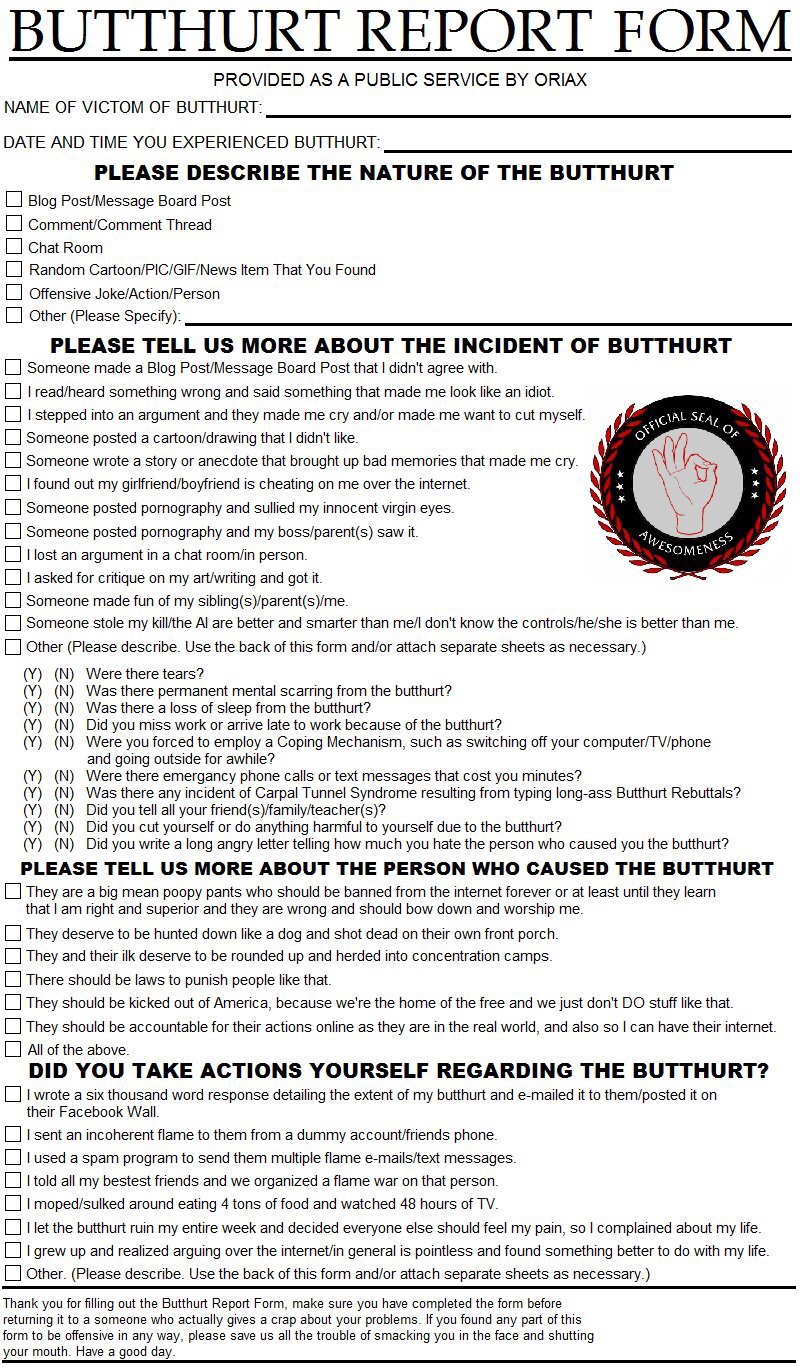
Should you find yourself sanctioned after running afoul of the CF comments policy as stated and feel you have been wronged, please download and complete the Butthurt Report form below in quadruplicate; retain one copy for your personal records and send the others to the email address posted in the right sidebar.

Please refrain from whining, sniveling, and/or bursting into tears and waving your chubby fists around in frustrated rage, lest you suffer an aneurysm or stroke unnecessarily. Your completed form will be reviewed and your complaint addressed whenever management feels like getting around to it. Thank you.

CF Glossary

ProPol: Professional Politician

Vichy GOPe: Putative "Republicans" who talk a great game but never can seem to find a hill they consider worth dying on; Quislings, Petains, Benedicts, backstabbers, fake phony frauds

Fake Phony Fraud(s), S'faccim: two excellent descriptors coined by the late great WABC host Bob Grant which are interchangeable, both meaning as they do pretty much the same thing

Mordor On The Potomac: Washington, DC

The Enemy: shitlibs, Progtards, Leftards, Swamp critters, et al ad nauseum

Burn, Loot, Murder: what the misleading acronym BLM really stands for

pAntiFa: an alternative spelling of "fascist scum"

"Mike Hendrix is, without a doubt, the greatest one-legged blogger in the world." ‐Henry Chinaski

Subscribe to CF!

Support options

Shameless begging

If you enjoy the site, please consider donating:

Correspondence

Email addy: mike-at-this-url dot etc

All e-mails assumed to be legitimate fodder for publication, scorn, ridicule, or other public mockery unless specified as private by the sender

Allied territory

Alternatives to shitlib social media: A few people worth following on Gab:

Fuck you

Kill one for mommy today! Click to embiggen

Notable Quotes

"America is at that awkward stage. It's too late to work within the system, but too early to shoot the bastards."
Claire Wolfe, 101 Things to Do 'Til the Revolution

Claire's Cabal—The Freedom Forums

FREEDOM!!!

"There are men in all ages who mean to govern well, but they mean to govern. They promise to be good masters, but they mean to be masters."
Daniel Webster

“When I was young I was depressed all the time. But suicide no longer seemed a possibility in my life. At my age there was very little left to kill.”
Charles Bukowski

“A slave is one who waits for someone to come and free him.”
Ezra Pound

“The illusion of freedom will continue as long as it’s profitable to continue the illusion. At the point where the illusion becomes too expensive to maintain, they will just take down the scenery, they will pull back the curtains, they will move the tables and chairs out of the way and you will see the brick wall at the back of the theater.”
Frank Zappa

“The right of a nation to kill a tyrant in case of necessity can no more be doubted than to hang a robber, or kill a flea.”
John Adams

"A society of sheep must in time beget a government of wolves."
Bertrand de Jouvenel

"It is terrible to contemplate how few politicians are hanged."
GK Chesterton

"I predict that the Bush administration will be seen by freedom-wishing Americans a generation or two hence as the hinge on the cell door locking up our freedom. When my children are my age, they will not be free in any recognizably traditional American meaning of the word. I’d tell them to emigrate, but there’s nowhere left to go. I am left with nauseating near-conviction that I am a member of the last generation in the history of the world that is minimally truly free."
Donald Sensing

"The only way to live free is to live unobserved."
Etienne de la Boiete

"History does not long entrust the care of freedom to the weak or the timid."
Dwight D. Eisenhower

"To put it simply, the Left is the stupid and the insane, led by the evil. You can’t persuade the stupid or the insane and you had damn well better fight the evil."
Skeptic

"There is no better way to stamp your power on people than through the dead hand of bureaucracy. You cannot reason with paperwork."
David Black, from Turn Left For Gibraltar

"If the laws of God and men, are therefore of no effect, when the magistracy is left at liberty to break them; and if the lusts of those who are too strong for the tribunals of justice, cannot be otherwise restrained than by sedition, tumults and war, those seditions, tumults and wars, are justified by the laws of God and man."
John Adams

"The limits of tyranny are prescribed by the endurance of those whom they oppress."
Frederick Douglass

"Give me the media and I will make of any nation a herd of swine."
Joseph Goebbels

“I hope we once again have reminded people that man is not free unless government is limited. There’s a clear cause and effect here that is as neat and predictable as a law of physics: As government expands, liberty contracts.”
Ronald Reagan

"Ain't no misunderstanding this war. They want to rule us and aim to do it. We aim not to allow it. All there is to it."
NC Reed, from Parno's Peril

"I just want a government that fits in the box it originally came in."
Bill Whittle

Best of the best

Finest hosting service

Image swiped from The Last Refuge

2016 Fabulous 50 Blog Awards

RSS feed

RSS - entries - Entries
RSS - entries - Comments

Boycott the New York Times -- Read the Real News at Larwyn's Linx

Copyright © 2026