Musical notes

Had a few most excellent old tunes that I’d jdamned near forgotten about altogether pop into my empty head the other day, and I been a-movin’ and a-groovin’ to ‘em ever since. First up, Jack Rabbit Slim’s slashing, energetic “Rock-A-Cha.”

Next up, Travis and Bob’s cool old chestnut, “Tell Him No,” which I used to play with Mook in the Parodis.

Then, we have the legendary Sister Rosetta Tharpe and her great, great rendition of “Didn’t It Rain.”

I dunno, seeing Tharpe wailing on that SG Custom always felt sorta incongruous to me, perhaps because I never could stand an SG myself. Doesn’t seem to bother her any, though.

Lastly but by no means leastly, my own personal favorite of the whole bunch: Larry Finnegan’s strange but haunting 1962 earwig, “Dear One.”

What, you didn’t think I WASN’T gonna delve a little further into this one, did ya? COME ON, MAN! I DID say it was one of my all-timers, ya know.

Finnegan’s wavery falsetto on the intro immediately gives way to a deeper, more chesty man-voice for the rest of the song. It’s just one of several odd, quirky little aspects of this quirky little tune. Others include the spoken lines from the girl who done him wrong, echoing the B-part lyrics sung by Finnegan.

The sudden 180-degree shift in narrative point of view from Finnegan in the victim role to the cheating hussy in this section is almost jarring, but not quite. As the song moves along through, then gets back to the regular chorus-verse-chorus choogle of most pop/rock music, the uninflected, zombie-like recitation of the lame explanation for her faithless betrayal begins to sound funny, really.

Especially the final part, to wit: “But I lost my head/And I lost my heart/And I lost your love to him.” Whuuu….? Lost HIS love, you mean, not YOURS. Right? i mean, how the fug you gonna lose HIS love to etc, ya silly bint?!? Like I said: weird.

Leaving all the departures from standard pop-song form aside, the thing you really want to pay close attention to here is the drummer’s shuffle-beat paradiddling around on the snare. The jangly, tinkly piano is nice, as is the bass line, the guitars, the basic melody, all of it. But it’s the snare drum that drives this thing, that propels the song from run-of-the-mill teenybopper fluff right up into the hightest heights of truly unforgettable music. Once you home in on that snare, that’s it: you’re gone.

As you will no doubt realize straightaway, as inventive and unusual as the entire tune is, it’s that rolling, rollicking snare drum that really makes the whole thing git up and snort. I gots no idea who that drummer is/was, but he’s a bona fide genius—even doing them paradiddles the whole entire song, pretty much, he still never plays ‘em the same way twice.

Reminds me of BP’s drummer Mark, who played similar-type rolls and shuffle-beats on the snare himself, except he pounded them skins so durn viciously you coud almost hear the heads scream in agony. If I’m lyin’, I’m flyin’.

Update! Y’all prolly knew I’d just HAVE to do some poking around on this drummer business, din’tcha?

When it came to music, Larry counted Johnny Cash and Don Gibson as his two favorite artists. While at the university he and his older brother Vincent, then a senior at Boston College, wrote Dear One. They started knocking on the doors of record companies all over New York, but had no takers until they met Hy Weiss, the owner of the small but successful Old Town Records. Weiss had already produced such hits as So Fine by the Fiestas from 1959, and Let The Little Girl Dance by Billy Bland the following year, as well as Life Is But A Dream by the Harptones. Hy Weiss recognized Larry’s talent and saw the potential in Dear One. He also changed Larry’s last name from Finneran to Finnegan, figuring that dee-jays stood a better chance of remembering a common name like Finnegan.

Dear One was recorded at Mira Sound Studios, West 54th St., New York. According to Vincent Finneran, “There was no demo version of ‘Dear One’, just one recording with two takes. And the thing that made the song successful was the engineer Bill McMeekan. He put five microphones in and around the piano and three microphones on the drums which gave the song a unique sound. Dick Pitassy played piano. Two different girls sang on ‘Dear One’; one did the opening female lines and another did the later ones.”

One of the girls, Bambi LaMorte (today Mignon Lawless), remembers, “Larry dated one of my roommates (Sandy Bryant). I attended St.Mary’s College which is directly across the street from Notre Dame. I met Larry through Sandy. We would sometimes all hang out together. I was a music major and since I lived in Pelham, New York (about 20 minutes from Manhattan), Larry asked me if I would sing a female part on his recording. I said ‘Sure.’ We went to a recording studio somewhere in Manhattan over Thanksgiving vacation 1961 and recorded ‘Dear One’. The only professional musician was Gary Chester, the drummer. Larry felt it was important to have an experienced drummer. I believe there were two guitar players, both from Notre Dame. The only things I remember about that night were that the guitar players were not taking the recording seriously enough and kept making mistakes. Larry finally yelled at them and they shaped up. I don’t remember how many tries it took to get the original, but they did a lot of starting and stopping. I do remember that I had to do my part cold turkey, without any practice. I only sang the introduction to ‘Dear One’. They didn’t like the way I spoke the part, and overdubbed it later. I have no idea who the other woman singer is. Larry’s agent hired someone to do it. Larry and I went back to the studio one night and recorded a song we wrote together. I played guitar, he sang, and then we dubbed different instruments onto the recording. It was fascinating to experience his creativity at work.”

Jeez: two takes, no isolation, baffles, or sound damping, just ambient mics and roll tape boys! Sometimes it seems as if there’s a really cool story behind every hit song, out-of-nowhere artist, or recording-studio session, don’t it?

The power of Elvis part…4?

Well, kinda-sorta, anyway. NOTE: Check out the Greatest Hits page for the first three “Power of Elvis…” installments, to which this post isn’t exactly related other than that they all share a common topic. Or it wasn’t my intention when I was writing it for this piece to be related, nor to amount to a sequel to the others, at any rate. What the hey, it’s all about Elvis in the end, so why belabor such a trivial point?

Today being August 16th, and August 16th, 1977 being the death-i-versary of the once, future, and forever King of Rock and Roll, let’s get to commemoratin’, shall we?

First off, we gots a YewToob of what I consider one of Elvis’s most appealing signature songs, a catchy R&B confection originally penned by Lloyd Price*, which would soon after be immortalized on 2-inch Ampex Grand Master R2R tape (amazing price at the link: 35 dollars? Back in my day we had to fork over slightly more than a hunnerd smackeroos for it) by Price in a NOLA studio session run by the great Dave Bartholomew, writer and producer of many if not most of Antoine “Fats” Domino’s early chartbusters.

Lots of wonderful archival pix in that one of Elvis, Gladys, and the iconic Jordanaires quartet in younger, happier days.

In his latter-day backing band Elvis had a genuine virtuoso on lead guitar, the savant James Burton (“…one of the best guitar players to ever touch a fretboard”), who back in the late ‘60s began working for E first as a player in the touring band, later a recording-studio session man**. Burton stayed on with Presley in both positions until Elvis’s death.

Here’s a fat-Elvis vid of Burton strutting his stuff in Omaha, Nebraska taken in June of ’77, a mere couple of months before Elvis departed this vale of tears. In this short clip, Burton whips his trademark ugly-ass pink paisley Telecaster like a rented mule.

Even a partial listing of musicians Burton worked with either onstage or in the studio is nothing short of jawdropping: Bob Luman; Dale Hawkins; Ricky Nelson; Elvis Presley (he was also leader of Presley’s TCB Band, the same slot as the similarly awe-inspiring Travis Wammack filled for/with Little Richard Penniman at Tramps when the BPs played a 2-shows-per-night, three-night stand opening for the self-styled Architect of Rock & Roll); The Everly Brothers; Johnny Cash; Merle Haggard; Glen Campbell; John Denver; Gram Parsons; Emmylou Harris; Judy Collins; Jerry Lee Lewis; Claude King; Elvis Costello; Joe Osborn; Roy Orbison; Joni Mitchell; Hoyt Axton; Townes Van Zandt; Steve Young; Vince Gill; and Suzi Quatro.

Pretty impressive rundown of name artists, no? All the more impressive because it IS only partial. Others omitted include: Albert Lee, Rodney Crowell, Steve Wariner, Brian May, and Jeff “Skunk” Baxter, to name but a noteworthy few. Even this incomplete list is in fact a veritable Who’s Who of rock & roll, country, rockabilly, and pop artists, that’s what.

Next up: in the aftermath of The King’s bruising humiliation on The Steve Allen Show (after which disastrous outing Elvis could only describe himself as “distraught,” finding himself practically incapable of coherent speech due to the miserable asshat Allen’s openly-flaunted dislike of and contempt for Presley not just as a performer but personally) a visibly-exhausted Elvis had a long, cordial conversation with columnist/reporter/interviewer Hy Gardner for his popular “Hy Gardner Calling” phone-in show.

What a nice departure the warm, friendly, gregarious way Gardner treated the young phenom is from the egomaniac Steve Allen’s supercilious, sneering approach.

Last but by no means least, we come to the well-known story of a show-stopping (literally!) Vegas altercation betwixt Elvis Presley and a belligerent, sloppy-drunk oaf heckler, Big (Boob) Mike Henderson. Clocking in at just under 16 minutes it’s a long ‘un, I freely admit. But stick with it, definitely; the payoff is well worth the wait.

Awright, awright, a WAY better payoff woulda been seeing Elvis slam a hard, fast knuckle samwidge into this punk-ass bitch’s snot locker, knocking Sir Punch-A-Lot flat on his stupid ass onto the casino stage.

As is noted in the vid, Elvis’s deft defusing of a volatile, rapidly-escalating confrontation which could just as easily have taken a different, much darker turn was so smoothly managed that his handling of the situation is still studied today in conflict-management and -resolution training courses as the pluperfect example of how it’s done. Soft-spoken, surehanded, patient, preternaturally calm, humane—against all odds, Elvis forged peace from what appeared to be inevitable, unavoidable violence; soothed and gently reassured 1) a twitchy, unhinged antagonist; 2) an audience made anxious by the increasingly irrational bluster and brigandry of the inebriated, obnoxious lowlife; 3) every musician, crewman, custodian, sound/lighting technician, and venue staffer onstage with the prospective combatants; turned an enemy into a friend by merely speaking frankly and honestly to and demonstrating an unfeigned interest in him—all these nigh-impossibilities pulled off singlehandedly before a capacity crowd of 20,000 screaming cash customers, no less!

Too, it tells us everything we’ll ever need to know about what kind of man Elvis Presley really, truly was way down deep inside.

The narrator of the above vidya dryly informs us that, as the artist the Colonel liked to call “My Boy” strode placidly out to front-center-stage to address his rage-incapacitated interlocutor, Tom Parker was standing in the wings at Stage Right “having a heart attack,” and I expect he was at that. Elvis’s bandmates and backing vocalists (the Sweet Inspirations, Millie Kirkham, and Kathy Westmoreland), the audience, the stagehands, go-fers, and production crew—they must surely ALL have been clutching their chests in prodigious agonies of consternation at the sight of the show’s Starring Attraction putting himself in harm’s way so nonchalantly.

Moving on from speculation, hypothesizing, and out-and-out fantasizing, to this day Elvis Presley still outsells pretty much everybody else, and not by a small margin, either. Despite the figures that show the product fairly flying off the shelves, Elvis Presley records, tapes, and CDs don’t turn up in the Hot 100 nowadays because, according to Billboard, the fact that they aren’t new releases disqualifies them. No matter; we already know well enough who the King really is, thankee. It is assuredly NOT pathetic national joke Howard Stern, however girlishly and vehemently he may whinge otherwise.

In sum, even 48 years after his tragic demise*** the Big E’s spectral presence still looms large over the music biz, an incorporeal inspiration and influence that doesn’t look like going away anytime soon.

Elvis, you may be gone but you will NEVER be forgotten, bless your beautiful soul. We love you, and will always miss you.

* Amusingly enough, I remember meeting Price after one of those aforementioned Tramps shows supporting Little Richard

** A hateful, thankless job if ever there was one; go ahead, ask me how I know, I DARES ya!

*** No, Elvis did NOT “die on the toilet,” as has been gleefully and erroneously claimed for decades by his detractors. Elvis’s master bedroom and en suite bathroom had a modest-sized but plush lounge area separating them, just spacious enough to accommodate a chaise longue and a comfy, well-cushioned La-Z-Boy recliner/rocker. Elvis thought of his lounge as a place of refuge, his own private hideaway in which he could shuck his ELVIS PRESLEY, LADIES AND GENTLEMEN! persona and go back to being Gladys and Vernon Presley’s only kid—just 19 years of age, a part-time delivery man for Crown Electric Company of Memphis, paid a whopping one (1) dollar per hour—for a spell.

In his lounge, things were quite different: Elvis could laze about in his PJs, his tall, thick, heavily-pomaded, spectacular pompadour disheveled, a-tangle, and uncombed. Unlike World Famous Elvis, Private Lounge Elvis didn’t need to impress anybody; in that place late in the night, he didn’t owe a single soul a single goddamned thing. There was no fear of failure; no grinding pressure to capture and hold an audience; no nervousness, no jittery, unsettled stomach, no stage fright; no expectations whatsoever for him to live up to. In his lounge, Elvis could simply relax, read, and enjoy a refreshing interlude of uninterrupted peace, quiet, and solitude which would belong to him and him alone.

Until that fateful night when his young girlfriend Ginger Alden discovered him crumpled unconscious and non-responsive on the carpeted floor of the lounge—NOT on, in front of, or next to the toilet. Elvis actually passed away in the ambulance on the way to Memphis General Hospital

Update! My mention of Dave Bartholomew way up yonder brought to mind another NOLA R&B icon: Smiley Lewis, who will always be twinned with Bartholomew in my addled, befogged brain for some unknown reason. Between them, those two cats wrote more unforgettable music than you can shake a stick at—music which constitutes the bedrock, the very foundation-stones, of rock & roll both back in Lewis’ and Bartholomew’s day and as we in the modern era know it as well. Like yet another bona-fide legend from a previous musical era, Willie Dixon, Bartholomew and Lewis are simply all over classic R&B/RaB/rock & roll; everyplace you look you’re gonna see those rascals peeping back atcha.

I dunno, maybe I can hardly think of one without thinking immediately of the other because I spent so dang many years playing so dang many of their songs with the BPs. And HEY PRESTO! Just like that, I’m reminded of another legend: Big Al Downing, who we’ve discussed before in these h’yar parts.

Now THAT’S the stuff! Had to’ve played that song about a blue million times with the Playboys, and it was a stone gas each and every time we did. It never yet got old, and it ain’t ever gonna.

Updated update! Every picture tells a story, don’t it?

From August 1977: Thousands of grief-stricken Elvis fans outside Graceland right before the gates were opened to admit them, allowing them to mourn their lost idol in the grounds of his longtime home. From what I’ve read, the feeling of the Presley family was that if the fans were comforted by being invited inside the gates of Graceland and off the streets and sidewalks, then it was worth whatever damage to the carefully-manicured lawn the teeming throng might do along the way.

After all, trampled, torn-up grass, disfigured shrubbery, and mauled flower beds can always be made whole again with some hard work. But a heart shattered by sudden, unexpected bereavement? Ehhh, not so much.

Update to the updated update! Been idly mulling over this self-generated Bartholomew/Lewis mental pairing of mine, when something struck me as kinda weird about it. I mean, it’s mainly just the BarthoLew entity, even though there are a shitload of other two-man combinations which could, perhaps even should, have the same affect on me, but don’t. For example, whenever somebody mention Dave Edmunds, Nick Lowe doesn’t necessarily come waltzing along into my head close behind. Same-same for, oh, say, Paul Stanley and Gene Simmons; David Bowie and Iggy Pop; Pete Townsend and Roger Daltrey; Layne Staley and Jerry Cantrell.

On the flipside, though: Lester Flatt and Earl Scruggs? Homer and Jethro? Jan and Dean? Crosby and Hope? Sam and Dave?

Begging your pardon, kind sirs, but don’t you even think of throwing Simon and Garfunkle at me at this juncture. I’ve spent a considerable chunk of my life trying my level best NOT to think of Art Shinola and his boozum chum Paul Gobblefuckndinkle, and after lo, these many years I’ve become quite good at it, believe you me. You chuck those two shit-slurping doofii at my head, thereby distracting me from the task at hand, disrupting my concentration, and upending my groove so ruinously I can’t get my head back on straight, my heart back in the game, my attention refocused and re-aimed correctly, my thoughts realigned and retuned so that they’ll flow freely, unhindered and unobstructed in the way a mighty river does.

I tremble and quake with fear at the painfully slow dawning of a dreadful realization: I may not ever be able to do these most needful of things again. In which event I hereby solemnly swear that I will neither rest nor remit nor recede nor relent until the blaggard who forcibly reacquainted me with those two dickless purveyors of emasculated, stupefyingly flavorless Wimp Rock gruel have been dealt with to my own satisfaction: ie cruelly, harshly, and above all fully.

Lastly but not leastly, what price Loretta and Doolittle Lynn (to purloin a typically-exquisite Wodehouse phrase)? Where do THEY fit into this gi-normous 50,000-piece jigsaw puzzle? DO they fit into it, even…?

Okay, okay, let’s forget I brought the whole thing up. From now on, we’ll just pretend it never happened.

Farewell to Dave Edmunds

Not gone quite yet, but on the way out.

Rock musician Dave Edmunds, 81, hospitalized and fighting for life after ‘major cardiac arrest’
Rocker Dave Edmunds, best known for his 1970 hit “I Hear You Knocking,” is hospitalized and fighting for his life after suffering a “major cardiac arrest.”

The popular Welsh musician’s wife, Cici Edmunds, shared the shocking news in a lengthy Facebook post on July 29.

“My beloved husband of 40 years has had a major cardiac arrest,” she began. “He died in my arms while I desperately tried to keep him alive.”

Edmunds, 81, was ultimately revived after his wife and a nurse administered “heavy CPR.”

“I’m still in shock, and I believe I have PTSD from the horrific experience,” his wife continued. “He very clearly has brain damage and severe memory loss.”

Brian Setzer, Edmunds’ close friend and former producer, claimed Edmunds officially retired from music and performing in July 2017.

“It’s with a bittersweet announcement that my good friend and guitar legend Dave Edmunds is retiring after tomorrow night’s show,” Setzer wrote on Facebook at the time.

Actually, I believe the Post got that wrong. Far as I know, Setzer never produced Edmunds, it was Edmunds who produced Setzer—the Stray Cats, more precisely. Edmunds was the man who “discovered” the Stray Cats back during their career-making sojourn in London, producing the material that would be culled from their two UK LPs to become their first US release, Built For Speed

I’ve run my favorite Dave Edmunds song here before, I believe, although this version isn’t the same as the one I posted back then.

Down on the farm

Don’t recall exactly how or why, but I ran across this gem the other day, which came with an added kicker ere all was said and done.

The BPs covered this butt-rockin’ classic RaB tune for many years—a strict, straight-up rendition without any embellishment or “improvements,” not even in the guitar solo. It always got a solid response from the crowd, getting people out on the dance floor with a quickness to shake their booties joyously. But that additional kicker I mentioned? It’s in the YewToob comments section.

Crazy, man, crazy! As Fate would have it, Poe and his Poe Kats have a pretty storied history their own selves, which goes well beyond big Al Downing and “Down On The Farm.”

Bobby Nelson Poe, Sr. (April 13, 1933 – January 22, 2011), also known as The Poe Kat, was an American musician who had a long and varied career in the music business.

Bobby Poe was born in Vinita, Oklahoma. In the mid-1950s, he formed Bobby Poe and The Poe Kats, which featured African-American piano player Big Al Downing, lead guitar player Vernon Sandusky and drummer Joe Brawley. Bobby Poe and The Poe Kats were also Rockabilly Queen Wanda Jackson’s first Rock and Roll backing band. They toured with Wanda and can also be found on her early Capitol Records recordings, including the Rockabilly classic “Let’s Have a Party”. Bobby, Wanda, Big Al and Vernon are all members of the Rockabilly Hall of Fame.

Bobby Poe and The Poe Kats came to the attention of Sam Phillips of Sun Records with their first recorded track, “Rock and Roll Record Girl”. Based on the music of the old standard “Chattanooga Shoe Shine Boy”, “Rock and Roll Record Girl” was at first blocked from release by Wesley Rose of Acuff-Rose because of that fact. By the time all of the legal hurdles were cleared, Sam Phillips was no longer interested in releasing the track. Instead, Dallas, Texas radio personality Jim Lowe stepped in and released the single on his White Rock Records label. “Rock and Roll Record Girl” backed with “Rock and Roll Boogie” became a number 1 single in the state of Texas.

After one more single for Jim Lowe’s White Rock Records entitled “Piano Nellie”, under the name of Bobby Brant and The Rhythm Rockers (which was shortly thereafter picked up and re-released by EastWest Records), Bobby Poe gave up his career as an artist to become an artist manager. His first client was Big Al Downing. In the 1960s, Poe moved to the Washington, D.C. area and expanded his operation. He managed and co-produced The Chartbusters, which featured his old bandmate Vernon Sandusky. The Chartbusters scored a Top 40 hit in 1964 with their recording “She’s The One”. Tom Hanks was quoted in People Magazine as saying The Chartbusters were one of the influences for his film “That Thing You Do!”. Vernon Sandusky went on to play guitar in Country Music Hall of Famer Roy Clark’s band for over 20 years. Bobby Poe also co-managed The British Walkers, which featured Bobby (sometimes spelled Bobbie) Howard and legendary blues guitarist Roy Buchanan.

One of the things I’ve always loved about the music biz is the wild, wild stories lurking behind even the most ordinary-seeming artists. More unexpected twists and turns than the most remote mountain blacktop, that’s for sure.

A tragic loss

Hopefully only a temporary setback, but still truly horrible news from an old and dear friend.

“I cannot play guitar.” Rockabilly legend Brian Setzer reveals he has an auto-immune disease that prevents him from playing guitar
Setzer said the effects of his illness became apparent during the Stray Cats’ 2024 summer tour, the group’s first road stint in five years

Brian Setzer announced he has been diagnosed with an autoimmune disease that prevents him from playing guitar.

The rockabilly electric guitar legend made the news public on February 13 via Facebook:

Hi everybody,

I just wanted to check in with you all. Towards the end of the last Stray Cats tour I noticed that my hands were cramping up. I’ve since discovered that I have an auto-immune disease. I cannot play guitar.

There is no pain, but it feels like I am wearing a pair of gloves when I try to play. I have seen some progress in that I can hold a pen and tie my shoes. I know this sounds ridiculous, but I was at a point where I couldn’t even do that. Luckily, I have the best hospital in the world down the block from me. It’s called the Mayo Clinic. I know I will beat this, it will just take some time.

I love you all,

Brian

Although there is no cure for autoimmune diseases, their symptoms can be mitigated with a range of treatments. With any luck, Setzer will be able to play again soon.

Setzer is by the far the best-known and most successful rockabilly guitarist in rock and roll history. He first found success with the Stray Cats in the 1980s, when he helped relaunch the rockabilly genre decades after it has fallen from popularity.

“Rockabilly is so near and dear to my heart,” the guitarist told Guitar Player in 2023. “There’s just something exciting about it, and it never goes out of style. You can always add your own wrinkle to it and take it somewhere else.”

Truer words etc. Brian, I doubt you’ll ever see this, but in case you do please know that my thoughts, hopes, and prayers are with you, brother. You’re one of the very best guitarists I know or ever have known, so I know it’s a bitter pill indeed to have to swallow—Depuytren’s Contracture left me unable to play anything but the most rudimentary, primitive licks as of about 5-6 years ago or so myself—even moreso when music has been your life, for most of your life, as it has been for you and me both. Hang tough, never give up the fight; I just know your tremendous courage, determination, and strong heart will see you through in the end.

Update! A little inside-the-music story that illustrates one of the biggest reasons I think so highly of Setzer: my brother has always been quite close not only to Brian but the entire Setzer family, enough so that when Brian’s dad passed away the fam insisted on flying Jeff up from NC for the funeral. Myself, I’ve never met Brian’s dad OR mom, nor have I ever been out to the Setzer clan’s Old Home Place out on Lawn Guyland. Whereas Jeff, y’know, has.

Anyhoo, the thing that always got me was, ever since then each and every time I’ve run into Brian, opened for the BSO, whatever whenever wherever, the very first words out of Brian’s mouth to me have been, and I quote: “So how’s Jeff doing, Mike?” No exceptions, not a single one. That always impressed the heck out of me, made me feel good, and brought home forcefully what a decent, thoughtful, just plain good guy Brian is.

I gigged regularly with a half-assed little side-band trio in NYC which included oldest Setzer sibling Gary on drums for a year or thereabouts, and played little brother Kenny’s wedding after-party down in Miami with another side project of mine—a party Brian and his lovely wife also attended, hanging out at our big ol’ table drinking free open-bar booze and shooting the breeze with us well into the wee hours.

Now, for some bizarre reason I’ve been informed many times over lo, these many years—as is also the case with Mike Ness and, truth be told, my own self as well—by people I neither knew nor wished to know that “Ohhh, that Brian Setzer is such an asshole, what a dick!”

Who even knows the reason why, I certainly don’t. Some too-drunk chick trying (and failing) to coax him into a fast Green Room, tour bus, or parking lot fuck? A random dude who felt himself short-changed in the attention department in the impromptu post-show grip ’n’ grin line, perhaps? Don’t know, don’t care. In any event, you’ll never, ever get me to put a yes to that “Brian Setzer is an asshole” proposition. I know firsthand that it simply ain’t so.

Good luck and best wishes for a full and speedy recovery, Bri. God willing, you’ll pull through and have the last laugh on everybody ere the end.

Short and Sweet for The Last Day of 2024

No comment needed
Beauty in Australia

Drivin’ Wheel

Looking around earlier for something else entirely, I stumbled across a great old tune I’d very nearly forgotten about.

That’s the late Robert Gordon performing T-Bone Burnette’s original composition, with Chris Spedding on guitar; the bassist and drummer are unknown to me, I’m afraid. On the Gordon LP this selection is from, the guitarist is the incomparable Danny Gatton, and of course the above vid is interspersed with scenes capably culled from Robert Mitchum’s classic tale of bootlegger derring-do, Thunder Road. Whoever put this video together did one heck of a fine job, if you ask me.

Classic REAL rock and roll

Appropros my response to Ase’s comment here, please allow me to present Macy “Skip” Skipper’s RaB classic, “Bop Pills.”

Excellent tune, fun lyrics, solid arrangement, the song would go on to become grist for the classic-cover mill for the Cramps, my old friend Tim Polecat*, and a smattering of other artists of discriminating tastes.

* My relationship with Tim got off to a somewhat rocky start when, after the BP’s set on a RaB-weekender bill on which Tim’s band the Polecats were that night’s headliners, me and my bud Too Tall Paul (both of us obnoxious rowdies just drunk as boiled owls, as per usual) stood off to the side of the stage and heckled Tim mercilessly in exaggerated, poofter English accents. This fusillade of aggressive catcalling had poor old Tim glaring angry daggers at us all thru his entire set, and understandably so. The offense which got us started in on him in the first place was the Polecats’ recent recording of a particularly wimpy David Bowie semi-hit, “John, I’m Only Dancing”—a limp dishrag of a song that bore no relationship to the kind of punchy, hard-edged Neo-rockabilly my band and Paul’s Frantic Flattops were known for. Reintroduced to Tim many years later by a mutual female friend; I spoke at length to him over the phone one night at her place, and as it turned out we got along famously. Imagine my surprise to learn during that unexpected conversation that Tim was in truth an entirely likeable, warm, unpretentious cat after all. Tim avowed repeatedly that he remembered the Playboys fondly and admired us as a thoroughly kick-ass outfit; the heckling incident in New Jersey never came up, to my profound relief. Iconic Polecats guitarist Boz Boorer eventually became a good friend as well, but that’s a whole ‘nother story

As featured in my upcoming autobiography

On any list of the all-time top o’ the heap purveyors of Brit-style power-pop, rockabilly, and R&B would have to be Rockpile, featuring Welshman Dave Edmunds on vocals and lead guitar and his PiMC© Nick Lowe on bass/vocals. My verymost favorite Rockpile tune will give y’all a li’l taste of what I’m talkin’ ‘bout here.

“Didn’t see a thing until it came…” WHOA, that’s good squishy!

Edmunds, as well as co-conspirator Lowe, has several other non-Rockpile feathers in his not-inconsiderable cap, among them this YUUUGE one:

The band first appeared in the New York Area in the middle of 1979 performing under a number of names including the Tomcats, the Teds, and Bryan and the Tom Cats. According to Brian Setzer (singer/songwriter and guitarist), they changed names to fool club owners (who would not hire the same band for consecutive nights), but kept the “Cats” moniker in their various names so the audience would know they were the same band.

Setzer joined up with Slim Jim Phantom (drums) and they soon added Phantom’s schoolmate and friend Lee Rocker (stand-up bass); all three of them came from the same neighborhood and were interested in punk and rockabilly music.Since 1983, they have used only “Stray Cats” as their name. The band name “Stray Cats” had appeared in the 1973 rock ‘n’ roll film That’ll Be the Day and its 1974 sequel Stardust. They also went to many concerts and enjoyed the punk scene. They met the Clash and they used to see Siouxsie and the Banshees, Charlie Harper and the UK Subs.

The group, whose style was based upon the sounds of Sun Records artists and other artists from the 1950s, was heavily influenced by Eddie Cochran, Carl Perkins, Gene Vincent, and Bill Haley & His Comets. The Stray Cats quickly developed a large following in the New York music scene playing at CBGB and Max’s Kansas City as well as venues on Long Island. When the Cats heard a rumor that there was a revival of the 1950s Teddy Boy youth subculture in England, the band moved to the UK. They spearheaded the nascent rockabilly revival, blending the 1950s Sun Studio sound with modern punk musical elements. In terms of visual style, the Stray Cats also blended elements of 1950 rockabilly clothes, such as wearing drape jackets, brothel creepers, and western shirts, with punk clothes, such as tight black zipper trousers and modern versions of 1950s hair styles.

In the middle of 1980, the band found themselves being courted by record labels including Virgin Records, Stiff Records, and Arista Records. Word quickly spread and soon members of The Rolling Stones, The Who, and Led Zeppelin were at their shows.

After a gig in London, Stray Cats met musician and producer Dave Edmunds, well known as a roots rock enthusiast for his work with Rockpile and as a solo artist. Edmunds offered to work with the group, and they entered the studio to record their self-titled debut album, Stray Cats, released in Britain in 1981 on Arista Records. In addition to having three hits that year with “Runaway Boys”, “Rock This Town”, and “Stray Cat Strut”, they also performed on the eighth day of the Montreux Jazz Festival. The UK follow-up to Stray Cats, Gonna Ball, was not as well-received, providing no hits. Yet the combined sales of their first two albums were enough to convince EMI America to compile the best tracks from the two UK albums and issue an album (Built for Speed) in the U.S. in 1982. The record went on to sell a million copies (Platinum) in the US and Canada and was the no. 2 record on the Billboard album charts for 15 weeks.

Bold mine, and ‘nuff said about that.

As fate would have it, I’ve been good friends with Setzer for decades, first meeting him and his gracious spouse at the invite-only afterparty I played with my NYC side-band cohorts Tom Hopkins and Jeff Dilena celebrating (drowning in an ocean of open-bar liquor, more like) Brian’s little brother Kenny and his stunning wife Ariel’s nuptials down in Miami. I also worked a side gig during my NYC tenure with senior Setzer sibling Gary, a somewhat lackluster RaB trio that also boasted Hopkins slapping that doghouse bass.

An extremely talented drummer, Jeff went on to lay down the beat for the late Robert Gordon’s backing band, a fairly plum gig despite Robert’s well-earned rep as an insufferable prick. After many years as a semi-high mucky-muck in the midtown Manhattan offices of Columbia Records, the Gordon gig paid handsomely enough to permit Jeff to quit his cushy sinecure at Columbia to drum full-time for Gordon. Me, I went on to have numerous run-ins with the douchebag Gordon before Jeff took the job with him, sordid tales which will also be revealed in my aforementioned tell-all autobiography.

Never did get to meet Dave Edmunds, alas, although I certainly wish I had.

Ahhh, the good ole days…

Update! Okay, okay, kwitcherbitchin’ folks, here’s a couple of archival snaps, below the fold so as not to annoy anybody.

Continue reading “As featured in my upcoming autobiography”

The greatest band you never heard of

A look behind the scenes at the Cramps. First, a cpl-three of my personal favorites.

Yes, I’m aware that the Cramps’ bare-bones, raw, stripped-to-the-primer sound; the shock/schlock vintage horror-movie sensibilities which are shot through both their recordings and their onstage presentation; and Lux Interior’s more-shouted-than-sung vocal style isn’t going to appeal to all of y’all CF Lifers—let alone the bizarre way he prowls and flings himself around onstage, the outré antics, the in-your-face freaky-deakiness. I can see how that might be off-putting to those who didn’t come of age during the mid-70s punk rock explosion like I did, and that’s cool. In consideration of more-restrained and/or genteel tastes, I’ll do y’all a favor and just tuck the rest of this post away beneath the fold.

Continue reading “The greatest band you never heard of”

Apropos of nothing

There are damned few blogs whose comment section I bother to check out much, but the tall but brilliant, fabulously talented and visually stunning example of a placental mammal Diogenes Sarcastica‘s would be one of those. Commenter Dan Patterson’s most apropos mention of “The Steps to Heaven” put me in mind of an old Eddie Cochran gem I felt worth putting up here, just to share the wealth a little.

Eddie wrote, recorded, and performed one hell of a lot of great tunes before his tragic death in Bath, Somerset at the too-tender age of 21, no doubt—“Twenty Flight Rock,” “Summertime Blues,” “C’mon Everybody,” to name but a few—but this one has always been my absolute favorite of them all.

Update! Okay, okay, have just a bit more Eddie Cochran lore, from the above-linked Wikipedia article.

Cochran was one of the first rock-and-roll artists to write his own songs and overdub tracks. He is also credited with being one of the first to use an unwound third string to “bend” notes up a whole tone—an innovation (imparted to UK guitarist Joe Brown, who secured much session work as a result) that has since become an essential part of the standard rock guitar vocabulary. Artists such as Joan Jett and the Blackhearts, the Rolling Stones, Bruce Springsteen, UFO, Van Halen, Tom Petty, Rod Stewart, T. Rex, Cliff Richard, the Who, Stray Cats, the Beach Boys, the Beatles, Blue Cheer, Led Zeppelin, the White Stripes, the Sex Pistols, Sid Vicious, Rush, Simple Minds, George Thorogood, Guitar Wolf, Paul McCartney, Alan Jackson, Terry Manning, the Move, David Bowie, Jimi Hendrix, Johnny Hallyday and U2 have covered his songs.

It was because Paul McCartney knew the chords and words to “Twenty Flight Rock” that he became a member of the Beatles. John Lennon was so impressed that he invited McCartney to play with his band, the Quarrymen. Jimi Hendrix performed “Summertime Blues” early in his career, and Pete Townshend of the Who was heavily influenced by Cochran’s guitar style (“Summertime Blues” was a staple of live performances by the Who for most of their career, until the death of bassist and vocalist John Entwistle in 2002, and is featured on their album Live at Leeds). San Francisco Sound band Blue Cheer’s version of “Summertime Blues” was their only hit and signature song, and has been described as the first heavy metal song. Terry Manning recorded a live version of “Somethin’ Else” at a concert inside Elvis Presley’s first house in Memphis.

The glam rock artist Marc Bolan had his main Gibson Les Paul guitar refinished in a transparent orange to resemble the Gretsch 6120 played by Cochran, who was his music hero. He was also an influence on the guitar player Brian Setzer, of Stray Cats, who plays a 6120 almost like that of Cochran, whom he portrayed in the film La Bamba.

Never anywhere near as renowned or revered in the US as he was (and remains) in Jollye Olde—it was the same with nearly all of the great old rockabilly icons, excepting Elvis Presley, who ironically enough never performed overseas—Cochran’s continuing influence on rock & roll really can’t be overstated.

In fact, it was thanks to Eddie Cochran that I myself abandoned punk rock to dive into the rockabilly pool myself, a genre so incredibly deep as to be for all intents and purposes bottomless. At my cousin and BP’s drummer Mark’s place one hot summer afternoon, we were listening to his collection of Sid Vicious’s post-Pistols 45RPM releases, almost every one of which was an Eddie Cochran cover, none of which we’d ever heard the originals before.

We started looking at the labels and, seeing the songwriter credit to one “E. Cochran,” found our curiosity well and truly piqued—who WAS this mysterious E Cochran chap anyway, and how is it that Sid had come to cover so much of his stuff? Mark always having been the record-collector geek to end all record-collector geeks, he consulted his indie-label catalogs, looked up this E. Cochran dude, and placed a telephone order for several of the original 45s Sid had glommed onto.

When the vinyl arrived a cpl-three weeks later, we adjourned to Mark’s place again, put them on the turntable, and were forthwith blown right the fuck away. From that day forward, we were ex-punks and fledgling rockabilly greasers. So it was that eventually, from this joyous discovery, the Belmont Playboys were born.

As hinted at in the Wiki article, Gene Vincent was (re-)crippled in the same taxicab crash that sent Eddie Cochran to Rock And Roll Heaven and never really recovered from his injuries. Certainly, he was never the same afterwards, either in body or in spirit, enduring constant pain and walking with a pronounced limp for the rest of his days; the crash with Cochran exacerbated severe injuries to his legs sustained in a motorcycle accident in 1955.

Craddock (Vincent Eugene, a/k/a Gene Vincent—M) dropped out of school in 1952, at the age of seventeen, and enlisted in the United States Navy. As he was under the age of enlistment, his parents signed the forms allowing him to enter. He completed boot camp and joined the fleet as a crewman aboard the fleet oiler USS Chukawan, with a two-week training period in the repair ship USS Amphion, before returning to the Chukawan. He never saw combat but completed a Korean War deployment. He sailed home from Korean waters aboard the battleship USS Wisconsin but was not part of the ship’s company.

Craddock planned a career in the Navy and, in 1955, used his $612 re-enlistment bonus to buy a new Triumph motorcycle. On July 4, 1955, while he was in Norfolk, his left leg was shattered in an auto crash. He refused to allow the leg to be amputated, and the leg was saved, but the injury left him with a limp and pain. He wore a steel sheath as a leg brace for the rest of his life. Most accounts relate the accident as the fault of a drunk driver who struck him. Years later in some of his music biographies, there is no mention of an accident, but it was claimed that his injury was due to a wound incurred in combat in Korea. He spent time in the Portsmouth Naval Hospital and was medically discharged from the navy shortly thereafter.

Cochran ended up departing this vale of tears on April 17th, 1960, the day after the wreck—Easter Sunday, as it happens. As for Gene Vincent? Wellllll…

Moar coinkydink: the “clapper boy” at Vincent’s right shoulder above is an “early rockabilly pioneer” from High Point, NC, name of Paul Peek. Now, as fate would have it, the folks responsible for putting together a little annual whoopjamboreehoo called Bubbapalooza at the legendary Star Bar in ATL tracked Paul down to a semi-rural Holiday Inn not too far from the Alabama line, where Peek was working a steady solo guitar/singing gig in the hotel lounge—one of the most dreadful, depressing gigs there is, a test of endurance and sheer will that truly puts the “work” in the phrase “working musician.”

The Star Bar people implored Paul to show up at Star Bar for Bubba the next Saturday night, a suggestion Peek was dubious about, to say the very least. But throughout the intervening week the Star Bar folks kept after him: visiting the Holiday Inn to attend his nightly lounge ordeal; badgering him on the phone; plying him with endless rounds of beer and/or whiskey in hopes of persuading a drunken pledge of attendance out of him, etc. The Star Bar crew worked poor ol’ Paul as assiduously as an intractably smitten high-school senior does his virgin sophomore girlfriend on Prom night.

And lo and behold, on Saturday night who but Paul Peek should cross the Star Bar threshold and present himself at my usual haunt down at the end of the bar, just before the Playboys were to take the stage as the headline act. I was introduced to him and extended a warm invitation for him to join us onstage for a few Vincent tunes.

Paul Peek in the flesh cut a decidedly unimposing figure: mid-60s, probably; medium height and build; balding; modest and soft-spoken; painfully shy, peering awkwardly at me through Coke-bottle glasses. Whatever flash he may have had in his youth, there was nothing whatsoever of flash about the man standing beside me now. No garbardine, no suede creepers, no vintage 50s panel shirt or velvet smoking jacket. Just an average, quiet old guy who seemed to feel as if his mere presence here might be some kind of imposition.

I can’t recall whether Paul had brought a guitar of his own along or played one of mine—seems to me now he had his own battered acoustic box, but I could very easily be wrong. No matter. Assisted by the urging of the Star Bar staff, I finally coaxed him up with us early in the set. The place was elbow-to-elbow, I mean this house was packed. Paul grinned over at me, eyes wide behind those thick-ass goggles of his, as we launched into a Vincent chestnut—”Be Bop A Lula,” perhaps, I dunno.

As the band vamped the intro behind us, I waved Paul to the center-stage mic and introduced him to the appreciative audience. After having sworn up and down to me at the bar that “none of these young people will know who I am, they won’t care about seeing some old man up there,” the audience let rip with a thunderous ROAR on hearing his name that would’ve liquified the bowels of an entire pride of savage African lions, just from pure fright.

Paul ate it up, every bit of it; you could see the happy pride at this unexpected ovation written all over his beaming face. We finished the first song, then I asked him to sit in with us for a couple more numbers. During I guess the fourth song, Paul decided it was time to do a little showboating, dropping to one knee during my guitar solo. Thanks to his creaky old knees, two of us had to help him get back upright, whereupon the crowd roared its approval yet again.

Paul ended up playing half the damned set with us; barside with him after the show, he profusely thanked everyone within arm’s reach for his thrilling Bubbapalooza experience, signing autographs while he recounted amazing tales to me of life on the road backing the immortal Gene Vincent. That was the night I learned about Gene’s salty-rock-and-roll-dog motto from the man who’d lived it with him: “We blow into town. We drink all the whiskey. We screw all the women. We make a big racket. Then we leave. I mean, seriously, what’s not to like?”

I’ve never forgotten that glorious night, and I never will. I’m quite sure that Paul Peek never did either.

Git-fiddlin’

A fascinating list of the most expensive guitars EVAR, including this one.

5. Reach Out to Asia Fender Stratocaster

Sold: Qatar, 2005
Price: $2,700,000

Unique here in that it was never owned by a superstar, the Reach Out to Asia Strat was auctioned for victims of the 2004 Indian Ocean tsunami.

It was a humble Mexican Standard Stratocaster bearing the signatures of Mick Jagger, Keith Richards, Eric Clapton, Brian May, Jimmy Page, David Gilmour, Jeff Beck, Pete Townsend, Mark Knopfler, Ray Davies, Liam Gallagher, Ronnie Wood, Tony Iommi, Angus and Malcolm Young, Paul McCartney, Sting, Ritchie Blackmore, Def Leppard and Bryan Adams. 

New made-in-Mexico Strats sold for around $350 in 2005, making this objectively the most overpriced axe of all time. 

If 2 million seven sounds a tad extravagant to ya, believe me, you ain’t seen nothin’ yet.

One of the very best Strats I ever did own was a Mexi-Strat, a Wayne’s World model, incredible as it may seem. Hard as I tried to be one, as desperately as I wanted to be one my whole life, I just never could master the Stratocaster. Me, I’m way more of a Gibson guy, myself. That said, enjoy this vidya of little ol’ moi bashing away on the best guitar I ever did own: a heavily-customized and -tweaked Sam Ash house-brand copy of the grand old Gibson ES5 box, playing a song I’d completely forgotten I wrote until I ran across this h’yar vid just recently.

Good times, good times.

Update! One of the aforementioned tweaks was the replacement of the “master tone” knob, which is pure-tee uselessness defined, with a master volume, which is anything but. The guitar came stock with a volume control for each pickup, which was also extremely useful, but no pickup selector switch, which elevated the master-volume from being merely useful, to damned critical: you needed a way to cut the danged thing off between songs onstage, lest you get either that annoying 40-cycle hum single coil pickups are infamous for, or outright squalling feedback should you be bold enough to remove your damping-hand from the strings for a micro-millisecond, and a quick swipe of that master-volume accomplished that nicely.

Glen Campbell, overrated?

Not hardly, chump. UNDERrated, if anything.

Was Glen Campbell a highly overrated guitar player? Isn’t it true that country music is the least complex and simplest to play? The man certainly didn’t have the technical skill to play metal or anything more difficult. Do you agree?
When Eddie Van Halen asks for guitar lessons (via comments made directly by Alice Cooper), it’s a pretty good bet you have something significant to offer. Alice said that Eddie Van Halen did exactly that regarding Glen Campbell.

Glen Campbell was beyond impressive and nary a whiff of distortion to hide behind.

Also, you don’t play with the Wrecking Crew if you are overrated. Just sayin’.

True, dat. But who is/was this Wrecking Crew of whom he speaks, you ask? Oh, just this.

The Wrecking Crew were a group of all-purpose, highly revered studio musicians who appeared on thousands of popular records – including massive hits such as “Mr. Tambourine Man” by The Byrds and “California Dreamin’” by The Mamas And The Papas. The instrumental work by this group of session men (and one woman) defined the sound of popular music on radio during the 60s and early 70s, meaning The Wrecking Crew can reasonably lay claim to being the most-recorded band in history.

The exact number of musicians in the loose collective of Los Angeles session musicians known as The Wrecking Crew is not known, partly because of the informal nature of the hiring and also because much of their work went uncredited. Three of their key members were the magnificent session drummer Hal Blaine, bassist and guitarist Carol Kaye (one of the few female session players in that era), and guitarist Tommy Tedesco.

Among the leading musicians who were members at various times were: Earl Palmer, Barney Kessel, Plas Johnson, Al Casey, Glen Campbell, James Burton, Leon Russell, Larry Knechtel, Jack Nitzsche, Mike Melvoin, Don Randi, Al DeLory, Billy Strange, Howard Roberts, Jerry Cole, Louie Shelton, Mike Deasy, Bill Pitman, Lyle Ritz, Chuck Berghofer, Joe Osborn, Ray Pohlman, Jim Gordon, Chuck Findley, Ollie Mitchell, Lew McCreary, Jay Migliori, Jim Horn, Steve Douglas, Allan Beutler, Roy Caton, and Jackie Kelso.

The great James Burton, just to home in one of those many standout names, was Elvis Presley’s lead guitarist for many years, and a total badass he was, too.

Burton plays better and with more precision behind his damned head than most of us do with the guitar in its usual position. Back before joining up with Elvis in the waning days of the King’s glory, of course, Burton also played on all those great old Ricky Nelson hits way back when, among an incredible roster of others. Happily, the Master of the Telecaster is still with us, alive and kicking at 83 years young.

James Edward Burton (born August 21, 1939, in Dubberly, Louisiana) is an American guitarist. A member of the Rock and Roll Hall of Fame since 2001 (his induction speech was given by longtime fan Keith Richards), Burton has also been recognized by the Rockabilly Hall of Fame and the Musicians Hall of Fame and Museum. Critic Mark Deming writes that “Burton has a well-deserved reputation as one of the finest guitar pickers in either country or rock … Burton is one of the best guitar players to ever touch a fretboard.” He is ranked number 19 in Rolling Stone list of 100 Greatest Guitarists.

Since the 1950s, Burton has recorded and performed with an array of singers, including Bob Luman, Dale Hawkins, Ricky Nelson, Elvis Presley (and was leader of Presley’s TCB Band), The Everly Brothers, Johnny Cash, Merle Haggard, Glen Campbell, John Denver, Gram Parsons, Emmylou Harris, Judy Collins, Jerry Lee Lewis, Claude King, Elvis Costello, Joe Osborn, Roy Orbison, Joni Mitchell, Hoyt Axton, Townes Van Zandt, Steve Young, Vince Gill, and Suzi Quatro.

Impressive credentials in anybody’s book—anybody who knows what the hell he’s talking about, anyway. But before I forget, let’s get back to Glen Campbell and his by-no-means-inconsiderable guitar-pickin’ chops.

Yeah, like I said: UNDERrated, if anything. With tasty, countrified-jazz riffage like that in his pocket, ready to be whipped out and sprayed across the landscape anytime he needed ‘em, Glen Campbell was about as “overrated” a guitarslinger as the incomparable Roy Clark was.

They just ain’t making guitar wizards like Glen or Roy anymore, folks, and that’s a crying shame.

Update! Well, I shoulda known such a thing would exist out there, but looky what just popped up coinkydinkally in my YewToob after the Roy Clark vids I was listening to as background music for post-writing were done.

I gots no idea why, but Campbell seemed to favor those weirdo Ovation electrics, like the 12-string he’s working over in the above vid. In fact, it appears that he had a longstanding endorsement deal with Ovation to produce a cpl-three Glen Campbell signature-model guitars. Bizarre, if you ask me. But then, I never have been big on them Ovations, and I damned sure ain’t no Glen Campbell, so what the hell do I know?

“Overrated”? In a pig’s eye. Pull the other one, bright boy, it has a big ol’ bell on it.

Wierderer and wierderer update! That mention of Alice Cooper in the Glen Campbell context above? Yeah, well, just get a load of this right here.

Campbell’s was a remarkable career but was not without its share of tragedy. His popularity both soared and waned. He battled the demons of alcoholism and drug addiction, only to emerge a better man. Illness eventually robbed him of his memory. But through it all, Glen was always revered by other musicians. One of whom was shock rock pioneer Alice Cooper. Campbell and Cooper became friends in the 1980s when both had moved to Phoenix, trying to escape destructive lifestyles. The two men remained friends for the rest of Campbell’s life. In this 2017 interview, Alice Cooper reflects upon the unlikely relationship and beautiful bond he had with his friend Glen Campbell.

“You think of Glen, country; Alice Cooper, rock and roll; we couldn’t have been closer.” Cooper elaborated, “It was unique in the fact that I was so far away from him in music, the character of Alice Cooper, and he was so far into the middle. Really mainstream rock and roll, you know. He could go hang out with the Rat Pack, or he could hang out with Donnie and Marie, or he could hang out with the Beatles or anybody. He was in that middle, he was that sort of all purpose, good-looking kid that could do anything. He was the golden boy. And yet him and I were like this when it came to sense of humor, when it came to golf, when it came to music.”

“It was one of those things where I’d be playing golf with him, and this was when he was in good shape, he was out touring, and he was playing guitar and he was playing golf every day, and he was doing Branson. Every once in a while, he would tell me a joke on the first tee. And then on about the fourth tee, he’d tell me the same joke again. And then about the 16th hole, he would tell me the joke again. And we would all just kind of go ‘well, maybe he’s just forgetful’. We could just see the beginnings of it, of him slipping a little bit.”

“We were telling jokes,” Cooper remembered, “I told him a joke, and he was laughing his head off. Came back about 10 minutes later and he says, ‘Tell me that joke again.’ I tell him the joke. He came back like five times.”

“Yet, you put a guitar in his hand, and he was a virtuoso. You would get him on stage, and he was automatic. I don’t care how much he had slipped; he was there. When it came to that, he was there.”

“We were both songwriters. We were both musicians. We were both in the business 50 years. So, we understood the business.” Alice would go on to say, “I loved being with Glen. I loved playing golf with him. He had a million stories about his world. And I had a million stories about my world. In other words, he would tell me a story about Roger Miller. And Bobby Goldsboro. And this guy, and this guy. And I’d laugh and I’d say, ‘Okay, I’ll tell you a good one on Paul McCartney and Jimi Hendrix’. We could both tell a lot of stories because we were both in those different worlds. And sometimes it crossed over. We did know all the same people. We knew the Sinatras, and we knew Elvis Presley. We both knew the Beatles so a lot of it was just telling stories about the stuff that happened to us. And Glen had some good ones. He got around.”

“I always said as an amateur, 60 yards in, the best player I ever played with. He was a master short game player. We had some really fun times. I played at least one or two times a week with Glen when he lived here.”

“You know if Glen called up and was like, ‘Alice, let’s play tomorrow?’ I’d go, ‘absolutely, let’s go.’” said Cooper. “I loved being with Glen.”

Whodaevvathunkit, huh? What an amazing, heartwarming story. Strange bedfellows, perhaps. But one can only be happy for them that somehow, against all odds, they found each other and developed such a beautiful friendship to gladden their hearts and lighten their burden just that little bit extra.

Deep dive update! Okay, I’m really down the rabbit hole here, but the mention earlier of the Wrecking Crew got me to thinking about some of the great session groups of yore: Booker T & the MGs, the Muscle Shoals Rhythm Section, the Mar-Keys, &c. To wit:

Session musicians (also known as studio musicians or backing musicians) are musicians that are hired to perform in recording sessions and/or live performances. The term sideman is also used in the case of live performances, such as accompanying a recording artist on a tour. Session musicians are usually not permanent or official members of a musical ensemble or band. They work behind the scenes and rarely achieve individual fame in their own right as soloists or bandleaders. However, top session musicians are well known within the music industry, and some have become publicly recognized, such as the Wrecking Crew, the Muscle Shoals Rhythm Section and The Funk Brothers who worked with Motown Records.

Many session musicians specialize in playing common rhythm section instruments such as guitar, piano, bass, or drums. Others are specialists, and play brass, woodwinds, and strings. Many session musicians play multiple instruments, which lets them play in a wider range of musical situations, genres and styles. Examples of “doubling” include double bass and electric bass, acoustic guitar and mandolin, piano and accordion, and saxophone and other woodwind instruments.

Session musicians are used when musical skills are needed on a short-term basis. Typically session musicians are used by recording studios to provide backing tracks for other musicians for recording sessions and live performances; recording music for advertising, film, television, and theatre. In the 2000s, the terms “session musician” and “studio musician” are synonymous, though in past decades, “studio musician” meant a musician associated with a single record company, recording studio or entertainment agency.

Session musicians may play in a wide range of genres or specialize in a specific genre (e.g. country music or jazz). Some session musicians with a Classical music background may focus on film score recordings. Even within a specific genre specialization, there may be even more focused sub-specializations. For example, a sub-specialization within trumpet session players is “high note specialist”.

The working schedule for session musicians often depends on the terms set out by musicians’ unions or associations, as these organizations typically set out rules on performance schedules (e.g. regarding length of session and breaks). The length of employment may be as short as a single day, in the case of a recording a brief demo song, or as long as several weeks, if an album or film score is being recorded.

Thanks to my then-gf’s best friend Neil working out of Hit Factory, I got called in myself for some occasional—VERY occasional, they had plenty of bigger and better names than mine on the in-house Rolodex—session work there when I lived in NYC. It was…demanding, to say the very least. Extremely so, in fact. Nonetheless, I loved every minute of it; the pay was good (union scale, usually, which back then in NYC was 500/hr), and I was hugely flattered to even be asked at all. Quite the compliment it was, really.

Tales from the tour bus

Commenting on last night’s Junior Brown post, Skeptic said:

I’ve been fortunate enough to see Junior, the Reverend, and Big Sandy live (although not on the same bill). Great entertainers all.

Indeed they are, and excepting Brown, who I’ve never met, just really great guys as well. So I began my response to Skeptic thusly:

Man, Big Sandy (Robert Williams, actually, as you probably know), in addition to being enormously talented, is without doubt one of the sweetest, nicest human beings I’ve ever had the privilege of knowing. When my wife was killed, he was one of the very first to call me. He had been friends with both her and her mom since way before I’d met them myself, and you could easily tell he was just heartbroken over it. I’ve never forgotten that act of kindness and open-hearted generosity, and I never will.

First time I ever did a show with him was out in LA, at Ronnie Mack’s Barn Dance. There was just all kinds of big rockabilly names on the bill that night; hell, even Brian Setzer showed up to make a surprise appearance to close out the evening. While Brian was on, me, James Intveld, Sandy, and a handful of others were brought onstage with him as well.

I got that far in, and that’s when it hit me: this story is just too damned good to let it languish in comment-section obscurity, it really merits a main-page post of its own. So here’s the rest of it, blockquoted just becuz.

Brian called out for us to do Eddie Cochran’s “Summertime Blues” to end the set, which the backing band launched into. Setzer sang the first verse, then frantically waved all his fellow frontmen into a midstage huddle before going on with the song–he had forgotten the rest of the lyrics, and wanted to know if any of the rest of us knew ’em!

Naturally, being under pressure like that, smack in the middle of actually PLAYING the song in front of a packed house, the spots circling us like hungry sharks, every damned one of us immediately lapsed into a total brain fart, failing to come up with so much as a single syllable of the blood-simple lyrics to one of the hoariest old RaB chestnuts known to man.

I mean, really, now. “Summertime Blues”? Hell, plenty of people who wouldn’t know rockabilly from Adam’s housecat probably know the words to that song! KNEW them? Of course we knew them! We’d all played and sung the blasted thing a million and one times; every one of us was a professional player, with years of onstage experience under our belts, so stage fright couldn’t have been an issue.

But still—there we all were, drawing a total blank, as the backing musicians went right on endlessly repeating the lead-in to the second verse whilst darting looks of confusion, wonderment, and dismay at our little stage-front conference as we all went right on NOT stepping up to the center mic to take charge and get the stalled-out show moving again.

Finally, I did so myself, just repeating the first verse Brian had already sung in hopes that it might jar something loose in my bourbon-addled brain which would bring the rest back to me again. But it’s what happened right before then that still makes me laugh to this very day.

See, Big Sandy was absolutely high-school drunk at that point, drunk as a boiled owl—or, as my friend Joe used to say, fucked up as a nine-eyed nigger. The guy had this goofy, vacant grin smeared loosely all over his slaphappy mug, the look of a man totally at peace with the entire world, delighted to be where he was in that golden moment—wherethehellever THAT might have been.

One of the other players, can’t remember who, nodded me over to where he was struggling to hold Sandy more or less upright by his right arm, in an unmistakable plea for assistance—Sandy is a big, heavy dude, see, and whoever-it-was, well…wasn’t.

So I got myself over there straightaway, latched onto Sandy’s free left arm, and our two-man rescue squad proceeded to walk/stagger/drag our cheerfully-inebriated charge over to the area of the stage known amongst showbiz types as the backline—ie, the row of guitar/bass amps and drum kit prepositioned for all the night’s bands to use, standard practice when a big venue has an unusually large number of groups booked, so as to shorten the time needed to break down the stage and set up for the next act.

And the backline is where we dumped Sandy, gently lowering him to sit atop a tweed Fender Bassman amp, his back against the rear stage wall. He was a sight: that same smile on his face, tapping both feet to the music, his body precariously swaying, a bottle of Heineken clutched tightly in each hand. Years later, I asked him if he remembered that auspicious evening, to which he replied, “YES! Ummm, maybe. Well, okay, parts of it.”

Too, too funny. I told him if he ever needed help remembering any of the more lurid details, I’d be glad to remind him, because I was never gonna forget it. We both laughed, and then headed on back to the bar.

Big Sandy was by no means the only one deep in his cups that night, mind; it was also the night I hung out after the show with a cripplingly-blasted Janeane Garofalo, which I told all about here. An auspicious occasion indeed, all the way ‘round.

Update! Added a green-room pic from after the Horton’s Holiday Hayride show to the Junior Brown post, in case any of y’all might be interested in such piffling trivialities.

A look back

At the man who helped make Elvis the once and forever King.

On the day Sam Phillips died, the crowd at the world’s (alleged) all-time biggest rock concert, in Toronto, booed and threw bottles at teen heartthrob Justin Timberlake, of the boy band ‘N Sync. Master Timberlake was said to be too “plastic” and “manufactured” for the taste of rock fans there to see Rush and AC/DC. This is the fellow to whom, as she revealed this summer, Britney Spears surrendered her much-advertised virginity, which suggests that letting the suits in the head office mold your identity is not without its compensations. But young Justin sportingly said he thought the bottle-hurling was “understandable”.

And so it is. Rock’n’roll may be the most aggressively corporate branch of showbusiness ever invented but it’s still obsessed with being “raw” and “authentic” and “countercultural”. That’s where Sam Phillips comes in: he represents rock’s BC era – Before Corporate -before Elvis said goodbye to Sam’s Sun Records, in Memphis, and headed for RCA and Hollywood and Vegas. But back in 1954 it was Sam who told Elvis to sing the country song (“Blue Moon Of Kentucky”) kinda bluesy and the blues song (“That’s All Right”) kinda country, and, as Elvis was a polite 19-year old who obliged his elders, somewhere in the crisscross something clicked.

No, no, a thousand times no. Or not quite, anyhow. Contrary to popular belief, Elvis allowed himself to be wheedled, cajoled, or otherwise manipulated by absolutely NOBODY when it came to his music. As Peter’s Guralnick’s brilliantly-done two-part biography of him makes abundantly plain, Elvis knew exactly what he was doing from the very beginning, only losing his way both musically and personally after succumbing to various excesses and overindulgences in the early 70s.

Phillips’s nevertheless crucial role in one Elvis Aron Presley’s (Aron pronounced “AY-ron,” the better to sync with the name of his stillborn twin Jesse Garon, actually) journey ever upwards from rawboned aspiring singer and interpreter of the Great American Songbook, which is how Elvis saw himself and was all he ever dreamed of being, was that of a collaborator and partner, not a Svengali.

It’s the Phillips tracks that redeem Elvis for everything that came afterward.

Not necessarily. Can even a remotely credible contention be made that these stellar vocal performances somehow need to be “redeemed”?

No sir, it can NOT. Onwards. Seeing as how my music posts tend to run a bit, um, long, and also that Elvis, Phillips, and rock and roll generally are subjects I’ve spent most of my “adult” (allegedly) life studying closely, I’ll tuck the rest of this one below the fold.

Continue reading “A look back”

CF Archives

Categories

Comments policy

NOTE: In order to comment, you must be registered and approved as a CF user. Since so many user-registrations are attempted by spam-bots for their own nefarious purposes, YOUR REGISTRATION MAY BE ERRONEOUSLY DENIED.

If you are in fact a legit hooman bean desirous of registering yourself a CF user name so as to be able to comment only to find yourself caught up as collateral damage in one of my irregularly (un)scheduled sweeps for hinky registration attempts, please shoot me a kite at the email addy over in the right sidebar and let me know so’s I can get ya fixed up manually.

ALSO NOTE: You MUST use a valid, legit email address in order to successfully register, the new anti-spam software I installed last night requires it. My thanks to Barry for all his help sorting this mess out last night.

Comments appear entirely at the whim of the guy who pays the bills for this site and may be deleted, ridiculed, maliciously edited for purposes of mockery, or otherwise pissed over as he in his capricious fancy sees fit. The CF comments section is pretty free-form and rough and tumble; tolerance level for rowdiness and misbehavior is fairly high here, but is NOT without limit.

Management is under no obligation whatever to allow the comments section to be taken over and ruined by trolls, Leftists, and/or other oxygen thieves, and will take any measures deemed necessary to prevent such. Conduct yourself with the merest modicum of decorum, courtesy, and respect and you'll be fine. Pick pointless squabbles with other commenters, fling provocative personal insults, issue threats, or annoy the host (me) and...you won't.

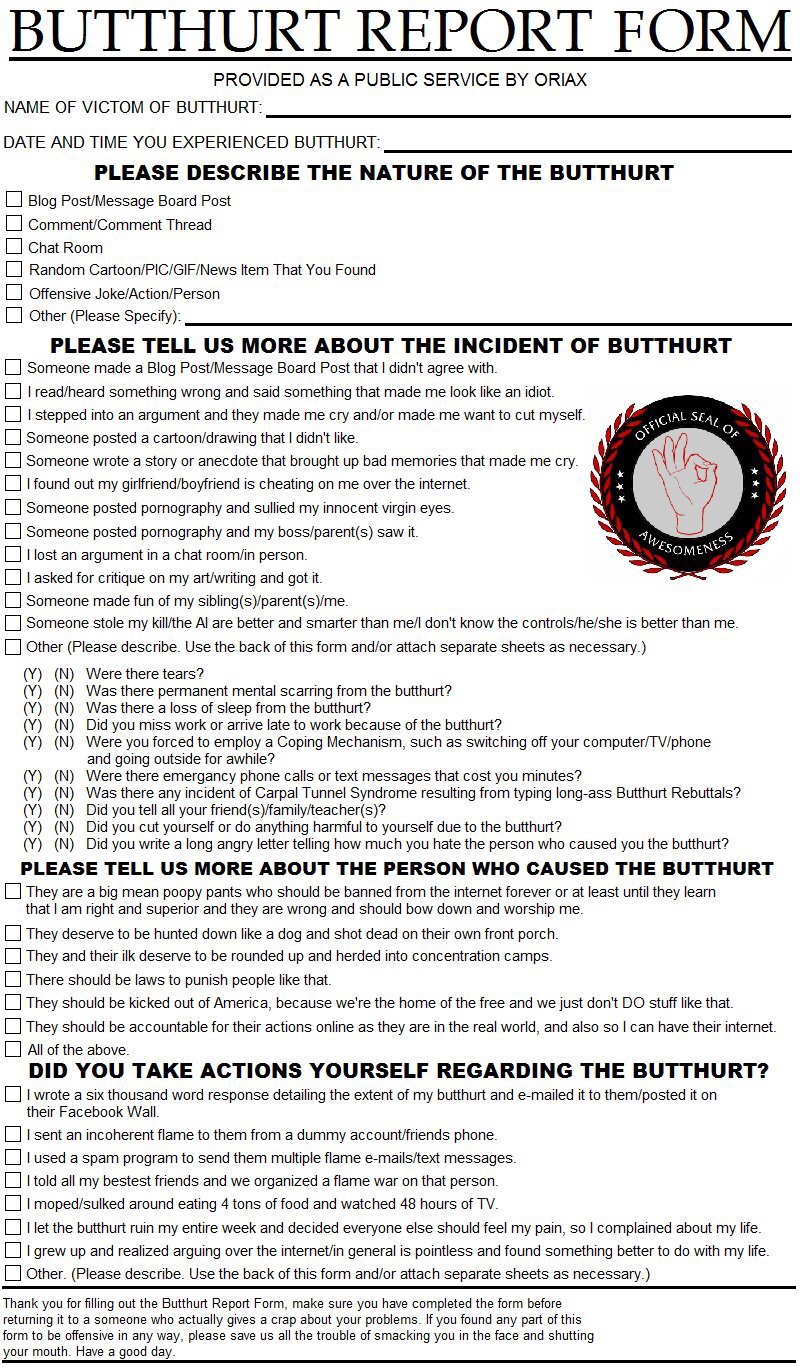
Should you find yourself sanctioned after running afoul of the CF comments policy as stated and feel you have been wronged, please download and complete the Butthurt Report form below in quadruplicate; retain one copy for your personal records and send the others to the email address posted in the right sidebar.

Please refrain from whining, sniveling, and/or bursting into tears and waving your chubby fists around in frustrated rage, lest you suffer an aneurysm or stroke unnecessarily. Your completed form will be reviewed and your complaint addressed whenever management feels like getting around to it. Thank you.

CF Glossary

ProPol: Professional Politician

Vichy GOPe: Putative "Republicans" who talk a great game but never can seem to find a hill they consider worth dying on; Quislings, Petains, Benedicts, backstabbers, fake phony frauds

Fake Phony Fraud(s), S'faccim: two excellent descriptors coined by the late great WABC host Bob Grant which are interchangeable, both meaning as they do pretty much the same thing

Mordor On The Potomac: Washington, DC

The Enemy: shitlibs, Progtards, Leftards, Swamp critters, et al ad nauseum

Burn, Loot, Murder: what the misleading acronym BLM really stands for

pAntiFa: an alternative spelling of "fascist scum"

"Mike Hendrix is, without a doubt, the greatest one-legged blogger in the world." ‐Henry Chinaski

Subscribe to CF!

Support options

Shameless begging

If you enjoy the site, please consider donating:

Correspondence

Email addy: mike-at-this-url dot etc

All e-mails assumed to be legitimate fodder for publication, scorn, ridicule, or other public mockery unless specified as private by the sender

Allied territory

Alternatives to shitlib social media: A few people worth following on Gab:

Fuck you

Kill one for mommy today! Click to embiggen

Notable Quotes

"America is at that awkward stage. It's too late to work within the system, but too early to shoot the bastards."
Claire Wolfe, 101 Things to Do 'Til the Revolution

Claire's Cabal—The Freedom Forums

FREEDOM!!!

"There are men in all ages who mean to govern well, but they mean to govern. They promise to be good masters, but they mean to be masters."
Daniel Webster

“When I was young I was depressed all the time. But suicide no longer seemed a possibility in my life. At my age there was very little left to kill.”
Charles Bukowski

“A slave is one who waits for someone to come and free him.”
Ezra Pound

“The illusion of freedom will continue as long as it’s profitable to continue the illusion. At the point where the illusion becomes too expensive to maintain, they will just take down the scenery, they will pull back the curtains, they will move the tables and chairs out of the way and you will see the brick wall at the back of the theater.”
Frank Zappa

“The right of a nation to kill a tyrant in case of necessity can no more be doubted than to hang a robber, or kill a flea.”
John Adams

"A society of sheep must in time beget a government of wolves."
Bertrand de Jouvenel

"It is terrible to contemplate how few politicians are hanged."
GK Chesterton

"I predict that the Bush administration will be seen by freedom-wishing Americans a generation or two hence as the hinge on the cell door locking up our freedom. When my children are my age, they will not be free in any recognizably traditional American meaning of the word. I’d tell them to emigrate, but there’s nowhere left to go. I am left with nauseating near-conviction that I am a member of the last generation in the history of the world that is minimally truly free."
Donald Sensing

"The only way to live free is to live unobserved."
Etienne de la Boiete

"History does not long entrust the care of freedom to the weak or the timid."
Dwight D. Eisenhower

"To put it simply, the Left is the stupid and the insane, led by the evil. You can’t persuade the stupid or the insane and you had damn well better fight the evil."
Skeptic

"There is no better way to stamp your power on people than through the dead hand of bureaucracy. You cannot reason with paperwork."
David Black, from Turn Left For Gibraltar

"If the laws of God and men, are therefore of no effect, when the magistracy is left at liberty to break them; and if the lusts of those who are too strong for the tribunals of justice, cannot be otherwise restrained than by sedition, tumults and war, those seditions, tumults and wars, are justified by the laws of God and man."
John Adams

"The limits of tyranny are prescribed by the endurance of those whom they oppress."
Frederick Douglass

"Give me the media and I will make of any nation a herd of swine."
Joseph Goebbels

“I hope we once again have reminded people that man is not free unless government is limited. There’s a clear cause and effect here that is as neat and predictable as a law of physics: As government expands, liberty contracts.”
Ronald Reagan

"Ain't no misunderstanding this war. They want to rule us and aim to do it. We aim not to allow it. All there is to it."
NC Reed, from Parno's Peril

"I just want a government that fits in the box it originally came in."
Bill Whittle

Best of the best

Finest hosting service

Image swiped from The Last Refuge

2016 Fabulous 50 Blog Awards

RSS feed

RSS - entries - Entries
RSS - entries - Comments

Boycott the New York Times -- Read the Real News at Larwyn's Linx

Copyright © 2026