Words mean things

Except, of course, when they don’t.

Political science professor Gay — who stepped down amid a tempest of allegations that she did not do enough to combat antisemitism and academic plagiarism Tuesday — will return to a position on the Cambridge, Mass., school’s faculty.

Bold mine, and indicative of some truly prime bullshit: 1) they are NOT “allegations,” and 2) it isn’t that she “didn’t do enough” to combat anything—she did plenty. Among other disgraceful things she is known for a fact to have done: she DID commit plagiarism, and she DID express her ((((JooJooJooJOOOOO!!!)))) hate clearly, unequivocally, even pridefully.

This, mind, while the selfsame dicks-with-ears puff out their sunken chests to indignantly declare the madman Trump ineligible to run for President because he’s a known “insurrectionist” and treasonous revolutionary—proving for all time that they really are incapable of shame, because otherwise they’d all be blushing so hard they’d stroke out and die of it.

The above rampant horsepuckey is but one of many abuses of the Mother Tongue we see perpetrated in the mass media every single day; in fact, I doubt it was even the most egregious example from that particular day. Fred Reed offers a primer for those who aspire to do better, a category which would not include any “mainstream” Jurassic Media “journalists.”

English, What’s Left of It, & Its Management
Recently I took part in a discussion of writing and how to do it on Counter-Currents. This being a topic of some importance to me, I decided to throw together a few thoughts in a form more coherent that I could do in a podcast. A danger in doing this is that readers will joyfully point out instances in which I have failed to follow my own suggestions. To these sins I confess in advance. Anyway:

This is not a golden age of writing. For one thing, few today have the grasp of English grammar that long ago we had learned by the fifth grade, or any idea why it might be important. Nor, I suspect, have many read much in the best authors in English, and so have not acquired an ingrained feel for what is good and what isn’t. I may be wrong. I hope so.

For another, good writing is elitist, and must be. Elitism means a preference for the better to the worse. In an intellectual climate resembling that of an urban bus station, in which the lower cultural orders seek to drag standards to the bottom, few will prefer good writing to bad, or know the difference.

Further, when people are in constant communication via telephones, garbling and semi-literacy are less important than they were when poor communication demanded clarity. In the following we will pretend that it is 1955 and that I am speaking to young people who want to write well.

To begin, my advice to the aspiring writer is to forget “creativity.” Writing is first a craft, involving rules and principles and things to which the student should learn to pay attention. Later, perhaps, writing is an art. You have to learn the notes before playing a concerto. Accepting this is important.

Also important, crucial I would say, is the habit of paying attention to language itself, not just its content. By this I mean the structure of sentences, choice of words, turn of phrase. If you read a piece and think it good, read it again and ask why it is good. If an analytical piece, is the analysis clear and compelling? The phrasing fresh and devoid of cliché? The vocabulary extensive and correct in use?

To again use a comparison to music, the listener doesn’t have to know music theory, but the musician does.

Lots, lots more good stuff to follow, including several rules I gleefully traduce on a habitual basis myself, just ’cause I think it’s funny. Even if you’re not a professional writer, you may find it interesting. NYPost link via JJ, Fred link via WRSA. Thanks, fellas!

Update! Also via JJ, Bill Ackerman digs deeper into the Gay brouhaha.

I first became concerned about @Harvard when 34 Harvard student organizations, early on the morning of October 8th before Israel had taken any military actions in Gaza, came out publicly in support of Hamas, a globally recognized terrorist organization, holding Israel ‘solely responsible’ for Hamas’ barbaric and heinous acts.

How could this be? I wondered.

When I saw President Gay’s initial statement about the massacre, it provided more context (!) for the student groups’ statement of support for terrorism. The protests began as pro-Palestine and then became anti-Israel. Shortly, thereafter, antisemitism exploded on campus as protesters who violated Harvard’s own codes of conduct were emboldened by the lack of enforcement of Harvard’s rules, and kept testing the limits on how aggressive, intimidating, and disruptive they could be to Jewish and Israeli students, and the student body at large. Sadly, antisemitism remains a simmering source of hate even at our best universities among a subset of students.

A few weeks later, I went up to campus to see things with my own eyes, and listen and learn from students and faculty. I met with 15 or so members of the faculty and a few hundred students in small and large settings, and a clearer picture began to emerge.

I ultimately concluded that antisemitism was not the core of the problem, it was simply a troubling warning sign – it was the “canary in the coal mine” – despite how destructive it was in impacting student life and learning on campus.  

I came to learn that the root cause of antisemitism at Harvard was an ideology that had been promulgated on campus, an oppressor/oppressed framework, that provided the intellectual bulwark behind the protests, helping to generate anti-Israel and anti-Jewish hate speech and harassment.

Then I did more research. The more I learned, the more concerned I became, and the more ignorant I realized I had been about DEI, a powerful movement that has not only pervaded Harvard, but the educational system at large. I came to understand that Diversity, Equity, and Inclusion was not what I had naively thought these words meant.

I have always believed that diversity is an important feature of a successful organization, but by diversity I mean diversity in its broadest form: diversity of viewpoints, politics, ethnicity, race, age, religion, experience, socioeconomic background, sexual identity, gender, one’s upbringing, and more. 

What I learned, however, was that DEI was not about diversity in its purest form, but rather DEI was a political advocacy movement on behalf of certain groups that are deemed oppressed under DEI’s own methodology.

OHHH yeah, you’ll want to read all of this one. It’s choice stuff, covering a heckuva lot of bases well beyond the Gay business, and I haven’t finished it yet myself.

1
2

Happy (?) New year!

I made a funny.

I saw something similar over the weekend somewhere or other, but when I went looking I couldn’t find it again, since I couldn’t remember where the heck I’d seen the danged thing. So I decided to hell with it and just struck out on my own—found the raw image, so’s it’s the same pitcher, same sentiment more or less, I just worded it differently and added the CF link, of course. Hopefully the maker of the original won’t waste his time trying to sue me over it; the phrase “blood from a rock” springs immediately to mind.

2
1

Haley gets one right

Even though the Hallelujah Chorus of VOTE HARDERER!!! Republicrats© is giving her hell for it, she ain’t wrong for once.

I’ve never run for office, but I can imagine that for a politician in the South — especially a conservative — questions about race relations and history sound like “gotcha” questions. That may have been what was on Nikki Haley’s mind at a town hall event in New Hampshire earlier this week when an attendee asked her a historical question.

A voter asked Haley, “What was the cause of the United States Civil War?” Granted, it’s an odd question, but Haley could have answered it quickly and moved on. Instead, she gave the strangest answer imaginable.

“Well, don’t come with an easy question,” she began with a quip. “I mean, I think the cause of the Civil War was basically how government was going to run, the freedoms, and what people could and couldn’t do.”

She then turned the tables on the man who asked the question and asked him what he thought caused the Civil War. That part of the exchange wasn’t audible on the video of the town hall, but it opened the door for Haley to dig her hole of bizarre answers a little deeper.

“I mean, I think it always comes down to the role of government and what the rights of the people are,” she continued. “And we — I will always stand by the fact that I think government was intended to secure the rights and freedoms of the people. It was never meant to be all things to all people.”

“Bizarre”…and perfectly correct, too. The “offense” Haley is being pilloried for, of course, is not making the obligatory genuflection towards the written-by-the-winners revisionist history which holds that the “cause” of Civil War I was blood-simple, that the North invaded and punitively subjugated the South over the “peculiar institution” of slavery.

Just one leeeetle problem with that belief: know who else didn’t think the War of Northern Aggression was all about slavery? Massa Abraham Lincoln, that’s who. Among other things, he said this:

My paramount object in this struggle is to save the Union, and is not either to save or to destroy slavery. If I could save the Union without freeing any slave I would do it, and if I could save it by freeing all the slaves I would do it; and if I could save it by freeing some and leaving others alone I would also do that. What I do about slavery, and the colored race, I do because I believe it helps to save the Union; and what I forbear, I forbear because I do not believe it would help to save the Union. I shall do less whenever I shall believe what I am doing hurts the cause, and I shall do more whenever I shall believe doing more will help the cause.

Note also that the “Great Emancipator,” with his fabled Proclamation in 1863, freed not a single slave in any state wherein he actually had the power to do so; the Emancipation Proclamation was a purely political document whose two-fold purpose was to maintain the shaky entente back home between the radical contingent of so-called “fire eater” abolitionists and the moderates, as well as to gain military advantage for the Yankee invader over the Southern foe.

The Emancipation Proclamation did not free all slaves in the U.S., contrary to a common misconception; it applied in the ten states that were still in rebellion on January 1, 1863, but it did not cover the nearly 500,000 slaves in the slaveholding border states (Missouri, Kentucky, Maryland, and Delaware) or in parts of Virginia and Louisiana that were no longer in rebellion. Those slaves were freed by later separate state and federal actions.

The state of Tennessee had already mostly returned to Union control, under a recognized Union government, so it was not named and was exempted. Virginia was named, but exemptions were specified for the 48 counties then in the process of forming the new state of West Virginia, and seven additional counties and two cities in the Union-controlled Tidewater region of Virginia. Also specifically exempted were New Orleans and 13 named parishes of Louisiana, which were mostly under federal control at the time of the Emancipation Proclamation. These exemptions left unemancipated an additional 300,000 slaves.

The Emancipation Proclamation has been ridiculed, notably by Richard Hofstadter, who wrote that it “had all the moral grandeur of a bill of lading” and “declared free all slaves…precisely where its effect could not reach”. Disagreeing with Hofstadter, William W. Freehling wrote that Lincoln’s asserting his power as Commander-in-Chief to issue the proclamation “reads not like an entrepreneur’s bill for past services but like a warrior’s brandishing of a new weapon”.

Lincoln first discussed the proclamation with his cabinet in July 1862. He drafted his “preliminary proclamation” and read it to Secretary of State William Seward, and Secretary of Navy Gideon Welles, on July 13. Seward and Welles were at first speechless, then Seward referred to possible anarchy throughout the South and resulting foreign intervention; Welles apparently said nothing. On July 22, Lincoln presented it to his entire cabinet as something he had determined to do and he asked their opinion on wording. Although Secretary of War Edwin Stanton supported it, Seward advised Lincoln to issue the proclamation after a major Union victory, or else it would appear as if the Union was giving “its last shriek of retreat”. Walter Stahr, however, writes, “There are contemporary sources, however, that suggest others were involved in the decision to delay”, and Stahr quotes them.

In September 1862, the Battle of Antietam gave Lincoln the victory he needed to issue the Preliminary Emancipation Proclamation. In the battle, though the Union suffered heavier losses than the Confederates and General McClellan allowed the escape of Robert E. Lee’s retreating troops, Union forces turned back a Confederate invasion of Maryland, eliminating more than a quarter of Lee’s army in the process.

On September 22, 1862, five days after Antietam, and while residing at the Soldier’s Home, Lincoln called his cabinet into session and issued the Preliminary Emancipation Proclamation. According to Civil War historian James M. McPherson, Lincoln told cabinet members, “I made a solemn vow before God, that if General Lee was driven back from Pennsylvania, I would crown the result by the declaration of freedom to the slaves.” Lincoln had first shown an early draft of the proclamation to Vice President Hannibal Hamlin, an ardent abolitionist, who was more often kept in the dark on presidential decisions. The final proclamation was issued on January 1, 1863. Although implicitly granted authority by Congress, Lincoln used his powers as Commander-in-Chief of the Army and Navy to issue the proclamation “as a necessary war measure.” Therefore, it was not the equivalent of a statute enacted by Congress or a constitutional amendment, because Lincoln or a subsequent president could revoke it. One week after issuing the final Proclamation, Lincoln wrote to Major General John McClernand: “After the commencement of hostilities I struggled nearly a year and a half to get along without touching the ‘institution’; and when finally I conditionally determined to touch it, I gave a hundred days fair notice of my purpose, to all the States and people, within which time they could have turned it wholly aside, by simply again becoming good citizens of the United States. They chose to disregard it, and I made the peremptory proclamation on what appeared to me to be a military necessity. And being made, it must stand”. Lincoln continued, however, that the states included in the proclamation could “adopt systems of apprenticeship for the colored people, conforming substantially to the most approved plans of gradual emancipation; and…they may be nearly as well off, in this respect, as if the present trouble had not occurred”. He concluded by asking McClernand not to “make this letter public”.

Initially, the Emancipation Proclamation effectively freed only a small percentage of the slaves, namely those who were behind Union lines in areas not exempted. Most slaves were still behind Confederate lines or in exempted Union-occupied areas. Secretary of State William H. Seward commented, “We show our sympathy with slavery by emancipating slaves where we cannot reach them and holding them in bondage where we can set them free.” Had any slave state ended its secession attempt before January 1, 1863, it could have kept slavery, at least temporarily.

And there you have it. Nota bene:

  • Quite a few Northerners still owned slaves for some years after the war was over
  • Northern general US Grant was as ambivalent about slavery as his boss Lincoln, at least initially:

    To his father he wrote, “My inclination is to whip the rebellion into submission, preserving all Constitutional rights. If it cannot be whipped any other way than through a war against slavery, let it come to that legitimately. If it is necessary that slavery should fall that the Republic may continue its existence, let slavery go.”

    More on all that here

  • Legend has it that Grant’s wife retained ownership of her personal valet for several years after the end of the war; when asked about this apparent contradiction, Grant is said to have dismissed his interlocuter with a laconic “Because good help is so hard to find nowadays”
  • At the end of the war, certain Northern states and/or cities barred Nee-grows from so much as setting foot within their boundaries, decrees often enforced via violence

And so it goes. As is usually the case, the first American Civil War is not reducible to simple, easily summed-up causes and effects; it just doesn’t work that way, however much we flawed hoomons might wish otherwise. History is rich and complex, with many strange twists and turns serving to make the topic all the more interesting for those of us who study it intently.

Loathe though I ordinarily am to sing the woman’s praises, sincerest kudos to Nikki Haley for truly getting the historical nuance here, and refusing to yield to pressure from the stupes and dupes who don’t to dumb it down for them.

2
1

The year that was

David Thompson offers a whole year’s worth of reasons intelligent, rational people despair of the very concept of “human” “progress” as nothing more than a laughable conceit.

The year began with a tale of oysters and college lesbianism, via Bon Appétit magazine, in which Brooklynite pronoun-stipulator Isha Maratha was keen to overshare. For Ms Maratha, “My first time eating an oyster was an act of queer intimacy.” Indeed, we were told by an obliging editor, “The act of eating an oyster uniquely and intimately expresses her queerness.” And so, we were regaled, at length, with descriptions of mollusc-gobbling, stolen glances, and lemon wedges being squeezed. “There is something uniquely unspoken,” we learned, “between the eater and the eaten.”

We also pondered mass fare-dodging, now at record levels, and its progressive defenders – including those employed to maintain public transport – and whose pre-emptive disapproval of anyone noticing such crimes was remarkable in its vehemence and uniformity. The effects on social trust of a large and growing minority disregarding the law and norms of behaviour, and doing so with a learned impunity, is apparently something one shouldn’t – and mustn’t – register or explore. Because, in the progressive world, noticing habitual and brazen thievery is much worse than indulging in it. And obviously racist.

And we visited the pages of Scientific American, where wokeness is ascendant and thinking simply isn’t done. In particular, an “important analysis” piece in which we were urged – by Tracie Canada, a “socio-cultural anthropologist” at Duke University – to fret about “the violence Black men experience in [American] football,” and in which we were told that the physicality of the sport “disproportionately affects black men.” This was framed to imply, but never establish, some systemic racial wrongdoing – “anti-Black practices” that are “inescapable” – rather than, say, being an unremarkable reflection of the sport’s demographics, in which, at professional levels, black players are a majority. Or to put it another, no less scientific, way – the risk of injury while playing a contact sport disproportionately affects those who actually play it. When this rather glaring logical error was pointed out by readers, the magazine’s editor-in-chief promptly accused said readers of “systemic racism.”

In February, we encountered a suboptimal substitute teacher named Lydia Lamere – formerly Christopher Lamere – who spent lesson time directing students to his overtly sexual TikTok account, and conscripting middle-school children into his cross-dressing psychodrama. When not discussing “kink” and preferred sexual positions with other people’s eleven-year-old children, Mr Lamere found time to tells us, “I’m not a predator, I’m just a woman who happens to be super tall and hot.”

Matters academic cropped up again via an eye-widening overview of racial “equity” policies in various schools and institutions, where expectations of competence are deemed racist and terribly problematic. In New York City, for instance, thanks to “disparate impact” policies, firefighters are no longer expected to be able to read the instructions on their own firefighting equipment. Likewise, in scrupulously progressive Ontario, it is now illegal to use a maths test to determine whether maths teachers actually possess the knowledge that they are being paid to convey in class. Such is the world of triumphant wokeness, in which “suspending proficiency requirements” – and denouncing diligence and competence as “white supremacy,” a wickedness to be shunned – will somehow “benefit” the children on whom these things are imposed.

We also marvelled at a contrived and unconvincing display of forgiveness by Guardian contributor Anna Spargo-Ryan, whose home was invaded in the night by a gang of sociopaths armed with carving knives. It turns out that when being robbed by habitual predators, the progressive thing to do is to sympathise with the creatures breaking into one’s home and driving off with one’s stuff in one’s own car. Ms Spargo-Ryan was hailed by her peers as a “beautiful person” for gushing with pretentious sympathy for her assailants and for wishing to see the burglars spared the normal corrective consequences, presumably so that they might go on to burgle the homes of others, including her neighbours. Which of course they were busy doing. Though it occurs to me that a person breaking into someone’s home in the middle of the night and stealing their possessions is sending a pretty strong signal about how much concern, or how little, the rest of us should have for that person’s wellbeing.

The Pronoun Game, so very much in fashion, cropped up in March, along with a demand that employers accommodate the made-up identities of insufferable narcissists. Even when those made-up identities can change several times a day, with such changes being signalled via colour-coded pronoun bracelets, pronoun earrings, and other pronoun-stipulating accessories. Accessories that all colleagues would be expected to monitor closely, lest “misgendering” ensue, followed by a visit to Human Resources. A scenario that inspired the question of exactly how much farce in the workplace might be considered excessive.

Thanks to Oxford University’s Department of Biology, we beheld some ostentatious fretting about the “numerous negative consequences” of obscure Latin names that almost no-one knows about. According to Assistant Professor of Conservation Science Ricardo Rocha, some “1,565 species of bird, reptiles, amphibians and mammals” are named after “white, male Europeans from the 19th and 20th centuries,” which is apparently a very bad thing. What with all that whiteness and maleness, you see. This legacy of legwork and exploration is, we’re to believe, oppressing the people of Zimbabwe and Botswana, for whom the Latin textbook names of lizards and beetles are foremost in their minds. We were also assured that would-be botanists and biologists are in some way being psychologically injured by the existence of this Latin taxonomy, and by the fact that much of the “flora of New Caledonia” is “named after a man.”

Read on for the rest of it, there’s lots more yet to come, alas.

Sour reviews

These are just hilarious.

The Worst National Park Reviews of the Year
There was nothing to do, I didn’t see a bear, and that snake harassed me

Visitors come from across the globe to set foot in our national parks. But some people are simply unimpressed.

The internet gives these people a place to air their grievances. Some now-classic bad national park reviews have made their way further, into illustrations, T-shirts, and needlepoints. “There are bugs, and they will bite you on your face,” they say. Or, “Trees block view and there are too many gray rocks.” “The water is ice-cold,” someone griped about Acadia National Park in Maine, making it onto a poster made by Subpar Parks, which documents bad reviews.

The complaints keep coming. I searched Yelp, TripAdvisor, and Google for the best and worst reviews of our national parks in 2023. To be fair, most of the complaints were about excessive crowds, traffic jams, and new reservation systems. But some visitors had, uh, more nuanced grudges regarding lackluster scenery or were shocked by the lack of amenities. Here are my favorites.

1. Yosemite National Park, California
In California’s Sierra Nevada, Yosemite offers giant granite monoliths, waterfalls, and Sequoia trees up to 3,000 years old. But not everyone sees the beauty.

“Really annoying that it is the same way in and same way out. Scenery is not breathtaking.” —TripAdvisor

“I need someone to explain to me the hype of this place. This place looks like any place with mountains and trees. Too many people, not enough stores, not enough places to buy food.” —Yelp

2. Hawaii Volcanoes National Park
On Hawaii’s Big Island, this park stretches from sea level to 13,680 feet, boasting two of the world’s most active volcanoes. It is not known for its racquet sports, though.

“Absolutely horrible disappointment. There wasn’t a single pickleball court in sight. You’d think with it’s [sic] extreme length of 2.93 mi (4.72 km), an extreme width of 1.95 mi (3.14 km), a circumference of 7.85 mi (12.63 km) and an area of 4.14 sq mi (10.7 km2) they’d find some space for one.”—Yelp

3. Great Smoky Mountains National Park, North Carolina and Tennessee
Straddling two states, GSMNP is 500,000 acres of towering mountains, remote streams, and the most biodiverse wilderness in America. That doesn’t keep the young ’uns from doing their thing.

“Some falls/streams had nothing but toddlers peeing & pooing in the water.”—TripAdvisor

“Can’t say this is one of my fave national parks. No bear sightings but that’s not the park’s fault. … [T]he haziness of it gave me huge headaches.” –TripAdvisor

The Great Smoky Mountains, hazy? Wow. Read on for the rest of the side-splitting list. Can vacationing Americans really be this thoroughly spoiled, clueless, and out of touch? Apparently so, alas. Wonder no more where the well-known European epithet dismissing Yank tourists as “Ugly Americans” might have come from.

1

SHOCKER: “experts” wrong again!

Is ANYBODY still fool enough to listen to these idiots?

Are Low-Fat Dairy Products Really Healthier?
For decades, experts have said that less is more when it comes to dairy fat and health. But recent research has called this into question.

Scan the dairy case of any grocery store, and you’ll find rows upon rows of products with varying levels of fat. Nonfat, low-fat, whole: What’s the healthiest option?

If you consult the U.S. dietary guidelines or health authorities like the American Heart Association or the World Health Organization, the answer is clear: Choose a fat-free or low-fat version.

This recommendation stems from the idea that full-fat dairy products are high in saturated fats, so choosing lower-fat versions can reduce your risk of heart disease, said Dr. Dariush Mozaffarian, a cardiologist and professor of medicine at Tufts University.

But that guidance goes back to 1980, when the first edition of the Dietary Guidelines for Americans was published, he said. And since then, most studies on the health effects of dairy fat have failed to find any benefits of prioritizing low-fat versions over whole, Dr. Mozaffarian said.

What seems to be more important than the level of fat, he added, is which dairy product you choose in the first place.

In studies that have surveyed people about their diets and then tracked their health over many years, researchers have found associations between dairy consumption and lower risks of certain conditions, such as high blood pressure, cardiovascular disease and Type 2 diabetes, Dr. Mozaffarian said.

Such benefits, he added, were often present regardless of whether people chose reduced-fat or full-fat yogurt, cheese or milk. And though full-fat dairy products are higher in calories, studies have found that those who consume them aren’t more likely to gain weight.

In one study published in 2018, for example, researchers followed 136,000 adults from 21 countries for nine years. They found that, during the study period, those who consumed two or more servings of dairy per day were 22 percent less likely to develop cardiovascular disease and 17 percent less likely to die than those who consumed no dairy at all. Notably, those who consumed higher levels of saturated fat from dairy were not more likely to develop heart disease or die.

In another large analysis, also published in 2018, researchers pooled the results from 16 studies involving more than 63,000 adults. They found that, across an average of nine years, those who had higher levels of dairy fats in their blood were 29 percent less likely than those with lower levels to develop Type 2 diabetes.

This finding suggests that there may be a benefit to consuming dairy fat rather than avoiding it, Dr. Mozaffarian said.

Gee, imagine my surprise. Here’s my own “dietary recommendation,” for whatever it’s worth: Eat whatever the fuck you like, without being a glutton about it. Keep the sugar and junk food to a minimum. That is all, over and out, period fucking DOT. Right straight to hell with the “experts” and their usual doomsay—because in another decade or two, they’re all going to turn on a dime, reverse course, and denounce the current advice completely. Just as they always do, and always have done.

Low-fat, no-fat? No way, not this boy, not ever. Right straight to hell, also, with lab-created chemical abominations like margarine instead of butter; foul-tasting artificial sweeteners; thin, watery cow-juice instead of the full-flavor original; veggie “burgers” and Notdogs instead of the genuine article. Eat that gunk if you want to, you’ll never need to worry about tripping over me to get at it.

(Via Insty)

1
2
1

Walk gently on Mother Earth

CHRIST, what a muttonhead.

Should I Stop Flying? It’s a Difficult Decision to Make.

Yes. Yes, you absolutely should, immediately. Every minute you dither makes Mother Gaia cry, you know.

Four years ago, during a Zoom work meeting, a colleague who lives in London told me she’d decided to quit flying on airplanes. She simply couldn’t stomach the cost to the climate. Due to her decision, she said calmly, she would probably never visit the U.S. again. My heart skipped a beat.

Her choice seemed so extreme. She shared it with me casually in the context of conversation, without a trace of judgment or moralizing. Still, I felt shocked and inexplicably a little defensive—but also intrigued. At the time, I traveled by air as often as ten times a year for my work as a journalist and to see family members strewn about the country. I couldn’t imagine my life without flying.

But my colleague’s comment lodged in my mind as a beautiful and challenging seed. Over the next few years, it cracked through the concrete of what had been, until then, a completely unexamined belief in my inviolable entitlement to flying. When the pandemic arrived, grounding travelers and shrinking international air travel by 60 percent in 2020, I began to see that significantly reducing air travel—or even giving it up altogether—was absolutely possible.

Rare individuals have chosen not to fly for ethical reasons for decades, but in the years leading up to the pandemic, the smattering of outliers coalesced into a movement. It took root most quickly and deeply in Sweden, which in 2017 became the first country in the world to establish a legally binding carbon-neutrality target—a year before Greta Thunberg began protesting in front of its parliament. In Swedish, the movement became known as flygskam, which translates to “flight shame,” a term commonly attributed to Swedish singer Staffan Lingberg, who gave up flying in 2017.

The number of people pledging to stop flying grew so much that Swedish air travel declined 5 percent between 2018 and 2019, and the movement strengthened in other parts of Europe as well. In the U.S., the flight-free movement, in the form of groups like Flight Free USA and No Fly Climate Sci, has been slower to spread but is growing. This year, Flight Free USA, for example, is on track to see the largest number of pledges to stop or minimize flying at 436. By comparison, tens of thousands have pledged in Europe over the past four years.

Well, an admiring pat on the head for all those Neo-Luddite lackwits, then. But y’all should by no means stop there. Ditch your cars, your houses, your modern appliances, any clothing you didn’t sew with your own two pwecious widdle hands. Throw out your computer, your tablet, and your sail foam, all of which are made of plastic derived from *gasp!!!* fossil fuels. No more mass transit, either, most of which consists of either gas or diesel-engined buses or electric trains and/or subways which rely on a mostly coal-burning power grid.

Squatting in your dark, freezing-cold cave to cook over an open fire? Perish FORBID! When I think of the miasma of planet-killing pollutants spewed into our fragile atmosphere by such unnecessary indulgences, I can but weep. Small-scale agriculture? Non: cow farts, plus plants have feewings too, you know. Composting? Nein: that is just soooo 2010; you should be scooping, bagging, and eating your own poo like more enlightened pyrsynz are doing. Travel/commuting by horseback? Nyet, nyet, NYET: animal cruelty, you heartless, soulless monster, amongst a whole slew of other objections.

Criminy, but these navel-gazing, sanctimonious handwringers really make my hair hurt sometimes.

2
5
2

Citadel of shite

Clogged to overflowing with the very worst sort of bipedal turds.

As you may recall, on January 6th 2021, I was on air with Tucker as the alleged “storming of the Capitol” was drawing to a close. It was not yet over, but the media had already agreed the Official Narrative – that it was a shameful violation of the most hallowed precincts of “the Citadel of Democracy”. I got sick of that shtick almost instantly:

Mark Steyn rips media’s ‘citadel of democracy’ framing of Capitol: ‘It’s a citadel of crap’

Ah, but I was wrong. It turns out it’s a Citadel of Shags. Headline from The Daily Caller:

EXCLUSIVE: Senate Staffer Caught Filming Gay Sex Tape In Senate Hearing Room

Er, don’t hit the link unless you enjoy that sort of thing. If you think “Filming Gay Sex Tape” is just the usual teasing click-bait for a bit of lame-o soft-focus light-petting, not at all. It’s definitely Not Safe For Work, although evidently it’s safe for government work, as the Senate staffer in question had no qualms about uploading it to the Internet. The setting is the table of the Hearing Room of the Senate Judiciary Committee. That would be the room where Brett Kavanaugh was grilled, and FBI straight-shooter James Comey testified at length and with an impressively straight face about the “Russia investigation”. I have also testified at the US Senate, but can’t remember if it was that room or another. Still, if I’m ever asked back, I’ll remember to bring a couple of moist towelettes to wipe down the furniture.

So, if I understand the social norms of the People’s House, it’s completely unacceptable (and, indeed, a crime) to wander its precincts goofily with a MAGA hat and an American flag; but, if you stop for ten minutes to have anal sex before the Supreme Court nominee hearing re-convenes, that’s perfectly fine – so fine it might be worth entering it in mitigation and getting a couple of years knocked off your sentence. You will get a serious prison term if you put your feet on Nancy Pelosi’s desk, but not if you climb on, get down on hands and knees, and um…

Useful to know.

The staffer in question, an aide to Maryland Democrat Ben Cardin, one Aidan Maese-Czeropski, responded indignantly on LinkedIn:

This has been a difficult time for me, as I have been attacked for who I love…

In fairness, he was mostly attacked not “for who I love” but for where he loves him. Nevertheless, I assumed that this defence would prove effective – and that no Washington bigshot would dare to pink-slip a gay guy for getting caught being gay. Besides, in the broader sense, in a decadent pseudo-republic with no equality before the law, it seems entirely natural that some citizens rot in gaol merely for passing half-an-hour ambling aimlessly around the People’s House—and other, more favoured citizens can with impunity roger like billy-ho on the very People’s Table that determines the composition of the highest court in the land. The symbolism is too perfect.

Ain’t it, though. Ain’t it just. It’s Steyn, so you know what you must do, Glasshoppa.

Hitting the wrong target

Spurred on by this comment, I’m finally getting around to clearing out another one of those long-open tabs.

How Right-Wing Characters Become Sitcom Sensations

In spite of all the worst intentions of Hollywood shitlib producers and/or writers like Norman Lear, who thought he had himself a horse of a very different color in his overbroadly-drawn, intentionally-insulting caricature of what clueless pricks like him think your average Joe Lunchbucket is really like, that’s how.

Y’know, kinda like when a hoplophobic Leftard who’s never knowingly been in the same room with a firearm starts in regurgitating the nonsense they’ve gulped down about projectile weapons to some gun-savvy 2A individual, thereby unwittingly making a complete fool of Zhim/Xhrr/Theyselves without ever even realizing it.

If you’ve ever seen the television show Friends, you know that it’s about six young people in Manhattan, navigating romance, career, and friendships. Or is it? Maybe it’s actually about a homeless psychotic woman—the character of Phoebe, played by Lisa Kudrow—who peers into the window of the hip coffee joint and imagines the lives and adventures of the personalities she spies on, with herself as a beloved member of the group of friends. It’s all in her mind, all 10 seasons, and the theory is given a little bit of ballast by the series finale, in which the other characters move out of Manhattan and leave Phoebe alone, like the unmedicated schizophrenic she is.

According to this particular fan theory, anyway. Probably not what the creators and executive producers of the show had in mind, but if you think about it long enough, it starts to seem possible—maybe even preferable to the original.

Google the words “alternate interpretation of” or “fan theory for” and then insert the title of a popular movie or television show, and you’ll get a cascade of hilarious and often very dark results. It seems that people who love a show also love rethinking it from an entirely unexpected point of view.

If your show is indelible enough to inspire lunatic speculations from superfans, that’s what we in show business call “a high-class problem.” One of the ways you know you have a hit show on your hands is that your viewers quickly take ownership of the series. The characters become their characters, and whatever point the creators were trying to make, whatever message they were trying to send, utterly evaporates in the face of that kind of devoted fandom.

If you’re really lucky, this happens while your show is still on the air.

I noticed the same odd phenomenon in my own show-biz career: a fan would painstakingly explain to me after the show all about how the lyrics of a song he or she absolutely loved meant this, or that, or the other thing…and the interpretation would be at wide variance every time with what my actual intention was when I wrote the damned thing.

Eventually, I learned to just accept it and nod, shake the person’s hand, and mumble “Thagsverrmudge” in my best Fat Elvis voice, then move on to the next in line. Whatever a song was supposed to have been in the beginning, once it’s been released into the wild and audiences get hold of it the song is no longer exclusively your intellectual property—it’s now shared between you as the songwriter, the band you perform the song onstage with, and the audience, all of whom are assuredly going to exercise their right to make of your creation what they will.

I wasn’t at all bothered by this puzzling development myself, just considered it one of those strange, bemusing knuckleballs life tends to throw at you as a working artist in The Biz. You just gotta roll with it; who knows, the audience could well be righter about it than you know. But in the case of shitlibs like Lear, it can come back to bite ‘em on the ass in ways they never imagined it might.

In the early 1970’s, All in the Family captured the tumultuous controversies of its time. The show’s main character, Archie Bunker, was a reactionary bigot always mixing it up with his progressive, liberal son-in-law, Meathead. The show was designed by the producer Norman Lear to be a form of left-wing agitprop that would expound on the virtues of the younger, modern, and open-minded generation while exposing and mocking the petty small-minded prejudices of Archie. He would rail weekly against the changing American culture using scandalously edgy language that today is utterly unthinkable. Archie Bunker was supposed to be the butt of the joke, the dinosaur heading to extinction, a symbol of everything that was wrong with America in 1970.

The fans, though, refused to see it that way.

Archie Bunker caught fire with audiences. He became a national sensation, his catchphrases on T-shirts and lunch boxes and used in Johnny Carson monologues. The progressive writers and creators of the show may have thought Archie was the bad guy, but the audience saw a hard-working veteran who paid the bills and put food on the table—Archie held down two jobs!—all the while being forced to listen to his ultra-lefty layabout jobless graduate-student son-in-law tell him what a terrible person he was, often with his mouth full of a pork chop Archie had paid for. If Archie occasionally refers to Jews, African Americans, and homosexuals with hateful slurs, well, hey, the guy pays the mortgage. He’s earned the right to rant a little.

It helped that Archie was, by far, the most hilarious character on television at the time. Comedy writers, even really really liberal ones, naturally want to write for the character who brings the most heat to the screen. The more talented the writer, in fact, the more likely it is that he will sell out his principles for a really solid laugh. Still, it must have rankled Lear and his team to see Archie embraced by the audience, to realize that the character wasn’t theirs anymore—that the fans preferred their own version.

Had Google existed back then, and had you Googled “insane theory about All in the Family,” you’d probably be directed to something like this: “All in the Family is a show about a guy who dreams of being an empty-nester with his devoted wife but who instead is forced to support his married daughter and her lazy, super-woke husband. To get them to move into a place of their own, he does everything he can to drive them away, including loudly emitting a fusillade of reactionary notions. But the kids, especially his worthless son-in-law, are too lazy to move.”

Hollywood liberals keep making the same mistake. They try to create a right-wing villain and end up writing an audience favorite.

And you just know it’s gotta burn their asses up but GOOD. Sure hope so, at any rate.

4
1

The MemememeMEEEE Generation

Anything about this stand glaringly out to anybody?

38-year-old woman decides she wants a baby, claims she’s been ‘betrayed by feminism’
A woman said she felt “betrayed by feminism” after deciding she wanted to settle down, have a family and a husband as she approached 39th birthday. At one point during the interview with Fox News Digital, she broke down crying describing how she feared she would end up alone and childless.

Melissa Persling recently wrote an essay for Business Insider titled, “I’m 38 and single, and I recently realized I want a child. I’m terrified I’ve missed my opportunity.” She said after it went viral in November, hate began to pour in from men telling her that she’s lived a selfish life. Persling has a much different account of her story.

When Persling was 22, she married a traditional man and moved to a rural community in Coeur d’Alene, Idaho, where she grew up.

“He wanted a simple life with children and home-cooked meals,” she said. However, Persling – despite coming from a religious Christian background – made it clear to her husband-to-be that she did not want children.

“At that time I felt very strongly I did not want children, that I wasn’t going to be like the traditional housewife. I knew I did want to pursue a career,” she told Fox News Digital in an interview. “And I felt very strongly that that would never change. And I guess I was wrong.”

Persling said both her and her ex thought that love could conquer everything, but after 10 years, it was clear their differences in life goals were irreconcilable. Persling said she became resentful when he would ask for dinner or for his laundry to be done.

“I did little to hide my disdain for our small-town life. He was a good and hardworking man, but I don’t think I made him feel that way,” she said.

The bleary, teary tale of choice and consequence goes on from there. The point about being “betrayed by feminism” is fair enough, I suppose; as Sarah Hoyt quips, that’s what feminism was intended to do.  In the end, though, if you count up the number of times this pluperfect narcissist says “I feel,” “I think,” “I believe,” “I want,” “I need,” etc, you’ll probably end up thankful she doesn’t have kids. Because really, what kind of upbringing is that child going to have, and what will this woman’s influence over him/her/it end up creating?

2
1

Short stop

A few thoughts from Diogenes Sarcastica.

I fully intend to haunt people after I die. I have a list.

Somewhere in the world there is a tree that sprouted the very montent you were born and has grown along with you all this time. And I think that is wonderful!

When my mother was pregnant with my little bro and we were on the side of the road struggling with a flat tire, a car with three men stopped, not to help but to ask directions to a local golf course. Mom sent them 15 mile in the wrong direction. She is the Legend that shaped me.

There are 13 minerals that are essential for human life, and all of them can be found in Wine. Coincidence? I Think Not!

I do feel bad about the confrontation tonight and the lady at Costcos with her son on a leash. Lady I’m sorry I asked if he was a rescue. The profanity wasn’t really necessary, but thank you for not siccing him on me.

Plenty more rich, buttery goodness where that came from, folks.

3
1
1

What if they gave a war and nobody showed up?

If you lie to them repeatedly, they won’t come.

The foreign policy elite has sacrificed so many lives for so little justification. More than 7,000 service members and nearly 8,000 contractors died in combat after 9/11. An incredible 30,000 have committed suicide over the same period. Officially, some 52,000 were wounded in combat, many grievously. However, Brown University’s Watson Institute for International and Public Affairs reports that the real number “is exponentially larger,” given other injuries in theater and conditions diagnosed after returning home. Finally, hundreds of thousands of foreign civilians died in the misguided conflicts, innocent casualties of U.S. hubris and folly. 

It is one thing to risk your life and health for America. But to instead die in such foolish wars? And to have your sacrifice so shamefully wasted? Patriots should preserve their lives for something better.

So far, the military has no answer to the dearth in recruits. The services are simply muddling along, considering small fixes to significant shortfalls. Adding recruiters and hiking pay are obvious steps. Reaching younger Americans and adjusting military routine to modern youth culture are others. Decreasing disqualifications and increasing physical fitness would increase the recruit pool. Retaining more existing personnel would reduce the need for new recruits. So would hiring laterally for specialty roles and introducing robots. Such efforts should help at the margin. Even so, however, they are unlikely to fill personnel gaps in the thousands. 

The most important problem is that nothing has changed with U.S. foreign policy. Indeed, today’s potential wars are becoming more deadly. “We have strike groups, aircraft carriers with a Marine Expeditionary Unit outside Israel now,” observed Justin Henderson, a Marine Corps recruiter. He added, “We’re funding two wars, but we’re actually boots on the ground, drones above Gaza. So we’re already involved in there—and we’re not sure what’s happening in Taiwan. So this is a very tumultuous time for us, because we don’t know what’s going to happen.”

No, we don’t. Yet nothing good is likely to come from being involved in so many of the world’s incendiary confrontations and conflicts. Washington continues to ask young Americans to risk their lives here, there, and everywhere for no good reason.

Uncle Sam’s determination to be forever entangled in foreign wars is a very good reason not to join the armed services. The best way to solve the recruitment problem is to end frivolous interventions on behalf of peripheral interests. The armed services’ essential task is defending Americans—not sanctimonious Euroweenies, kleptocratic Saudi royals, well-heeled South Koreans, indifferent Taiwanese, and endless others. 

If the infamous Blob, as the foreign policy establishment has been called, refuses to abandon its determination to dominate the globe, it almost certainly will have to impose conscription. However, a return to the hated practice would foster resistance, intensify partisan polarization, and spur social conflict. Moreover, coercing service would reduce the quality of the U.S. military, hiking indiscipline, reducing retention, and draining morale. Doing so might put more people in uniform, but far fewer would want to be there and prepared to give their all in combat, especially in the frivolous interventions of late. 

The Washington War Party continues to spend wildly to dominate the globe, threat of national insolvency be damned. However, the challenge of finding young men and women willing to act as sentinels for a conflict-filled global empire is proving more daunting. If Americans increasingly refuse to serve, the Pentagon will have to do more than the policy equivalent of adjusting the deck chairs of the Titanic. Republicans and Democrats alike might have to again put America’s defense first.

Yet another lesson of history our damned-fool political “leaders” refuse to learn: as a nation staggers, weakens, and eventually collapses, its military does also. It’s a truism that has held up unfailingly throughout the history of human civilization; in fact, it’s how third-rate powers are made. For more information, please see Once-Great Britain, Moslem-conquered France and Germany, and the other sick men of (Western) Europe.

If you’re currently serving in the armed forces: get out, any way you can, by hook or by crook. If you’re thinking seriously of enlisting or signing on for another hitch: don’t, just…DON’T. Amerika v2.0 is in no way worth your blood, sweat, toil, and sacrifice, much less your very life. The civilian “leadership” despises its own soldiers; the majority of our pig-ignorant population loathes the soldiery in general as violent, thuggish knuckledraggers, the warrior spirit which animates and inspires any soldier worth his salt as the outdated creed of bloody-minded losers—the combination of which two represents a threat to all they consider good and decent.

The title of the article asks, “Why join the military?” The way things currently stand, I can’t think of one good reason any sane, sensible person would.

7
1

Bonus meme day!

Just A) for the sheer hell of it; B) to clear out some of the tremendous backlog of the things I keep downloading from various sources, which has become a near-obsession with me; C) because I can; D) they’re quite popular; E) hey, it’s CHRISTMAAAS!

The usual above-the fold/below-the-fold rule will apply, only there’s four ATF this time out, since this post has sixteen memes rather than the normal ten. Don’t hate me ‘cause I’m beautiful, y’all.

Continue reading “Bonus meme day!”

4
5

On laying hose

So you think you want to be a fireman, eh kid?

The hose that runs from the fire hydrant to the fire truck is called supply line. Most supply line is 3 inches or more in diameter, and in Central Florida, it’s usually 5 inches. (Orlando uses 4 inch, but that is because they typically have fire hydrants that are close together).

First, a bit of engineering.

The reason for this is hydrodynamics and friction loss. The average water main pressure is about 65 psi. At 1,000 gallons per minute, a 3 inch hose loses 80 pounds of pressure every 100 feet of hose length due to friction between the moving water and the hose itself, while a 4 inch diameter hose loses 20 pounds of pressure, and a 5 inch hose loses only 8 pounds. That means, if you want longer hose lays with high flow, the larger the diameter of your supply line, the better.

There is a lot of math involved in being the driver of a fire engine. You need to be able to calculate your friction losses in your head, rapidly, and remember that the lives of the guys in the burning building depend on you getting it correct. When you are flowing 2,000 gallons per minute through half a dozen different hose lines at 2 in the morning at a burning strip mall isn’t the time to realize that you are math deficient.

5 inch supply line has what is called a “sexless coupling” meaning that there is no male or female end, the couplings are interchangeable (butbutbut WHAT ABOUT THE OTHER 872+ GENDERS?!?—M). This allows you to start laying from either the fire to the hydrant, called a reverse lay, or from the hydrant to the fire, called a forward lay. There are advantages and disadvantages to both, but we won’t talk about that in this post.

My fire truck carried 1200 feet of 5 inch diameter supply line. That means with standard hydrant pressure, I could get a bit more than 800 gallons per minute into my engine without having to put another fire engine at the hydrant to boost pressure.

A whole bunch more fascinating stuff regarding what-all you need to know but almost certainly don’t when it comes to how fires are fought nowadays is included in this must-read post from Divemedic. Even if you never cared anything about being a fireman when you grew up—I didn’t, I admit, nor about being a cowboy, although being an astronaut did sound pretty cool—this stuff is just too good to miss out on reading, and you shouldn’t. There’s a video too, just for additional incentive to go check it out.

Back when I was working at the H-D shop, my boss Goose wanted desperately to be a fireman, but after failing the dummy-drag test three times he finally had to give it up as a lost cause. Goose practiced and strength-trained for months and months—and being a former USMC F4 mechanic, you know he wasn’t lacking in either intelligence or iron-willed determination—but in the end he’s a small, slight fella and those damned dummies are damned heavy. In fact, I think the dummy actually outweighed him by about twenty-thirty pounds.

At any rate, from hearing Goose talk about it, I probably know more than the average bear about what it takes to be a fireman, but even so DM still covers things I never heard about before.

Denominational cues ‘n’ clues

The handiest, most concise guide for the Christianity-curious you’ll ever find.

It can be so confusing, trying to figure out which of the 437 Christian denominations you want to join. In fact, scientists believe there are almost as many denominations as there are genders. That’s a lot of different ways to do church!

Luckily, we’re here to help you sort through them all. Here are the pros and cons of each of the major Christian denominations:

Baptist

Pro: Potlucks

Con: Diabetes

Presbyterian

Pro: Majestic old hymns that cause your soul to rejoice in God’s glory

Con: You are not allowed to move a single muscle while rejoicing in God’s glory

Joel Osteen’s Lakewood Church

Pro: Positive, uplifting messages

Con: Hell

Eastern Orthodox

Pro: Full, robust beards

Con: The women have them too

Charismatic

Pro: Hit your step goal 20 minutes into service

Con: Non-zero chance of getting knocked over by the pastor and/or bitten by a snake

Anglican

Pro: Can have a beer & cigar with your priest

Con: Decent chance your priest is a drag queen

United Methodist Church

Pro: Cool logo on church building

Con: Rainbow flag on church building

Unitarian

Pro: You can do whatever you want and there’s no God or hell

Con: Oh no! They’re wrong and now you’re in hell

Despite my best efforts, I have been unable to confirm whether the outlet from whence this excerpt was gleaned is a satire site or not, so you’ll just have to judge for yourselves.

4
1

CF Archives

Categories

Comments policy

NOTE: In order to comment, you must be registered and approved as a CF user. Since so many user-registrations are attempted by spam-bots for their own nefarious purposes, YOUR REGISTRATION MAY BE ERRONEOUSLY DENIED.

If you are in fact a legit hooman bean desirous of registering yourself a CF user name so as to be able to comment only to find yourself caught up as collateral damage in one of my irregularly (un)scheduled sweeps for hinky registration attempts, please shoot me a kite at the email addy over in the right sidebar and let me know so’s I can get ya fixed up manually.

ALSO NOTE: You MUST use a valid, legit email address in order to successfully register, the new anti-spam software I installed last night requires it. My thanks to Barry for all his help sorting this mess out last night.

Comments appear entirely at the whim of the guy who pays the bills for this site and may be deleted, ridiculed, maliciously edited for purposes of mockery, or otherwise pissed over as he in his capricious fancy sees fit. The CF comments section is pretty free-form and rough and tumble; tolerance level for rowdiness and misbehavior is fairly high here, but is NOT without limit.

Management is under no obligation whatever to allow the comments section to be taken over and ruined by trolls, Leftists, and/or other oxygen thieves, and will take any measures deemed necessary to prevent such. Conduct yourself with the merest modicum of decorum, courtesy, and respect and you'll be fine. Pick pointless squabbles with other commenters, fling provocative personal insults, issue threats, or annoy the host (me) and...you won't.

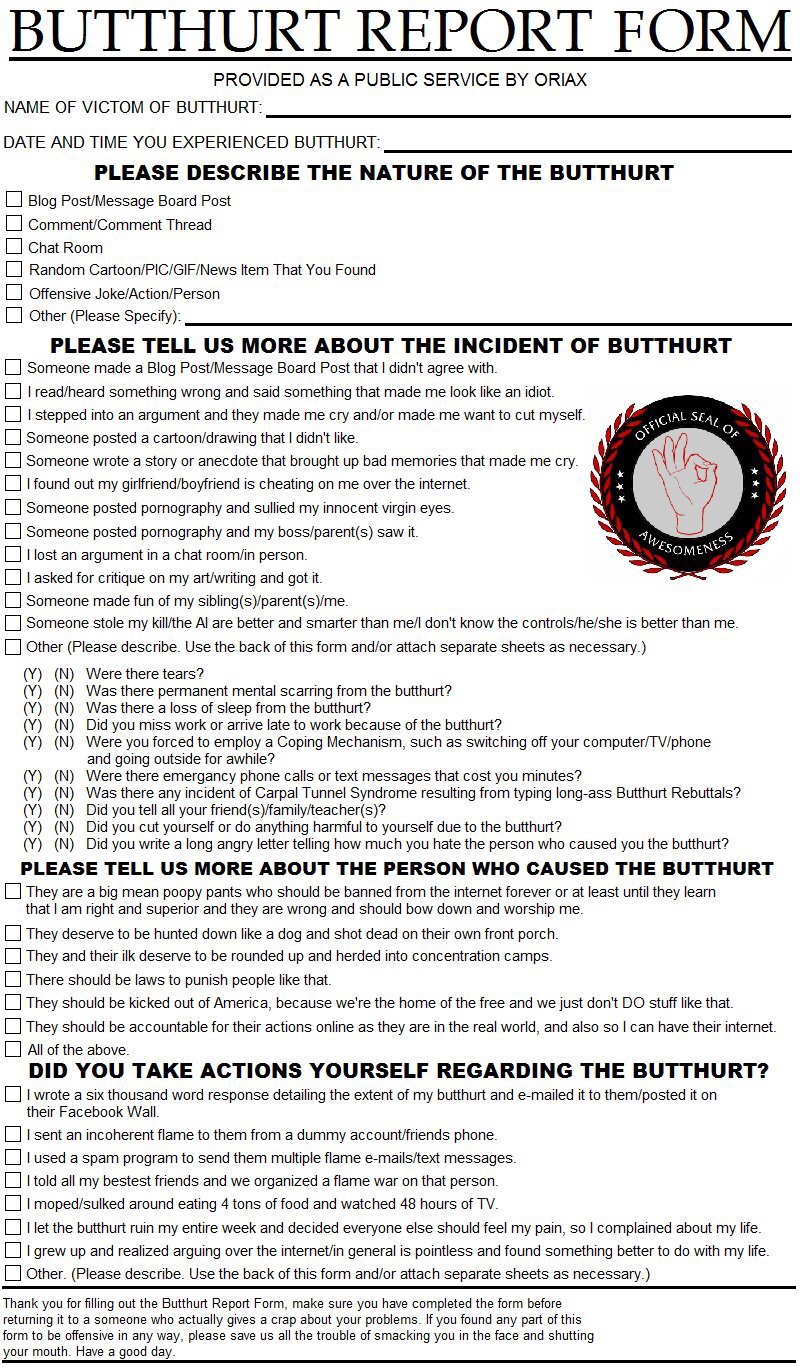
Should you find yourself sanctioned after running afoul of the CF comments policy as stated and feel you have been wronged, please download and complete the Butthurt Report form below in quadruplicate; retain one copy for your personal records and send the others to the email address posted in the right sidebar.

Please refrain from whining, sniveling, and/or bursting into tears and waving your chubby fists around in frustrated rage, lest you suffer an aneurysm or stroke unnecessarily. Your completed form will be reviewed and your complaint addressed whenever management feels like getting around to it. Thank you.

CF Glossary

ProPol: Professional Politician

Vichy GOPe: Putative "Republicans" who talk a great game but never can seem to find a hill they consider worth dying on; Quislings, Petains, Benedicts, backstabbers, fake phony frauds

Fake Phony Fraud(s), S'faccim: two excellent descriptors coined by the late great WABC host Bob Grant which are interchangeable, both meaning as they do pretty much the same thing

Mordor On The Potomac: Washington, DC

The Enemy: shitlibs, Progtards, Leftards, Swamp critters, et al ad nauseum

Burn, Loot, Murder: what the misleading acronym BLM really stands for

pAntiFa: an alternative spelling of "fascist scum"

"Mike Hendrix is, without a doubt, the greatest one-legged blogger in the world." ‐Henry Chinaski

Subscribe to CF!

Support options

Shameless begging

If you enjoy the site, please consider donating:

Correspondence

Email addy: mike-at-this-url dot etc

All e-mails assumed to be legitimate fodder for publication, scorn, ridicule, or other public mockery unless specified as private by the sender

Allied territory

Alternatives to shitlib social media: A few people worth following on Gab:

Fuck you

Kill one for mommy today! Click to embiggen

Notable Quotes

"America is at that awkward stage. It's too late to work within the system, but too early to shoot the bastards."
Claire Wolfe, 101 Things to Do 'Til the Revolution

Claire's Cabal—The Freedom Forums

FREEDOM!!!

"There are men in all ages who mean to govern well, but they mean to govern. They promise to be good masters, but they mean to be masters."
Daniel Webster

“When I was young I was depressed all the time. But suicide no longer seemed a possibility in my life. At my age there was very little left to kill.”
Charles Bukowski

“A slave is one who waits for someone to come and free him.”
Ezra Pound

“The illusion of freedom will continue as long as it’s profitable to continue the illusion. At the point where the illusion becomes too expensive to maintain, they will just take down the scenery, they will pull back the curtains, they will move the tables and chairs out of the way and you will see the brick wall at the back of the theater.”
Frank Zappa

“The right of a nation to kill a tyrant in case of necessity can no more be doubted than to hang a robber, or kill a flea.”
John Adams

"A society of sheep must in time beget a government of wolves."
Bertrand de Jouvenel

"It is terrible to contemplate how few politicians are hanged."
GK Chesterton

"I predict that the Bush administration will be seen by freedom-wishing Americans a generation or two hence as the hinge on the cell door locking up our freedom. When my children are my age, they will not be free in any recognizably traditional American meaning of the word. I’d tell them to emigrate, but there’s nowhere left to go. I am left with nauseating near-conviction that I am a member of the last generation in the history of the world that is minimally truly free."
Donald Sensing

"The only way to live free is to live unobserved."
Etienne de la Boiete

"History does not long entrust the care of freedom to the weak or the timid."
Dwight D. Eisenhower

"To put it simply, the Left is the stupid and the insane, led by the evil. You can’t persuade the stupid or the insane and you had damn well better fight the evil."
Skeptic

"There is no better way to stamp your power on people than through the dead hand of bureaucracy. You cannot reason with paperwork."
David Black, from Turn Left For Gibraltar

"If the laws of God and men, are therefore of no effect, when the magistracy is left at liberty to break them; and if the lusts of those who are too strong for the tribunals of justice, cannot be otherwise restrained than by sedition, tumults and war, those seditions, tumults and wars, are justified by the laws of God and man."
John Adams

"The limits of tyranny are prescribed by the endurance of those whom they oppress."
Frederick Douglass

"Give me the media and I will make of any nation a herd of swine."
Joseph Goebbels

“I hope we once again have reminded people that man is not free unless government is limited. There’s a clear cause and effect here that is as neat and predictable as a law of physics: As government expands, liberty contracts.”
Ronald Reagan

"Ain't no misunderstanding this war. They want to rule us and aim to do it. We aim not to allow it. All there is to it."
NC Reed, from Parno's Peril

"I just want a government that fits in the box it originally came in."
Bill Whittle

Best of the best

Finest hosting service

Image swiped from The Last Refuge

2016 Fabulous 50 Blog Awards

RSS feed

RSS - entries - Entries
RSS - entries - Comments

Boycott the New York Times -- Read the Real News at Larwyn's Linx

Copyright © 2026