” THAT TIME IN 1968 WHEN JIMMY PAGE AND THE YARDBIRDS PLAYED AT A CINCINNATI HIGH SCHOOL PROM”

Full props to Ed for a truly great catch.

IN 1968, JIMMY PAGE AND THE YARDBIRDS PLAYED AT ST. XAVIER’S PROM
Months before the legendary guitar player formed a little band called Led Zeppelin, he and his bandmates took an unexpected gig—and made quite an impression.

Oh, I just bet they did. I just bet they did at that.

By all accounts St. Xavier High School was a pretty buttoned-up place in the late 1960s: an all-male student body with a coat-and-tie dress code, daily Mass (confession optional), and a special Jesuit brand of detention called J.U.G., or Justice Under God (still in place today; ditto for the all-male thing). The chief rule enforcer back then was Patrick J. Boyle, S.J., the school’s assistant principal and unofficial dean of discipline, legendary for incidents like sending boys home mid-day for a haircut if their locks even grazed the tops of their shirt collars.

At the very same time, out in the world-at-large, the times they were a-changin’, as the song lyrics sort of go. Between war, devastating assassinations, increasingly violent protests, political theater, and even the world’s first manned lunar orbit, 1968 in particular would end up being one of the most pivotal and tumultuous years in recent U.S. history. High school and college students nationwide had begun advocating vehemently for a freer, less restrictive, and more open society; in the process they’d also managed to usher in a new era of rock music that aptly reflected the times (sex, drugs, et al). Such was the cultural landscape when St. X’s class of 1968 entered its senior year and a new principal, Father Ed Smith, arrived on campus for—among many other things—his first meetings with the student council.

One of the group’s first orders of business: planning the prom.

Even if you’re not a classic-hard-rock fan—which I am—a Led Zep fan—which, ditto—or a Yardbirds devotee—which I ain’t, and never have been—you’ll still find this a fun read. It’s an amazing story, albeit an all too familiar one to any poor lost soul who’s ever seriously attempted to embark on a career as a full-time professional musician. The weddings, bar mitzvahs, birthday parties, and sundry private gatherings any such misguided fool must endure so as to eke out their paltry living in the biz are indeed the curse of the calling.

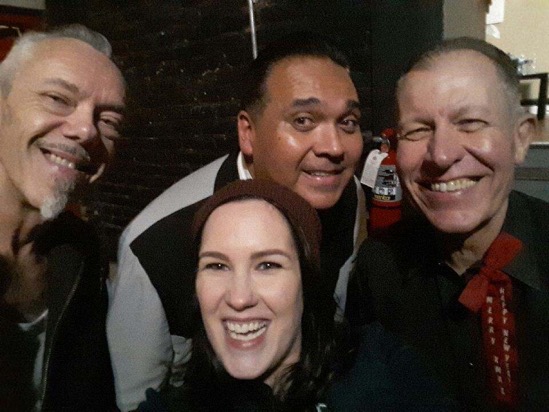
No, whether or not you do manage to scratch and claw your way to the top of the rock and roll heap, the road there is a long and thorny one, guaranteed to be liberally salted with what my erstwhile partner in musical crime Mookie Brill (yes, that’s moi with Mook in the top-left photo, thenksveddymuch; there’s video of our old power-duo, the Parodi Kings, available for perusal there also, looks like) un-affectionately used to call “menu venues,” along with the whole panoply of other painful life experiences. Not to complain or anything, it’s all just part of the working-musician life.

I remember one wedding the BPs played in DC, for one of the steepest tolls we ever did charge, wherein the minister responsible for the preceding nuptials introduced the band by turning to us to glare in goggle-eyed horror and sneering over the mic, “Guess it really does take all kinds to make a world.” My brother the doghouse bassist was so offended by the obvious insult he immediately started lobbying me hard for just up and walking out then and there (direct would-be-exit quote: “Man, SCREW this, let’s just pack our stuff up and leave!”), before we’d struck the very first chord and/or rock-star pose.

The bride and groom were so mortified by this incident that, in addition to our exorbitant fee (of which we damned well earned every fucking penny), they were moved to ship us an entire case of pricey Knob Creek small-batch bourbon and a nice note when they got back home to San Francisco by way of apology. Handsome is as handsome does, as they say; they were actually very nice people, one of many couples who had met at one of our Double Door shows back when they were living in CLT.

In one of life’s great ironies, the majority of those couples at whose wedding receptions we later played, those that I know of anyway, ended up divorced after a few years. It got so bad that, before the last few we did before giving them up forever, we went out of our way to warn the soon-to-be-unhappy couples when they first inquired about us playing for them of our dismal track record to date, and what it might well wind up meaning to them ere the (bitter, acrimonious) end.

Anyways, the thing that really grabbed me about the Yardbirds-prom article is this photo of Jimmy Page:

Whaaa....?
Page goes nearly all-Fender, shockingly enough

Yep, that is indeed Jimmy Page—renowned throughout the guitar-playing universe for his strict insistence on running various Gibson Les Pauls through several serried ranks of Marshall full-stacks, with a doubleneck SG along for the ride on “Stairway To Heaven,” natch—working not just a chop-shop Fender Tele (GASP!!!) but what looks to my jaded eyes to be a silverface Bassman head, alongside a Vox UL4120, through three (count ’em, 3) Dual Showman cabs.

A replica of Jimmy’s beat-up, junky old Tele can now be had from Fender as the obnoxiously-overpriced “Jimmy Page Signature Model Telecaster,” no less, available in various colors including “Natural with Artwork” at selected music stores near you. Really, what can one say but, “YIKES!”

Hell with them Yardbirds, sez I, have yourselves a little Led Zep as a palate cleanser instead.

ZOMG update! Scanning the comments over at Insty, there’s a whole slew of similar stories, including this one, from 1971:

Black Sabbath plays Union Catholic High School
From Master of Reality documentary
On the second night of their tour, February 18th, they played an uncommon stop for most rock bands. Union Catholic High School in Scotch Plains, New Jersey. The student body contacted the band’s booking agent, asking if Sabbath would play at their school. Tired of the usual dull bake sales and dances, the students of Union Catholic endeavored upon a novel approach to fundraising. It first started with The Who concert at the school in 1967, followed by other notable bands such as Chicago, Blood Sweat and Tears, and Cream. Black Sabbath would be the last.

One first-hand account said: “As the concert started, Ozzy came out with his band from our left. Then FROZE midstage. Facing him right up front were rows of seated priests and nuns in the audience. I still remember the puzzled look on his face. He then shrugged his shoulders and began.” Apparently, the nuns and priests had commandeered the first two rows.

The Marist brother, who was assigned to the student council, took one look at Ozzy, wearing a big cross and chain around his neck, and turned a member of the student body and said, “Finally. (YOU booked) A Christian band!”

The sold-out concert, with an estimated 2,200 attending, would gross $8,803.50, over $60k in 2022 dollars. Black Sabbath would go down as the biggest revenue generator in all of Union Catholic High School’s concert history.

Heh. And probably made about 300 bucks themselves, if that. There’s also this:

The Way It Was – The Who, 1967
The night of Nov. 22, 1967, is indelibly etched in the memories of local music fans lucky enough to nab a ticket to The Who’s performance at Southfield High School’s gym. “It was packed to the gills, and I was in the front row,” recalls Don Henderson, who shot this photo. The British group was preceded by warm-up bands The Unrelated Segments and The Amboy Dukes (with Ted Nugent). Singer Roger Daltrey’s back is to the crowd in front of drummer Keith Moon while guitarist Pete Townshend puts the finishing touches on his signature windmill move, in which he wound up his arm in anticipation of striking a furious power chord. Not pictured is bassist John Entwistle. Henderson, who was just 17 at the time, was himself then in an established local group, The Gang, which was one of the house bands at Detroit’s Grande Ballroom. Lead guitarist Henderson also saw The Who in June of ’67 at Ann Arbor’s The Fifth Dimension club, now long gone. He and his bandmates were smitten by the English group. “Our band looked up to The Who,” Henderson says. “They were what we wanted to be like and sound like and we did their songs.” By the time they appeared at Southfield High, The Who already had a string of hits, including “I Can’t Explain,” “My Generation,” and “Happy Jack.” Their signature concert finale was smashing their instruments. Henderson says they did so at Southfield High — after a fashion. “They didn’t go too crazy,” he remembers. “Pete Townshend knocked his guitar to the floor a couple of times and Keith Moon tipped his drums over.” Incidentally, the fellow peeking out of the curtains is Tom Weschler, a respected music photographer in his own right who also became Bob Seger’s road manager. Henderson continues to keep in touch with Weschler and Nugent.

Mind-blowing pics from the Sabbath show are included with that article, too. Other brushes with future greatness from Glenn’s/Ed’s comment section include Van Halen, REO Speedwagon, Chicago, Ted Nugent, and more. Every professional player, every band, be they exalted or humble, is gonna have skeletons of this nature rattling around in their closets.

Calls for another embed, I think, of the dead-bang greatest Sabbath tune of them all.


Not sure if that’s the original Sabbath drummer in that vid or not, and my apologies to Geezer Butler and all, but as far as I’m concerned as long as you have Ozzie and Tony Iommi in there, then hey, it’s Black Sabbath.

Repost update! After much thrashing about trying to figure this whole Substack business out, this post can now be viewed at my grubby, disreputable hangout there also: The Eyrie, Mike’s CF Adjunct. I left comments open, if you feel like giving it a whirl.

Rock in a hard place

I can agree with most of this. But not all of it.

From Vinyl Roofs to Classic Vinyl
REVIEW: ‘The Lives of Brian’ by Brian Johnson
Brian Johnson joined AC/DC in 1980 after the death of the band’s original singer Bon Scott. Before we proceed to Johnson’s amiable rockography, The Lives of Brian, we should clarify the musical technicalities. AC/DC are not a heavy metal band. They are frequently hard rock, but essentially they are a rock ’n’ roll band. Like Motörhead, and like the early punk bands that shared their energy and glee, they are the last, late progeny of ’50s rock ’n’ roll. They are loud and bluesy, and have more in common with Johnny Kidd and the Pirates than with Metallica or Def Leppard. The boogie in their early albums carries echoes of the age before Elvis. Like Motörhead’s Philthy Phil Taylor or The Damned’s Rat Scabies, the drumming of AC/DC’s first drummer Phil “The Stud” Rudd swings with the ghost of Gene Krupa and Buddy Rich.

Second, AC/DC are Australian. Formed in 1973, they came up the old way, which is the hard way, on the Australian pub circuit. The “pub” part might evoke cozy and ramshackle British country inns, but Australian pubs, according to those who have visited them and survived, are cavernous beer halls full of raging drunks. These bracing conditions made AC/DC what the Irish call a “show band,” playing other people’s hits, and entertaining the punters like a very loud vaudeville act. Hence their guitarist Angus Young dressing as a schoolboy, complete with satchel.

Third, Bon Scott was and always will be AC/DC’s singer. This is the Raft of Theseus part. Scott had been with the band for six years before he choked on his own vomit after an especially exuberant night out in South London. Brian Johnson replaced him in 1980, and freely admits that he is a singing caretaker, preserving Scott’s songs and the band that made them. Johnson’s 42 years on the job begin where The Lives of Brian ends. This is the story of what Johnson did before he became famous, and what he did to become famous. It is, as Bon Scott wrote, “a long way to the top if you want to rock ’n’ roll,” but the scenic route is much more interesting than the rock star’s cycle of arena shows and private jets.

“Caretaker”? Like hell. No slight of any kind to the inimitable Bon Scott intended, of course, but AC/DC has done some of its very best work with Johnson up front and center. I’ve been fortunate indeed to see Oz’s gift to real rock and roll live four times over the years, including my first time shortly before Scott passed on, and I can say without fear of contradiction that Johnson stepped up and filled some unimaginably oversized shoes with aplomb, class, and style. He never tried to make anybody forget about Scott, or to supplant him; he made the wiser choice to go his own way and add to Scott’s legacy instead, which is greatly to his credit both as a singer and as a man.

Yes, Bon Scott was AC/DC’s singer—WAS. But now Brian Johnson is, and not just the band itself but all of its fans have benefitted greatly from that. And if you try to tell me that this doesn’t stand on its own, no reference to the late great Bon Scott needed, well, I’m gonna tell you you’re as full of shit as a Christmas turkey.


WHOA, that’s good squishy.

Publick Notice

Yep, it’s a sad, sad day around these parts: no more Scrooge Picard nor Santa Bettie Page, either one. After much thrashing and flailing about, accompanied by some light screaming and pulling out of the hair by the roots, I finally got Angry Guy back up top, and all the colors reset the way I wanted ’em.

Tell your friends, wake the neighbors, send the word far and wide that Christmas is now officially over, as dead as…umm, Marley’s ghost, shall we say. Yes, it’s a bit earlier than I would usually take the CF Xmas theme-makeover down, but I figured it was the least I could do for CF Lifers with bossheads and/or angry wives and/or girlfriends who inexplicably felt nekkid Santa Bettie might have been just a wee bit much, having done the annual holiday rearranging around this here hogwallow earlier than usual this year.

Frankly, I’ve always found this to be the most depressing time of the whole year: the dead of winter; no more cheerful, merry lights and decorations all over the place; nothing to look forward to until early February, when my birthday comes along. And I gotta say, the more I pile up of them, the less there is to look forward to there too. Ah well, I do sincerely hope you all had a wonderful holiday anyhow. If not, here’s a little something to cheer ya up.


Sounds of the season, and a bleg

Okay, I think we’re close enough to Christmas by now to allow me to get away with this year’s repost of one of the very best serendipitous barside a cappella get-togethers in all of human history.


I’ve told the story behind this lovely recording before here, but it always bears repeating: the brilliant and hugely popular vocal ensembles Chanticleer and Cantus, during their annual joint Christmas-season tour, were hanging out at the hotel bar together after a show when they were suddenly inspired to burst into song, performing Franz Biebl’s gorgeous setting of the traditional Ave Maria before a rapt if unsuspecting audience.

The results are nothing short of miraculous; as many times as I’ve watched this vid, I still can’t help but think to myself that, to quote Salieri’s unforgettable line from Amadeus, “This was a music I had never heard. Filled with such longing, such unfulfillable longing. It seemed to me that I was hearing the very voice of God.

And this is where the bleg comes in, folks. See, there’s this fantastic Christmas album—recent, I believe, since I don’t recall the local classical-music radio station playing it before this year, although admittedly I pretty much missed out on last year’s Christmas completely—off of which I’ve been hearing a sort of mashup/medley for solo piano of Beethoven’s Für Elise with “We Three Kings.” I thought the album’s title might have been something along the lines of A Very Beethoven Christmas or Christmas With Beethoven or something along similar lines, but I cannot for the life of me remember what the dickens it actually was/is called.

Believe me, I’ve tried; I spent the last three hours Duck Duck Go’ing every permutation of “Beethoven” and “Christmas” I could conjure with and came up straight snake eyes, every single time. BUT…I did run across what I suspect might be it:


The only related info I’ve been able to locate online, other than a mere handful of vids on YewToob, is the “Classical Carols” book of sheet music on Amazon. No albums, CDs, tapes, or other audio-recording media at all. I’m stumped, I confess. So if anybody out there has any information for me concerning this elusive Beethoven Christmas album I may well have hallucinated, do speak up in the comments.

A Cuban missile-crisis Christmas?

FINALLY, another brilliant Steynmusic post.

Back in 1952, Gloria Shayne had been the pianist in the dining room of a New York hotel when a young man walked in, took one look at the gal at the keyboard, and went up and introduced himself. He was a Frenchman who spoke very little English, she was an American who spoke even less French. She liked pop music, he had come to America to be a classical musician. Yet within a month they were married. Flash forward ten years: Noël Regney’s English has improved, and, although he still hasn’t made his name in serious music, he’s learned to appreciate American pop music since his wife hit the jackpot with “Goodbye, Cruel World”. They even write songs together – usually with Noël writing the music, and Gloria the lyrics.

But not this time. Noël Regney had had a lively war. Born in Strasbourg, he’d been conscripted, after the German invasion, into the army of the Reich. And, although he soon deserted and joined the Resistance, he stayed in German uniform long enough to lead his platoon intentionally into the path of a group of French partisans, who wound up shooting him. After the liberation of his country, he went east to be the musical director of the Indochinese service of Radio France, and found himself in the middle of a new conflict. He thought the Second World War was so terrible that it must surely be the end of all war. But here it was – October 1962 – and as he saw it Washington and Moscow were playing a dangerous game of nuclear brinksmanship over Soviet missiles in Cuba. On the streets of Manhattan, he saw two infants in strollers being wheeled by their mothers along the sidewalk, and decided he wanted to write something for them. Not music, but words: A poem.He remembered scenes from his own childhood – sheep grazing in the pasture of the beautiful campagne – and he had the image he needed:

Said the wind to the little lamb,
‘Do you see what I see?
Way up in the sky, little lamb
Do you see what I see?
A star, a star
Dancing in the night
With a tail as big as a kite.’

He wrote a tune to go with it, too, but he decided it wasn’t right, and turned to his wife. “When he finished,” said Gloria, “Noël gave it to me and asked me to write the music. He said he wanted me to do it because he didn’t want the song to be too classical. I read over the lyrics, then went shopping. I was going to Bloomingdale’s when I thought of the first music line.”

It was only when she got home and played the tune for her husband that she realized she’d made a mistake, and had added one note more to that first line than the lyric required. But Noel loved the melody and didn’t want her to change a thing. So he went back to his poem and added a syllable for the spare note:

Said the night wind to the little lamb…

Gloria asked for one other text change: “A tail as big as a kite” didn’t sound right to her ears: somehow it wasn’t quite American English. But Noël put his foot down on that one: those words were staying, just as they were. “He was right,” she later told Yuletide musical archivist Ace Collins. “It is a line that people dearly love.” It’s perhaps the most vivid and memorable in the song, and a good example of how a phrase you might have no use for as a piece of speech can be transformed by music. The star dancing in the night with a tail as big as a kite is a rare moment of poetic imagery in a lyric that’s otherwise baldly descriptive. It’s slightly off-kilter – a tail as long as a kite, surely? – but “big” makes it more childlike and wondering.

The simple structure of the song is very effective – four verses, passing the story from the night wind to the little lamb, the little lamb to the shepherd boy, the shepherd boy to the mighty king, and finally the mighty king to the people. The repetition of “a star, a star/Dancing in the night” is matched by “a song, a song/High above the trees”, and “a child, a child/Shivers in the cold…” And at the end Noël Regney finally spelled out what was on his mind in that fall of 1962:

Said the king to the people everywhere,
‘Listen to what I say!
Pray for peace, people everywhere
Listen to what I say!
The child, the child
Sleeping in the night,
He will bring us goodness and light.

M and Mme Regney took their song to the Regency publishing company, and Regency immediately got hold of Harry Simeone. You can understand why. The Harry Simeone Chorale had had a huge hit four years earlier with “The Little Drummer Boy”, and to a casual listener “Do You Hear What I Hear?” can easily sound like “The Little Drummer Boy” sideways. Both tunes share a kind of simplistic formality, and the words of the later song echo the first: “Do You Hear?” reprises “Drummer Boy”‘s king and baby (actually, in the first song, the king is the baby) and one half of “the ox and lamb”, and the little shepherd boy is clearly a kindred spirit of the little drummer boy. So the Simeone Chorale recorded it, put it out for Thanksgiving 1962, and sold a quarter-million copies in its first week.

There were stories in the papers about drivers hearing it on the radio and pulling over on to the shoulder to listen to the lyrics. Regney and Shayne had written a song so powerful they couldn’t even get through it themselves without dissolving into tears. “We couldn’t sing it,” said Gloria. “Our little song broke us up. You must realize there was a threat of nuclear war at the time.”

But threats of nuclear war come and go; a good song is forever. What turned “Do You Hear What I Hear?” from a peace anthem to a seasonal standard was a recording the following year by Mister White Christmas himself, Bing Crosby. Bing’s warm dramatic baritone drew out the words in ways that the 25 voices of the Harry Simeone Chorale simply couldn’t. When I see these lyrics on paper, my mind’s ear hears them in Crosby’s voice:

Said the shepherd boy to the mighty king,
‘Do you know what I know?
In your palace warm, mighty king
Do you know what I know?
A child, a child
Shivers in the cold
Let us bring him silver and gold
Let us bring him silver and gold…’

Bing’s version sold a million copies, and the song never looked back.

“I am amazed that people can think they know the song,” said Noël Regney, “and not know it is a prayer for peace.” Ah, but most great popular art wiggles free of its creator. And so many if not most of those singing along to “Do You Hear What I Hear?” will have no idea that it has anything to do with some ancient flash point of the Cold War. Which is as it should be. Noël Regney and Gloria Shayne eventually divorced. The man who wrote those powerful words was hit by a stroke and ended his days unable to speak. The woman who wrote that melody was struck by cancer and unable to play the piano. But their song lives on, with a tail stretching across the decades:

Said the night wind to the little lamb,
‘Do you see what I see?
Way up in the sky, little lamb
Do you see what I see?
A star, a star
Dancing in the night
With a tail as big as a kite.’

Noël Regney: the first Noël to write an American Christmas classic, even if it took the Cuban missile crisis to inspire him.

Happily, Steyn includes what I myself agree is the best version yet recorded, by the aforementioned Der Bingle.


Wonderful stuff, no? And, as is so often the case, with an equally wonderful story behind its creation as well.

Happy birthday

To one of the greats, a true American original.

Berry Gordy: The Visionary Who Made Motown

A company that was started with a loan of $800 went on to help shape the sound of the 20th century. We could only be talking about Motown Records, founded on January 12, 1959 by Berry Gordy Jr, who was born in the city he helped make synonymous with soulfulness, Detroit, on November 28, 1929. Unfailingly spritely, just ahead of his 90th birthday, Gordy announced his retirement at the Hitsville Honours ceremony, safe in the knowledge that his achievements will last forever.

Gordy built his empire on his early success as a songwriter, notably of “Reet Petite,” “Lonely Teardrops” and others for perhaps the pre-eminent black music entertainer of the late 1950s, Jackie Wilson.

“Of the late 1950s”? RUFKM? Try: of all time, it’s a much better fit. Don’t believe me?


Jackie was so incredibly, unbelievably good that a young Elvis Presley, on his first time seeing him perform in Vegas, was so blown away by the show he asked to come backstage to visit with “Mr Excitement” in the green room, to which request Wilson graciously acceded. Elvis made his obeisances to a man he recognized as one of the most awe-inspiring vocalists the world has ever seen or ever will see before solemnly swearing that he would never, not EVER, willingly follow Jackie onstage.

Smart fella, that Elvis.

The two nascent legends shared a few laughs and hung out awhile just shooting the familiar old road-dog breeze, then Wilson explained one of his own stage tricks to Elvis: gulp down a bunch of salt tablets and drink a gallon or two of water before going out onstage, so as to make oneself sweat profusely during the show, something any audience just loves to see from a singer; as Wilson told E at the time, “the chicks love it.”

Elvis used the trick forever after, there being but one minor little problem with the technique—it’s just liable to kill ya from a heart attack or stroke eventually. In fact, it was almost certainly a contributing factor in Jackie Wilson’s own debilitating heart attack a few years on down the road, a setback from which he never really recovered.

On September 29, 1975, Wilson was one of the featured acts in Dick Clark‘s Good Ol’ Rock and Roll Revue, hosted by the Latin Casino in Cherry Hill, New Jersey. He was in the middle of singing “Lonely Teardrops” when he suffered a massive heart attack. On the words “My heart is crying” he collapsed on stage; audience members applauded as they initially thought it was part of the act. Clark sensed something was wrong, then ordered the musicians to stop the music. Cornell Gunter of the Coasters, who was backstage, noticed Wilson was not breathing. Gunter was able to resuscitate him and Wilson was then rushed to a nearby hospital.

Medical personnel worked to stabilize Wilson’s vital signs, but the lack of oxygen to his brain caused him to slip into a coma. He briefly recovered in early 1976, and was even able to take a few wobbly steps, but slipped back into a semi-comatose state.

Wilson’s friend, fellow singer Bobby Womack, planned a benefit at the Hollywood Palladium to raise funds for Wilson on March 4. Wilson was deemed conscious but incapacitated in early June 1976, unable to speak but aware of his surroundings. He was a resident of the Medford Leas Retirement Center in Medford, New Jersey, when he was admitted into Memorial Hospital of Burlington County in Mount Holly, New Jersey, due to having trouble taking nourishment, according to his attorney John Mulkerin. Elvis Presley covered a large portion of Wilson’s medical bills. Wilson’s friend Joyce McRae tried to become his caregiver while he was in a nursing home, but he was placed in the guardianship of his estranged wife Harlean Harris and her lawyer John Mulkerin in 1978.

Wilson died on January 21, 1984, at the age of 49 from complications of pneumonia. He was initially buried in an unmarked grave at Westlawn Cemetery near Detroit.

So sad. But all this got me to revisiting a few of my personal all-time Motown faves on YewToob, a list which would necessarily have to include this slice of pure musical genius on it.


Pay especial attention to what the aptly-named Miracles are doing behind Smokey here; it pulls the entire song together in a way most non-professionals will never even notice at all—a thing often striven for by tunesmiths, but seldom achieved except in the verymost brilliant compositions.

And yes, Smokey Robinson and the Miracles were also on Motown, of course. Actually, Robinson himself was the label’s VP from 1972 until 1990, two years after the company had been sold.

So yeah, happy 93rd birthday to the great Berry Gordy, who brought us so very much wonderful, wonderful music on the Motown label. Thanks for that, sir, and God bless you.

BOO!

Happy Halloween to all CF Lifers everywhere, and to all the ships at sea. Buck Throckmorton posts up a good ‘un in celebration of the day.


Now, one from my dear departed friend Ronnie Dawson.


Though they share the same title, near as I can tell the two songs have no connection with one another: not chord progressions, not tempo or rhythm, not lyrics, not nothin’. But now that I brought up Uncle Ronnie (that’s what I called him, at his insistence, which I found quite flattering), no way am I gonna pass up the opportunity to post this one.


Now as fate would have it, I attended the Conyne taping along with a large contingent of the NYC-RAB scenesters, and a good time was had by all, believe you me. Backing Ronnie up is the absolute best rockabilly combo I’ve ever seen or heard tell of: High Noon, a trio from Austin Texas, with the welcome addition of the brilliant and drop-dead gorgeous Lisa Pankratz pounding the skins.

Ronnie always gave a good, energetic performance onstage, but out of a thousand and one Dawson shows I either saw or played on, I never, ever saw him as charged up as he was that incredible night. Not just Ronnie, but the whole band was very nearly sending sparks flying off their bodies, they were all so excited and exhilarated. The audience was, too, even Conan himself. Take especial note of what Ronnie does at 3:34 in the vid: he’s waving his arm around over his head at the NYC-RAB crew. We were all up dancing in the aisles, and he was beckoning us to come right down front to dance closer to him nearer to the stage.

After the performance, when he got over to sit on the couch and chat a bit with Conan, first thing out of O’Brien’s mouth was a stunned but amused “My GOD, what have you DONE to these people?” Watch the vid again, you can just about see the sheet-lightning emanating from Ronnie and the band. It was fucking shit-hot, that’s what. I’ve never seen anything remotely like it, in all my years of rockin’ and rollin’.

When the taping was done, me and my gf at the time met Ronnie, Lisa, and the High Noon crew up at their Midtown hotel and went out bar-hopping to celebrate this historic triumph for real rock and roll. We hit several Midtown dive bars—yes, there are a few, but you gotta look for ’em—until airtime for the Conan show started getting close (the taping was at 5:30). Then we began to ask each bartender at wherever we were at the time if they would pretty please turn the TV to the right channel so we could watch the show, since several of us were gonna be on it. After being turned down by three (3) assholes who preferred watching some goddamned sportsball event instead, somebody (wasn’t me) suggested that we all go downtown to cram ourselves into my apartment to watch.

And so we did. Mine and Jen’s less-than-palatial crib was more crowded and smoky even than it usually was, which is saying something; the drinks were flowing freely, we had the TV cranked to window-rattling volume, and the laughter, shouting, and general hullaboo was boisterous enough to almost drown THAT out.

We celebrated for a few more hours, watching the show over and over on the VCR, and then everyone piled into my rattletrap E350 van for the drive back uptown to drop the band off at their hotel. As we jounced and shook up the perpetually-under-construction FDR drive at a leisurely 80mph, a fear-stricken Lisa shouted from the back, “Mike, I think you’ve been in New York too long!”

It was without a doubt the most wonderful night of my entire life, and I wasn’t even onstage.

The Last Man Standing stands no more

As you would assume, I am indeed working on my Jerry Lee Lewis remembrance/obit. There’s a couple of documents I’m trying to get my hands on for it, which apparently do not exist on the innarnuts anywhere. In fact, one of them I know for sure is in the sole and exclusive possession of our former manager, who as far as I know is the only guy who has a copy of the thing. Unfortunately, Mike isn’t at all web-savvy, so I doubt he has the means to scan it and send it over to me, or would know how even if he did. We’ll see about that, I suppose. More coming, as and when…

Update! YES!!! Got ’em both, I can hardly believe it. Okay, folks, stay tuned, this is gonna be good.

Updated update! Okay, here we go. Somewhat atypically for these rock and roll-icon obits of mine, I did NOT ever get to meet or hang out with Jerry Lee Lewis, to my great disappointment. We DID have a show scheduled with him once, at the legendary Tramps in NYC. To wit:


Big night
Would’ve been our first Really Big Show at Tramp’s, but alas, t’was not to be


What showed up in lieu of The Killer that night was a doctor’s note (those with older eyes can click here to embiggen):


Real deal
Yes, it’s real


Mind, now, this was the selfsame Dr Nick who was widely despised among fans of the King as the Man Who Killed Elvis, the guy who for years had signed off on whatever self-prescribed drugs Elvis was of a mind to indulge in that particular evening. He’s also the real-life personage from whence The Simpsons‘ Dr Nick Rivera got his name:

The character design of Dr. Nick is based somewhat on Gábor Csupó, of Klasky Csupo studios, who was originally from Hungary—the animators mistakenly believed Hank Azaria was impersonating Gabor, when in fact the voice was actually a bad imitation of Ricky Ricardo from I Love Lucy.

His name came from George Nichopoulos, nicknamed Dr. Nick, Elvis Presley‘s personal physician who was indicted on 14 counts of over-prescribing drugs to Presley and several other patients in the years following Presley’s death. While Nichopoulos was acquitted of those charges, his medical license was revoked by the Tennessee medical authorities in 1993.

And there you have it. When that fateful note from Dr Nick finally did show up at Tramps instead of Jerry Lee it scared me half to death, because Terry Dunne, the owner and founder of Tramp’s, asked me right away if we’d be willing to go on and take the whole show anyhow, three sets instead of the agreed-upon two. I mean, who wouldn’t be scared, right? The joint was packed with people who had paid top buck to see Jerry Lee Lewis, only to learn they’d be getting a full night of the lowly if up-and-coming Belmont Playboys in his stead? My God, I thought, these people are gonna KILL us!

To the contrary, it all went quite well; we were warmly received, the dreaded mass stampede for the exits when it was announced that Lewis wouldn’t be appearing never happened, and we did a good show despite the jacked-up Fear Factor.

No, I never did get to meet the Killer, but he still wound up being one of my biggest personal influences nonetheless. That came about the night of a different show a few years later, when the BPs were to play at the old Park Elevator in CLT, situated in the century-old, decaying and decrepit Park Elevator building, before it burned up, was refurbished, and turned into condos like all the other old buildings around here.


Now, the Park Elevator was notoriously rickety in places, but as it happens there was a low entryway that led directly out onto the stage. In those days, I was the proud owner of a 71 Shovelhead FLH, fully tricked out with, among other things, a suicide shift and 20-inch apes sitting atop 5-inch risers:


Wheels
Me, my beloved 61 Galaxy, and the ol’ Shovel

So naturally, I conceived the brilliant notion that hey, wouldn’t it be just the most awesome thing ever if I rode the bike onto the stage when we went on? My friend Joe was also there on his hotrod Evo Sporty, and was quite eager to join me in risking my fool neck to ride his Harley out onto the stage through that tiny, low door also. So low was said portal, in fact, that I had to yank my apehangers back and down to even get through it; the damned bars were way too tall to go in as they were.

But no matter; such a minor obstacle could never be sufficient to deter a dedicated Jerry Lee wannabe like myself. Right before we were to do our dirty deed, I asked one of the proprietors of the Park Elevator, Tim Blong, if he thought the stage would be able to support all that weight without collapsing into rubble and killing us all. He shrugged eloquently, muttered, “Dunno, man, maybe?” and grinned. Joe turned to me with a slightly troubled look on his mug, as if to ask, “Well, we doin’ this or what?”

Which was when I asked myself what would come to be the eternal question for me regarding any outrageous, dangerous, or just plain stupid stunt I was thinking about attempting to pull off: What Would Jerry Lee Do?

The answer, of course, was always the same, being eminently obvious given the Killer’s hard-won reputation for bold, daredevil antics. We fired up the scoots, rode through that tiny door with our heads ducked way down low, put the bikes on the kickstands one on each side of the stage, and the show went on, as it always and forever must. A few fun facts about the Killer:

The last survivor of a generation of groundbreaking performers that included Elvis Presley, Chuck Berry and Little Richard, Lewis died at his Mississippi home, south of Memphis, Tennessee, representative Zach Farnum said in a release. The news came two days after the publication of an erroneous TMZ report of his death, later retracted.

Of all the rock rebels to emerge in the 1950s, few captured the new genre’s attraction and danger as unforgettably as the Louisiana-born piano player who called himself “The Killer.”

Tender ballads were best left to the old folks. Lewis was all about lust and gratification, with his leering tenor and demanding asides, violent tempos and brash glissandi, cocky sneer and crazy blond hair. He was a one-man stampede who made the fans scream and the keyboards swear, his live act so combustible that during a 1957 performance of “Whole Lotta Shakin’ Goin’ On” on “The Steve Allen Show,” chairs were thrown at him like buckets of water on an inferno.

“There was rockabilly. There was Elvis. But there was no pure rock ’n ’roll before Jerry Lee Lewis kicked in the door,” a Lewis admirer once observed. That admirer was Jerry Lee Lewis.

Heh. Pure, 24-karat Jerry Lee right there. Nobody ever saw his like before, and we never will again. Y’all might be familiar with the story of the night Lewis rammed his Cadillac into the front gate at Graceland, perhaps. Lewis, drunk as a boiled owl, was hauled off by the gendarmerie hollering at Elvis to come on out like a man so’s they could finally settle who the REAL King Of Rock And Roll was once and for all. More:

Lewis had a run of top 10 country hits between 1967-70, and hardly mellowed at all. He performed drinking songs such as “What’s Made Milwaukee Famous (Has Made a Loser Out of Me)”, the roving eye confessions of “She Still Comes Around” and a dry-eyed cover of a classic ballad of abandonment, “She Even Woke Me Up to Say Goodbye.” He had remained popular in Europe and a 1964 album, “Live at the Star Club, Hamburg,” is widely regarded as one of the greatest concert records.

A 1973 performance proved more troublesome: Lewis sang for the Grand Ole Opry and broke two longstanding rules — no swearing and no non-country songs.

“I am a rock and rollin’, country-and-western, rhythm and blues-singin’ motherf—–,” he told the audience.

Lewis married seven times, and was rarely far from trouble or death. His fourth wife, Jaren Elizabeth Gunn Pate, drowned in a swimming pool in 1982 while suing for divorce. His fifth wife, Shawn Stephens, 23 years his junior, died of an apparent drug overdose in 1983. Within a year, Lewis had married Kerrie McCarver, then 21. She filed for divorce in 1986, accusing him of physical abuse and infidelity. He countersued, but both petitions eventually were dropped. They finally divorced in 2005 after several years of separation. The couple had one child, Jerry Lee III.

Another son by a previous marriage, Steve Allen Lewis, 3, drowned in a swimming pool in 1962, and son Jerry Lee Jr. died in a traffic accident at 19 in 1973. Lewis also had two daughters, Phoebe and Lori Leigh, and is survived by his wife Judith.

His finances were also chaotic. Lewis made millions, but he liked his money in cash and ended up owing hundreds of thousands of dollars to the Internal Revenue Service. When he began welcoming tourists in 1994 to his longtime residence near Nesbit, Mississippi — complete with a piano-shaped swimming pool — he set up a 900 phone number fans could call for a recorded message at $2.75 a minute.

There’s always more to say about the inimitable Jerry Lee Lewis, and there will always be too. I’m sad he’s gone, at the same time I can hardly believe he didn’t die on us thirty or forty years ago, buck-wild as he was. The Killer grabbed life by the scruff of its neck and lived the ever-lovin’ hell out of it, from start to finish. With that, enjoy a so-called “lost track” recorded back in the year I was born, 1960, that’s long been Number One with a bullet on my own personal Jerry Lee Lewis hit parade, complete with a bit of studio chatter from the Killer himself.


That patter beforehand has actually been bowdlerized somewhere along the way. In the version I had, the track begins with a runner in the control room hollering to the Killer, asking what he wants to eat. Jerry Lee responds, “What am I gon’ eat? I’d like to eat a little pussy if you got some,” followed by an extremely salacious sluuurrp sound and a smacking of the lips. Jerry then laughs that great laugh of his, and yells “STONED!!!” After that is when the “That’ll be the only place you can play it” part included in the vid comes in.

And then the one and only Killer hits that big, fat power-chord—Jerry Lee was the only guy I ever heard of capable of producing power-chords on a piano, which formed the basis of his whole playing style—and we’re off and running. “Birthday Cake” also features probably his best-ever solo, a pounding, pulsating, joyous break that’s a thing of wonder every time I hear it. And I’ve heard it a thousand times.

The great Jerry Lee Lewis was a genuine American original: a rowdy, relentless Southern roughneck who neither knew nor cared one whit about such trivial irrelevancies as giving up, giving in, backing off, or calming the fuck down. He lived the way he played, WTFO and balls to the wall. May the Good Lord bless and keep his indomitable, irrepressible spirit forever.

Good ol’ Franky

Since I used up “Monster Mash” and “Haunted House” already, the two greatest Halloween songs EVAR, allow me to present another selection which I think is appropriate for the occasion.


Yes, there’s a drum solo—two, actually, even one of which is a big, fat strike against any live rendition—and it weighs in at a hefty 9:18 long, much of which is Edgar Winter just basically making a bunch of goddamn racket on the synth towards the end. But it’s still pretty good overall, if you can put up with those two highly objectionable things.

On the plus side, you really get a sense from it of just how short Rick Derringer is.

Believe it or not, I came across another live version from 2007 with truly terrific sound quality, but 1) it was over twelve (seriously, twelve!!!) minutes long, and 2) Rick Derringer ain’t in it. So, y’know, screw all that noise. In a manner of speaking.

If it ain’t good, then what good is it?

Dennis Prager has really pressed one my buttons with this one.

The Left — meaning progressives, not necessarily liberals — loathes the fact that conservativism preserves the past. That is why “change” is one of the most cherished words in the Left’s vocabulary. There is nothing more threatening or, perhaps more important, boring, to a leftist than preserving the past. “New” and “change” provide leftists meaning and excitement.

As one involved in the music world (I periodically conduct orchestras), I have always been struck by how important it is to orchestra CEOs, music professors and especially music critics that as much “new” music be played as possible. If a conductor prefers to program the classics, he is deemed a reactionary, while conductors who regularly program new music are heroes in the music world.

Music critics rarely discuss the question that preoccupies conservatives: Is this new piece of music good, let alone nearly as good as the classics? What matters to music critics is that the music is new — and, these days, that it was composed by a nonwhite person, ideally a woman.

Conservatives ask whether new music is good enough to warrant being played. They are preoccupied with excellence, not with newness or “change.”

This difference between conservatives and leftists/progressives applies to virtually every realm of life.

It explains the decision of the University of Pennsylvania’s Department of English to remove a large mural of Shakespeare and replace it with a mural of a gay female poet of color. No one in his or her right mind thinks that this poet is the equal of Shakespeare. But the members of the Penn English Department are not concerned with literary excellence. Shakespeare’s picture wasn’t replaced because his writing was surpassed. He was replaced because he was male, white and straight. And most of all, he was replaced because he was old. He is an “old (or dead) white European male,” in the words of the Left.

Change and newness are so vital to leftists that a progressive who cared first and foremost about excellence would cease to be a progressive.

Early this past summer, I sat down and composed a lengthy e-mail diatribe for the local classical-music radio station on this very topic, although I never did bother to hit “Send.” Said station, WDAV, is attached to Davidson College, and the hosting staff is shot through with kneejerk Progtards who are not at all shy about making their political leanings perfectly clear on-air.

The hell of it is, DAV is hands-down the best classical station I’ve ever listened to, among all the stations in all the cities I’ve lived in over the years. They don’t play nearly as much of the wretchedly tedious “new classical” dreck the stations in NYC, ATL, and New Orleans muck up their airwaves with. As far as their programming selection goes, DAV is, umm, sweet music to my ears.

Yeah, I know. Sorry, couldn’t help myself there. Don’t hate me ’cause I’m beautiful, aiiight?

Anyhoo, I listen to DAV pretty much all day and night, and enjoy it tremendously, the exception being the ever-winsome Rachel Stewart’s Sunday morning show, “Biscuits and Bach.” It’s devoted exclusively to the Baroque composers, see, and Baroque aggravates me like bamboo shoots under the fingernails. Verily, I do despise that shit. Well, Scarlatti I like a lot; same-same for the great composers for guitar at the fag-end of the era like Giuliani, Boccherini, and Paganini*.

Bach, Handel, all the rest, though? Humbug, I say!

Over just this past year or thereabouts, as if to intentionally annoy me further still beyond the occasional not-so-sly digs at Trump from the aforementioned hosts, the station has put several new programs into the regular rotation, all of them exercises in drooling PC.

One in particular focuses on “marginalized composers,” mainly females, who have been unfairly short-shrifted because you fiendish classical fans are so goddamned MISOGYNIST you refuse to listen to the flavor-of-the-month LGBTQZRWNmXXX Composers of Color, damn your eyes, despite their all CLEARLY being the equals of Beethoven, Mozart, and Chopin rolled together into one awesome wad of talent and inspiration.

Another gruesome offering, airing a couple afternoons a week at 2, I think it is, lionizes unknown Neegrow composers as the put-upon musical saints they all are, unjustly oppressed by De White Man because RACISM!!!, you rotten BASTARDS.

Then there’s Concierto, a show which I hesitate to lump in with the others, because it’s actually quite damned good and I like it a lot.

Concierto is a weekly program of classical music presented in Spanish and in English. The program features music by Latin American and Spanish composers and musicians. With Concierto, WDAV extends a welcoming hand to the fastest growing ethnic group in the Carolinas, while also seeking to introduce new listeners to the pleasures of classical music.

Concierto es un programa seminal de música clásica presentada en español e ingles. El programa cuenta la música clásica por compositores y músicos latinoamericanos y españoles. Con Concierto, WDAV extiende una mano de bienvenida al grupo étnico que está creciendo más rápido en las Carolinas, y a la misma vez también buscando a introducir nuevos oyentes a los placeres de la música clásica.

Spanish translation included above because of course it was.

These shows, plus a couple others I’ve labored mightily to put out of my mind, undermine their own raison d’etre by confirming that skin color, sex, and/or political opinion make seriously piss-poor criteria for judging compositional ability. Trust me, if these over-entitled hacks have indeed been “marginalized,” then they all came by it honest, and richly deserve to be. I endure these shows by the skin of my gritted teeth, and can say with no little authority that the “music” these talentless tyros are putting out is truly the pits: screechy, skrawky, aimlessly atonal clappa-trappa devoid of any semblance of melody, coherence, or worth. It is literally excruciating to listen to. Which, believe me, you shouldn’t. Nobody should.

But hey, it’s New, it’s Nonwhite, it’s Transgressive—for your standard-issue liberal dumbass, it checks all the necessary boxes, so what’s not to like? What it assuredly is NOT, is good. Not by any standard for “good” I can recognize or endorse, it ain’t.

So much for the outdated stereotype of classical-music mavens as stuffy, rigid, ultra-conservative old gits who poot dust and cobwebs; wear monocles, cummerbunds, and spats, even at home; and lounge about in their fancy-schmancy home “libraries” or Gentlemens Clubs gassing on about the lamentable state of the Modern World, to the eternal irritation of their long-suffering manservants. It just ain’t so anymore, if it ever even was. Nowadays, classical music-lovers are all yuppie-puppy standard-issue shitlibs: affluent, self-absorbed, smug, and entirely insufferable. Nice thing is, it makes all that beseeching and imploring for donations during the annual Fall Fundraiser so easy to ignore without feeling the slightest twinge of guilt over it.

*A bit late for Baroque on a couple of those, I know. In Scarlatti’s case, he’s generally considered to be the “bridge” between the Baroque and Classical periods, much the way Beethoven is thought of as being the same between Classical and Romantic. So there.

RIP Robert Gordon

Do I have stories about this guy? Oh, you just better bet I do.

Robert Gordon, Rockabilly Revival Icon, Dies at 75
Over his career, Gordon released more than 20 albums and helped usher in a rockabilly resurgence in the 1970s and ’80s.

Rockabilly revivalist Robert Gordon, whose albums with guitar greats Link Wray and Chris Spedding helped solidify his place in rock history and carry the genre over several decades, died Tuesday (Oct. 18) at Don Greene Hospice in New York City following a diagnosis of leukemia, according to a Facebook post by his label Cleopatra Records. He was 75.

Born in Bethesda, Maryland, Gordon was drawn to rock ‘n’ roll after he heard Elvis Presley’s “Heartbreak Hotel” at age nine. He soon dug into the music of Gene VincentEddie Cochrane and others ’50s greats and cut his first recording at 17 singing with a band called The Confidentials. His career ramped up after he relocated to New York City and joined the punk band Tuff Darts (which can be heard on the 1976 album Live At CBGBs alongside tracks by Mink DeVilleSun Ra and others).

In 1977, Gordon cut his debut “solo” album, Robert Gordon With Link Wray, and followed with several others, including 1978’s Fresh Fish Special (with Wray), which also includes Presley’s famed background singers The Jordanaires and Bruce Springsteen, who played on Gordon’s rendition of the Springsteen-penned track “Fire.” An ad in Billboard that ran on March 11, 1978, read, in part: “Robert Gordon, the new voice of Rock and Roll, and Link Wray, the legendary guitarist, are together again! FRESH FISH SPECIAL follows their red hot first album – and it’s a killer! Bruce Springsteen wrote a song for it. Elvis Presley, Gene Vincent, Eddie Cochran and Jack Scott are faithfully remembered in it.”

In 1979, Gordon released Rock Billy Boogie, which peaked at No. 106 on the Billboard 200. That was quickly followed by 1980’s Bad Boy and 1981’s Are You Gonna Be The One, which included the single “Someday, Someway,” which peaked at No. 76 on the Billboard Hot 100.

In 1982, Gordon ventured into acting, co-starring in outlaw biker flick The Loveless opposite Willem Dafoe. Gordon can also be seen performing with his band in a 1981 skit for Canadian sketch comedy show SCTV, in which he’s mistaken for astronaut Gordon Cooper.

As you may have guessed from my opener above, the BPs have a long, somewhat sordid history with Gordon. We played with him as supporting act several times, both in NYC and in Finland, resulting in my having a fair bit of dirt I could dish on ol’ Robert, but ain’t gonna. Instead, a few pics of us from our very first time working with him, at the legendary and now sadly-defunct music venue Tramps.

RIP
Robert Gordon and Chris Spedding, shot by me from the wings at Stage Right
After the show
Green room group shot of both bands, after the show
SCHWEEET!
Why we pick up a guitar in the first place; no idea what her name was, didn’t care

And there you have it, folks. Robert certainly did have a way of picking guitar talent; over the years, he worked with Spedding most, a brilliant player who also turned out to be a truly sweet, humble, and all-around nice man. That first show, Spedding borrowed a 9-volt battery from me for his tuner pedal, and actually returned the damned thing to me without even being asked—and believe me, that NEVER happens. Not just Chris, but Robert also had the peerless Danny Gatton in his onstage stable for a few years, as well as bona fide rock and roll icon Link Wray.

So yeah, rest easy, Robert Gordon. A top-notch singer, blessed with a deep, resonant voice and an excellent range. We had our run-ins over the years, as can happen sometimes in showbiz, but none of that matters now. May your troubadour’s heart and soul find everlasting peace.


Skynyrd and DeSantis kick out the Southern jams

Some of you may remember when I posted on a new Van Zant brothers tune celebrating “Sweet Florida” and its governor not too terribly long ago.


Well, don’t look now, but the other shoe has officially dropped.

Watch: Ron DeSantis Makes Surprise Appearance at Lynyrd Skynyrd Concert, Crowd Chants ‘USA!’

Florida Gov. Ron DeSantis (R) made a surprise appearance at a recent Lynyrd Skynyrd concert in Hollywood, Florida, where the stunned crowd erupted in loud applause and chanted “USA!”

DeSantis appeared onstage with his wife, Casey, and their children, during the band’s show Sunday at the Seminole Hard Rock Hotel & Casino.

Lynyrd Skynyrd has made no secret of its admiration of De Santis.

Earlier this year, lead singer Johnny Van Zant and his brother, Donny Van Zant, released a new single dedicated to the governor titled “Sweet Florida.”

The song includes the lyrics: “You can take it to the bank, he don’t care what Brandon thinks at the White House / He’s fighting for the right to keep our state free / Well he’s taking on the swamp and he’s calling out Dr. Fauci / He’s the only one fighting for you and me.”

Florida First Lady Casey DeSantis has reportedly announced that the Jacksonville band has donated $100,000 to help those affected by Hurricane Ian, with the amount matched by the Seminole tribe.

A hat tip and a hearty “good on ya, fellas” to all involved. I know some folks don’t quite trust DeSantis; certainly, he ain’t perfect, just like all the rest of us ain’t. But speaking strictly for myself, barring some truly monumental betrayal, this immortal quote alone guarantees I’ll always love the guy: “I will not, Joe, and you can go fuck yourself.”

The Louvin Brothers

So in a conversation with my mom, who considers herself a country music devotee, an astonishing gap in her musical education came shamefully to light: she had never heard of the Louvin Brothers, AT. ALL. Needless to say, I straightaway raced over to YouTube so as to put her back in the good graces of the Lord again. To wit:


The Louvin Brothers story is a fascinating one, which is true of a great number of legendary country artists from the 50s and 60s Golden Age of the genre.

The Louvin Brothers were an American musical duo composed of brothers Ira (April 21, 1924 – June 20, 1965) and Charlie (July 7, 1927 – January 26, 2011) Louvin ( Loudermilk). The brothers are cousins to John D. Loudermilk, a Nashville Songwriters Hall of Fame member.

The brothers wrote and performed countrybluegrass and gospel music. Ira played mandolin and generally sang lead vocal in the tenor range, while Charlie played rhythm guitar and offered supporting vocals in a lower pitch. They helped popularize the vocal technique of close harmony in country and country-rock.

After becoming regulars at the Grand Ole Opry and scoring a string of hit singles in the late 1950s and early ’60s, the Louvin Brothers broke up in 1963 due in large part to Charlie growing tired of Ira’s addictions and reckless behavior. Ira died in a traffic accident in 1965. They were inducted into the Country Music Hall of Fame in 2001, and Charlie died of cancer in 2011. Rolling Stone ranked the Louvin Brothers No. 4 on its list of the 20 Greatest Duos of All Time.

As a great many brother- and/or sister-duos (think the Everly Brothers, just to name one example) seem to have in common, Charlie and Ira could not possibly have been more different in terms of character and personality and thus, as with Don and Phil Everly, the boys didn’t get along worth a damn. While both the brothers were devoutly Christian, steeped in the teachings of their Southern Baptist faith, Ira was something of a hellraiser nonetheless, with a serious bent towards boozing, brawling, and chasing those wild, wild women. Charlie, for his part, was much more conservative, quiet, and straitlaced.

Which makes Ira’s story the more interesting of the two, at least for me.

In 1963, fed up with Ira’s drinking and abusive behavior, Charlie started a solo career, and Ira also went on his own.

Ira died on June 20, 1965, at the age of 41. He and his fourth wife, Anne Young, were on the way home from a performance in Kansas City when they came to a section of construction on Highway 70 outside of Williamsburg, Missouri where traffic had been reduced down to one lane. A drunken driver struck their car head-on, and both Ira and Anne were killed instantly. At the time, a warrant for Ira’s arrest had been issued on a DUI charge.

How ironic, that a man with his own LE want for DUI should get snuffed in a head-on crash with…a drunk driver.

After the tragic split that ended the Louvin Brothers as a brother-brother singing duo for good, Charlie went on to have significant success as a solo artist. This next selection (from 1968, I believe, three years after his brother’s demise) is one I consider to be probably the most beautiful songs I’ve ever heard, in any musical genre.


Gorgeous, plangent vocal harmonies; a real earwig of a guitar riff; a forlorn, plaintive lyrical narrative that penetrates the heart so deeply it actually, literally hurts to hear—man, if THAT ain’t country music, I sure don’t know what might be.

As it happens, up until The Sugar™ rendered my entire life all pear-shaped for me, I had a side-project yclept the Parodi Kings with two of my perennial partners in musical crime: Tom “Mookie” Brill, and one of my oldest and dearest friends, known here in the CF comments section as simply “brack.” Also as it happens, the Parodis regularly performed both of the above Louvins classics. I suspect they might be findable on YT someplace or other, but ain’t gonna go trying to dig ’em up right now myself because reasons.

Any interested parties should try poking around on Eric Benson’s YT channel, if he has one; he’s a friend of ours who for several years there took down every one of our shows via videocam, and made some really terrific, high-quality recordings too. If you do decide to go a-hunting, be sure to watch our version of “War Pigs” by Black Sabbath. That one makes me giggle to this very day, I swear it does. Take my word for it, folks, you haven’t truly lived until you’ve heard that song played on the doghouse bass.

In the mood

I know it might be a mite early to start in with the Halloween stuff, but I still want to post these because I just love them soooo much. First up, a solid gold seasonal chestnut from The Other Wicked Pickett.


Next, another classic, this one from The Other Gene Simmons.


Finally, this one isn’t really a Halloweeny tune, except for the spooky werewolf howl that kicks things off.


Seeing as how, as I’ve said here plenty of times over the years, the great Richie Blackmore is something of a God to me, I just HAD to include this one.

This H-ween stuff reminds me that somewhere around this place, I have an illo provided to me by Coop, another true great, especially for use in my annual Halloween theme-conversion, a practice I’ve abandoned in recent years. I need to see if I can’t resurrect it this year; gonna require some jiggery-pokery, since the theme I used it for before was a two-column design instead of my current three.

Okay, an occasion this auspicious demands that I run my all-time favorite D-Purp tune. Enjoy, y’all.


The dude who posted this vid on YouTube says it was “an attempt to synch Highway Star from the Made in Japan CD with sections of the Copenhagen DVD.” I’d say he did a damned fine job, myself.

CF Archives

Categories

Comments policy

NOTE: In order to comment, you must be registered and approved as a CF user. Since so many user-registrations are attempted by spam-bots for their own nefarious purposes, YOUR REGISTRATION MAY BE ERRONEOUSLY DENIED.

If you are in fact a legit hooman bean desirous of registering yourself a CF user name so as to be able to comment only to find yourself caught up as collateral damage in one of my irregularly (un)scheduled sweeps for hinky registration attempts, please shoot me a kite at the email addy over in the right sidebar and let me know so’s I can get ya fixed up manually.

ALSO NOTE: You MUST use a valid, legit email address in order to successfully register, the new anti-spam software I installed last night requires it. My thanks to Barry for all his help sorting this mess out last night.

Comments appear entirely at the whim of the guy who pays the bills for this site and may be deleted, ridiculed, maliciously edited for purposes of mockery, or otherwise pissed over as he in his capricious fancy sees fit. The CF comments section is pretty free-form and rough and tumble; tolerance level for rowdiness and misbehavior is fairly high here, but is NOT without limit.

Management is under no obligation whatever to allow the comments section to be taken over and ruined by trolls, Leftists, and/or other oxygen thieves, and will take any measures deemed necessary to prevent such. Conduct yourself with the merest modicum of decorum, courtesy, and respect and you'll be fine. Pick pointless squabbles with other commenters, fling provocative personal insults, issue threats, or annoy the host (me) and...you won't.

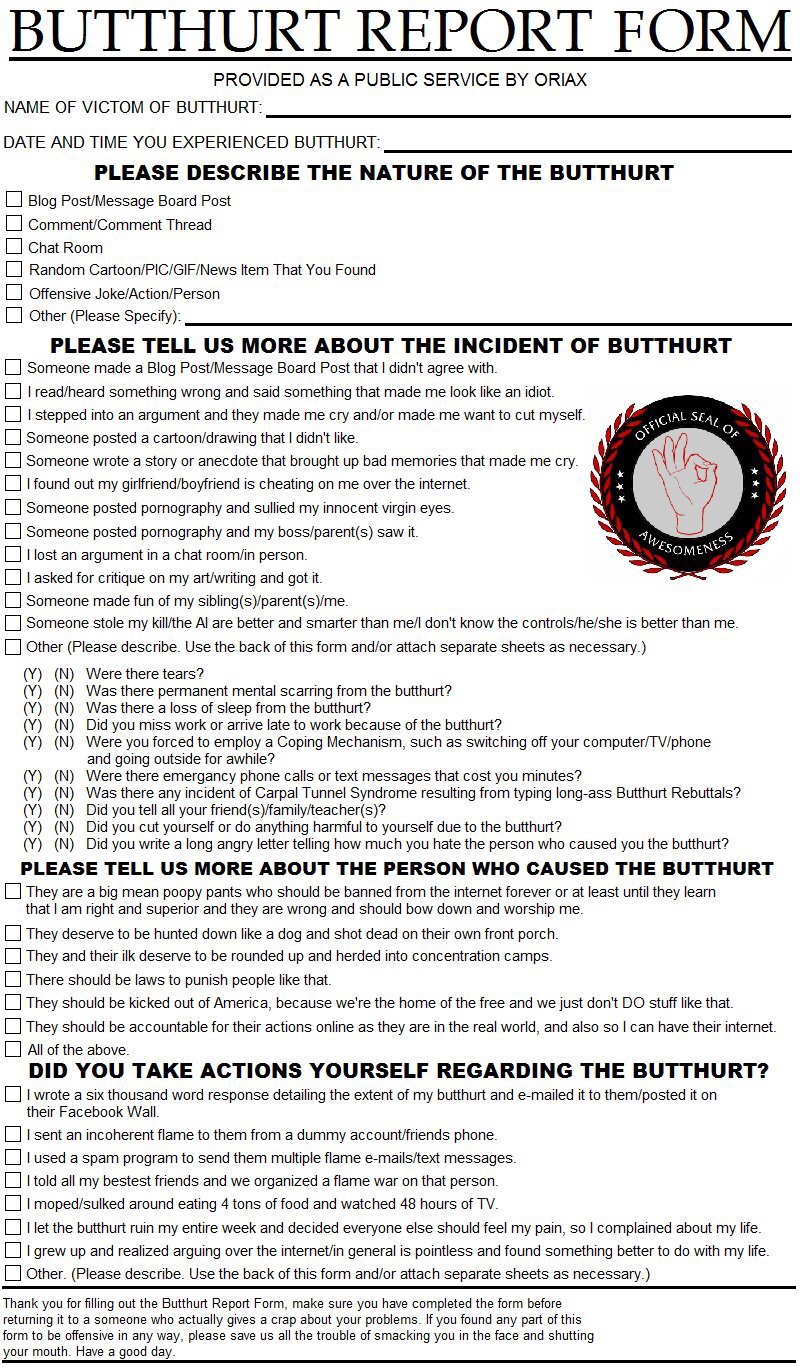
Should you find yourself sanctioned after running afoul of the CF comments policy as stated and feel you have been wronged, please download and complete the Butthurt Report form below in quadruplicate; retain one copy for your personal records and send the others to the email address posted in the right sidebar.

Please refrain from whining, sniveling, and/or bursting into tears and waving your chubby fists around in frustrated rage, lest you suffer an aneurysm or stroke unnecessarily. Your completed form will be reviewed and your complaint addressed whenever management feels like getting around to it. Thank you.

CF Glossary

ProPol: Professional Politician

Vichy GOPe: Putative "Republicans" who talk a great game but never can seem to find a hill they consider worth dying on; Quislings, Petains, Benedicts, backstabbers, fake phony frauds

Fake Phony Fraud(s), S'faccim: two excellent descriptors coined by the late great WABC host Bob Grant which are interchangeable, both meaning as they do pretty much the same thing

Mordor On The Potomac: Washington, DC

The Enemy: shitlibs, Progtards, Leftards, Swamp critters, et al ad nauseum

Burn, Loot, Murder: what the misleading acronym BLM really stands for

pAntiFa: an alternative spelling of "fascist scum"

"Mike Hendrix is, without a doubt, the greatest one-legged blogger in the world." ‐Henry Chinaski

Subscribe to CF!

Support options

Shameless begging

If you enjoy the site, please consider donating:

Correspondence

Email addy: mike-at-this-url dot etc

All e-mails assumed to be legitimate fodder for publication, scorn, ridicule, or other public mockery unless specified as private by the sender

Allied territory

Alternatives to shitlib social media: A few people worth following on Gab:

Fuck you

Kill one for mommy today! Click to embiggen

Notable Quotes

"America is at that awkward stage. It's too late to work within the system, but too early to shoot the bastards."
Claire Wolfe, 101 Things to Do 'Til the Revolution

Claire's Cabal—The Freedom Forums

FREEDOM!!!

"There are men in all ages who mean to govern well, but they mean to govern. They promise to be good masters, but they mean to be masters."
Daniel Webster

“When I was young I was depressed all the time. But suicide no longer seemed a possibility in my life. At my age there was very little left to kill.”
Charles Bukowski

“A slave is one who waits for someone to come and free him.”
Ezra Pound

“The illusion of freedom will continue as long as it’s profitable to continue the illusion. At the point where the illusion becomes too expensive to maintain, they will just take down the scenery, they will pull back the curtains, they will move the tables and chairs out of the way and you will see the brick wall at the back of the theater.”
Frank Zappa

“The right of a nation to kill a tyrant in case of necessity can no more be doubted than to hang a robber, or kill a flea.”
John Adams

"A society of sheep must in time beget a government of wolves."
Bertrand de Jouvenel

"It is terrible to contemplate how few politicians are hanged."
GK Chesterton

"I predict that the Bush administration will be seen by freedom-wishing Americans a generation or two hence as the hinge on the cell door locking up our freedom. When my children are my age, they will not be free in any recognizably traditional American meaning of the word. I’d tell them to emigrate, but there’s nowhere left to go. I am left with nauseating near-conviction that I am a member of the last generation in the history of the world that is minimally truly free."
Donald Sensing

"The only way to live free is to live unobserved."
Etienne de la Boiete

"History does not long entrust the care of freedom to the weak or the timid."
Dwight D. Eisenhower

"To put it simply, the Left is the stupid and the insane, led by the evil. You can’t persuade the stupid or the insane and you had damn well better fight the evil."
Skeptic

"There is no better way to stamp your power on people than through the dead hand of bureaucracy. You cannot reason with paperwork."
David Black, from Turn Left For Gibraltar

"If the laws of God and men, are therefore of no effect, when the magistracy is left at liberty to break them; and if the lusts of those who are too strong for the tribunals of justice, cannot be otherwise restrained than by sedition, tumults and war, those seditions, tumults and wars, are justified by the laws of God and man."
John Adams

"The limits of tyranny are prescribed by the endurance of those whom they oppress."
Frederick Douglass

"Give me the media and I will make of any nation a herd of swine."
Joseph Goebbels

“I hope we once again have reminded people that man is not free unless government is limited. There’s a clear cause and effect here that is as neat and predictable as a law of physics: As government expands, liberty contracts.”
Ronald Reagan

"Ain't no misunderstanding this war. They want to rule us and aim to do it. We aim not to allow it. All there is to it."
NC Reed, from Parno's Peril

"I just want a government that fits in the box it originally came in."
Bill Whittle

Best of the best

Finest hosting service

Image swiped from The Last Refuge

2016 Fabulous 50 Blog Awards

RSS feed

RSS - entries - Entries
RSS - entries - Comments

Boycott the New York Times -- Read the Real News at Larwyn's Linx

Copyright © 2026