Der Bingle

A Christmas story for the ages, one that exemplifies courage, character, and unswerving commitment to the non-negotiable demands of personal honor, patriotic duty, and obligation.


“Show more,” my saggy, baggy ass.

Late in Bing Crosby’s life, his nephew Howard asked him a casual question while they were out playing golf together.

“What was the single most difficult thing you ever had to do in your career?”
Howard expected Hollywood stories. Maybe gossip about a demanding director. Perhaps the pressure of a high-stakes film production or a struggle with studio executives.

Bing didn’t have to think about it at all.
December 1944. Northern France. The war in Europe was grinding toward its bloody conclusion.

Bing Crosby was on a USO tour, performing for American GIs and British soldiers far from home during the coldest, darkest days of winter.
That night, they set up an open-air stage in a field.

Fifteen thousand soldiers gathered to watch. Bing was joined by Dinah Shore and the Andrews Sisters.
They sang, they joked, they made the men laugh and holler—a brief moment of joy in the middle of a war zone.
Then came the closing number.
“White Christmas.”

The song had already become an anthem for homesick soldiers since its release in 1942. It played constantly on Armed Forces Radio. Men who hadn’t seen their families in years, who didn’t know if they ever would again, heard those opening notes and thought of snow-covered streets and Christmas trees and the homes they’d left behind.

As Bing began to sing, he looked out at the audience. Fifteen thousand men were crying. He had to finish the song. He had to maintain his composure and his vocal control while 15,000 soldiers wept in front of him. He told his nephew it was the toughest thing he ever had to do in his entire career.

What made Bing Crosby’s USO performances different from his Hollywood appearances were the small choices he made. He refused to wear his toupee. He hated the thing—called it a “scalp doily”-and wore it only when absolutely necessary for films.

But entertaining troops was different. “If I’m entertaining troops,” he said, “I’m not going to wear anything phony like a toupee. Forget it.”

He also insisted that officers and brass could not sit in the front rows. Those seats were reserved for enlisted men. The soldiers who would be on the front lines. The men who faced the greatest danger.

A few days after that performance in the field, those same soldiers were sent into combat. The Battle of the Bulge began on December 16, 1944. It was the largest and bloodiest battle fought by the United States in World War II.

The Germans launched a surprise offensive through the Ardennes Forest in a desperate attempt to split the Allied lines. Many of the men who had wept listening to “White Christmas” in that field in France never came home.

Bing Crosby tried to enlist when the war began. He was told he was too old. General George C. Marshall, the Army’s chief of staff, told him directly:

“Look, Bing, we don’t need you in the front lines. We need you raising money for the war effort.” He wasn’t just an entertainer to them. He was a piece of home. Bing never forgot it. 🙏♥️

Leftists who viscerally hate anything that reminds them of what America once was have smeared Bing Crosby as a nasty, hateful racist, bully, and two-bit tyrant who viciously ran roughshod over others and used his wife and children as punching bags—a distorted, unidimensional portrait which disgracefully omits the man’s finer qualities.

A Cuban missile-crisis Christmas?

FINALLY, another brilliant Steynmusic post.

Back in 1952, Gloria Shayne had been the pianist in the dining room of a New York hotel when a young man walked in, took one look at the gal at the keyboard, and went up and introduced himself. He was a Frenchman who spoke very little English, she was an American who spoke even less French. She liked pop music, he had come to America to be a classical musician. Yet within a month they were married. Flash forward ten years: Noël Regney’s English has improved, and, although he still hasn’t made his name in serious music, he’s learned to appreciate American pop music since his wife hit the jackpot with “Goodbye, Cruel World”. They even write songs together – usually with Noël writing the music, and Gloria the lyrics.

But not this time. Noël Regney had had a lively war. Born in Strasbourg, he’d been conscripted, after the German invasion, into the army of the Reich. And, although he soon deserted and joined the Resistance, he stayed in German uniform long enough to lead his platoon intentionally into the path of a group of French partisans, who wound up shooting him. After the liberation of his country, he went east to be the musical director of the Indochinese service of Radio France, and found himself in the middle of a new conflict. He thought the Second World War was so terrible that it must surely be the end of all war. But here it was – October 1962 – and as he saw it Washington and Moscow were playing a dangerous game of nuclear brinksmanship over Soviet missiles in Cuba. On the streets of Manhattan, he saw two infants in strollers being wheeled by their mothers along the sidewalk, and decided he wanted to write something for them. Not music, but words: A poem.He remembered scenes from his own childhood – sheep grazing in the pasture of the beautiful campagne – and he had the image he needed:

Said the wind to the little lamb,
‘Do you see what I see?
Way up in the sky, little lamb
Do you see what I see?
A star, a star
Dancing in the night
With a tail as big as a kite.’

He wrote a tune to go with it, too, but he decided it wasn’t right, and turned to his wife. “When he finished,” said Gloria, “Noël gave it to me and asked me to write the music. He said he wanted me to do it because he didn’t want the song to be too classical. I read over the lyrics, then went shopping. I was going to Bloomingdale’s when I thought of the first music line.”

It was only when she got home and played the tune for her husband that she realized she’d made a mistake, and had added one note more to that first line than the lyric required. But Noel loved the melody and didn’t want her to change a thing. So he went back to his poem and added a syllable for the spare note:

Said the night wind to the little lamb…

Gloria asked for one other text change: “A tail as big as a kite” didn’t sound right to her ears: somehow it wasn’t quite American English. But Noël put his foot down on that one: those words were staying, just as they were. “He was right,” she later told Yuletide musical archivist Ace Collins. “It is a line that people dearly love.” It’s perhaps the most vivid and memorable in the song, and a good example of how a phrase you might have no use for as a piece of speech can be transformed by music. The star dancing in the night with a tail as big as a kite is a rare moment of poetic imagery in a lyric that’s otherwise baldly descriptive. It’s slightly off-kilter – a tail as long as a kite, surely? – but “big” makes it more childlike and wondering.

The simple structure of the song is very effective – four verses, passing the story from the night wind to the little lamb, the little lamb to the shepherd boy, the shepherd boy to the mighty king, and finally the mighty king to the people. The repetition of “a star, a star/Dancing in the night” is matched by “a song, a song/High above the trees”, and “a child, a child/Shivers in the cold…” And at the end Noël Regney finally spelled out what was on his mind in that fall of 1962:

Said the king to the people everywhere,
‘Listen to what I say!
Pray for peace, people everywhere
Listen to what I say!
The child, the child
Sleeping in the night,
He will bring us goodness and light.

M and Mme Regney took their song to the Regency publishing company, and Regency immediately got hold of Harry Simeone. You can understand why. The Harry Simeone Chorale had had a huge hit four years earlier with “The Little Drummer Boy”, and to a casual listener “Do You Hear What I Hear?” can easily sound like “The Little Drummer Boy” sideways. Both tunes share a kind of simplistic formality, and the words of the later song echo the first: “Do You Hear?” reprises “Drummer Boy”‘s king and baby (actually, in the first song, the king is the baby) and one half of “the ox and lamb”, and the little shepherd boy is clearly a kindred spirit of the little drummer boy. So the Simeone Chorale recorded it, put it out for Thanksgiving 1962, and sold a quarter-million copies in its first week.

There were stories in the papers about drivers hearing it on the radio and pulling over on to the shoulder to listen to the lyrics. Regney and Shayne had written a song so powerful they couldn’t even get through it themselves without dissolving into tears. “We couldn’t sing it,” said Gloria. “Our little song broke us up. You must realize there was a threat of nuclear war at the time.”

But threats of nuclear war come and go; a good song is forever. What turned “Do You Hear What I Hear?” from a peace anthem to a seasonal standard was a recording the following year by Mister White Christmas himself, Bing Crosby. Bing’s warm dramatic baritone drew out the words in ways that the 25 voices of the Harry Simeone Chorale simply couldn’t. When I see these lyrics on paper, my mind’s ear hears them in Crosby’s voice:

Said the shepherd boy to the mighty king,
‘Do you know what I know?
In your palace warm, mighty king
Do you know what I know?
A child, a child
Shivers in the cold
Let us bring him silver and gold
Let us bring him silver and gold…’

Bing’s version sold a million copies, and the song never looked back.

“I am amazed that people can think they know the song,” said Noël Regney, “and not know it is a prayer for peace.” Ah, but most great popular art wiggles free of its creator. And so many if not most of those singing along to “Do You Hear What I Hear?” will have no idea that it has anything to do with some ancient flash point of the Cold War. Which is as it should be. Noël Regney and Gloria Shayne eventually divorced. The man who wrote those powerful words was hit by a stroke and ended his days unable to speak. The woman who wrote that melody was struck by cancer and unable to play the piano. But their song lives on, with a tail stretching across the decades:

Said the night wind to the little lamb,
‘Do you see what I see?
Way up in the sky, little lamb
Do you see what I see?
A star, a star
Dancing in the night
With a tail as big as a kite.’

Noël Regney: the first Noël to write an American Christmas classic, even if it took the Cuban missile crisis to inspire him.

Happily, Steyn includes what I myself agree is the best version yet recorded, by the aforementioned Der Bingle.


Wonderful stuff, no? And, as is so often the case, with an equally wonderful story behind its creation as well.

CF Archives

Categories

Comments policy

NOTE: In order to comment, you must be registered and approved as a CF user. Since so many user-registrations are attempted by spam-bots for their own nefarious purposes, YOUR REGISTRATION MAY BE ERRONEOUSLY DENIED.

If you are in fact a legit hooman bean desirous of registering yourself a CF user name so as to be able to comment only to find yourself caught up as collateral damage in one of my irregularly (un)scheduled sweeps for hinky registration attempts, please shoot me a kite at the email addy over in the right sidebar and let me know so’s I can get ya fixed up manually.

ALSO NOTE: You MUST use a valid, legit email address in order to successfully register, the new anti-spam software I installed last night requires it. My thanks to Barry for all his help sorting this mess out last night.

Comments appear entirely at the whim of the guy who pays the bills for this site and may be deleted, ridiculed, maliciously edited for purposes of mockery, or otherwise pissed over as he in his capricious fancy sees fit. The CF comments section is pretty free-form and rough and tumble; tolerance level for rowdiness and misbehavior is fairly high here, but is NOT without limit.

Management is under no obligation whatever to allow the comments section to be taken over and ruined by trolls, Leftists, and/or other oxygen thieves, and will take any measures deemed necessary to prevent such. Conduct yourself with the merest modicum of decorum, courtesy, and respect and you'll be fine. Pick pointless squabbles with other commenters, fling provocative personal insults, issue threats, or annoy the host (me) and...you won't.

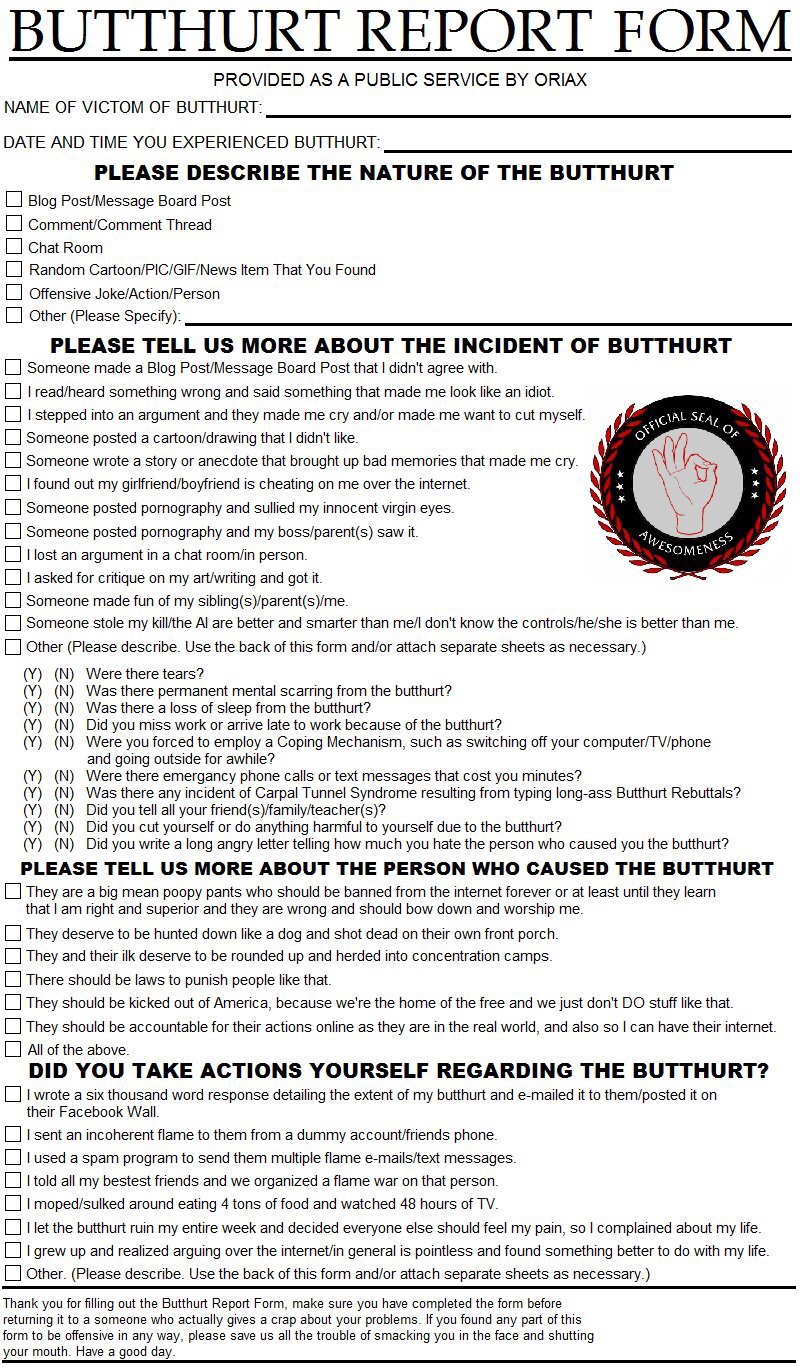
Should you find yourself sanctioned after running afoul of the CF comments policy as stated and feel you have been wronged, please download and complete the Butthurt Report form below in quadruplicate; retain one copy for your personal records and send the others to the email address posted in the right sidebar.

Please refrain from whining, sniveling, and/or bursting into tears and waving your chubby fists around in frustrated rage, lest you suffer an aneurysm or stroke unnecessarily. Your completed form will be reviewed and your complaint addressed whenever management feels like getting around to it. Thank you.

CF Glossary

ProPol: Professional Politician

Vichy GOPe: Putative "Republicans" who talk a great game but never can seem to find a hill they consider worth dying on; Quislings, Petains, Benedicts, backstabbers, fake phony frauds

Fake Phony Fraud(s), S'faccim: two excellent descriptors coined by the late great WABC host Bob Grant which are interchangeable, both meaning as they do pretty much the same thing

Mordor On The Potomac: Washington, DC

The Enemy: shitlibs, Progtards, Leftards, Swamp critters, et al ad nauseum

Burn, Loot, Murder: what the misleading acronym BLM really stands for

pAntiFa: an alternative spelling of "fascist scum"

"Mike Hendrix is, without a doubt, the greatest one-legged blogger in the world." ‐Henry Chinaski

Subscribe to CF!

Support options

Shameless begging

If you enjoy the site, please consider donating:

Correspondence

Email addy: mike-at-this-url dot etc

All e-mails assumed to be legitimate fodder for publication, scorn, ridicule, or other public mockery unless specified as private by the sender

Allied territory

Alternatives to shitlib social media: A few people worth following on Gab:

Fuck you

Kill one for mommy today! Click to embiggen

Notable Quotes

"America is at that awkward stage. It's too late to work within the system, but too early to shoot the bastards."
Claire Wolfe, 101 Things to Do 'Til the Revolution

Claire's Cabal—The Freedom Forums

FREEDOM!!!

"There are men in all ages who mean to govern well, but they mean to govern. They promise to be good masters, but they mean to be masters."
Daniel Webster

“When I was young I was depressed all the time. But suicide no longer seemed a possibility in my life. At my age there was very little left to kill.”
Charles Bukowski

“A slave is one who waits for someone to come and free him.”
Ezra Pound

“The illusion of freedom will continue as long as it’s profitable to continue the illusion. At the point where the illusion becomes too expensive to maintain, they will just take down the scenery, they will pull back the curtains, they will move the tables and chairs out of the way and you will see the brick wall at the back of the theater.”
Frank Zappa

“The right of a nation to kill a tyrant in case of necessity can no more be doubted than to hang a robber, or kill a flea.”
John Adams

"A society of sheep must in time beget a government of wolves."
Bertrand de Jouvenel

"It is terrible to contemplate how few politicians are hanged."
GK Chesterton

"I predict that the Bush administration will be seen by freedom-wishing Americans a generation or two hence as the hinge on the cell door locking up our freedom. When my children are my age, they will not be free in any recognizably traditional American meaning of the word. I’d tell them to emigrate, but there’s nowhere left to go. I am left with nauseating near-conviction that I am a member of the last generation in the history of the world that is minimally truly free."
Donald Sensing

"The only way to live free is to live unobserved."
Etienne de la Boiete

"History does not long entrust the care of freedom to the weak or the timid."
Dwight D. Eisenhower

"To put it simply, the Left is the stupid and the insane, led by the evil. You can’t persuade the stupid or the insane and you had damn well better fight the evil."
Skeptic

"There is no better way to stamp your power on people than through the dead hand of bureaucracy. You cannot reason with paperwork."
David Black, from Turn Left For Gibraltar

"If the laws of God and men, are therefore of no effect, when the magistracy is left at liberty to break them; and if the lusts of those who are too strong for the tribunals of justice, cannot be otherwise restrained than by sedition, tumults and war, those seditions, tumults and wars, are justified by the laws of God and man."
John Adams

"The limits of tyranny are prescribed by the endurance of those whom they oppress."
Frederick Douglass

"Give me the media and I will make of any nation a herd of swine."
Joseph Goebbels

“I hope we once again have reminded people that man is not free unless government is limited. There’s a clear cause and effect here that is as neat and predictable as a law of physics: As government expands, liberty contracts.”
Ronald Reagan

"Ain't no misunderstanding this war. They want to rule us and aim to do it. We aim not to allow it. All there is to it."
NC Reed, from Parno's Peril

"I just want a government that fits in the box it originally came in."
Bill Whittle

Best of the best

Finest hosting service

Image swiped from The Last Refuge

2016 Fabulous 50 Blog Awards

RSS feed

RSS - entries - Entries
RSS - entries - Comments

Boycott the New York Times -- Read the Real News at Larwyn's Linx

Copyright © 2026