
Hellacious planes, hellacious stories.
In 1963, a test pilot aimed a massive C-130 Hercules at a carrier deck with no tailhook or arresting wires. He pulled off 21 flawless landings, yet the Navy never did it again.
The audacious experiment was born out of a growing logistical problem: aircraft carriers were operating further out to sea, and standard transport planes were too small to deliver heavy replacement parts like jet engines. To see if they could increase their Carrier Onboard Delivery (COD) capacity, the Chief of Naval Operations ordered a feasibility study on landing the cargo plane at sea.
The Navy borrowed a Marine Corps KC-130F, removed its underwing refueling pods, installed heavy-duty anti-skid brakes, and painted a white centerline on the flight deck of the USS Forrestal. Test pilot Lt. James H. Flatley III was chosen to fly the operation without any catapults for takeoff.
To land a 121,000-pound cargo plane on a floating runway, the Forrestal steamed into the wind to generate up to 50 knots of natural wind over the deck. Flatley brought the Hercules down precisely on the carrier’s white line, immediately threw the four massive turboprop engines into reverse pitch, and stood on the anti-skid brakes. During one test run with an 85,000-pound gross weight, he brought the aircraft to a complete halt in just 267 feet.
Over several weeks, the crew completed 29 touch-and-goes alongside the full-stop landings, plus 21 unassisted takeoffs. The tests proved conclusively that the C-130 could safely resupply a carrier at sea, carrying up to 30,000 pounds of cargo and flying thousands of miles without refueling.
Despite the flawless execution, the Navy never adopted the C-130 operationally for one simple reason: its 132-foot wingspan completely monopolized the flight deck. To receive the Hercules, all other aircraft had to be moved out of the way or struck below, paralyzing normal combat operations. Taking a carrier out of the fight simply to receive cargo was considered unacceptable. Instead, the Navy used the C-130 data to justify building a smaller, purpose-built delivery plane—the Grumman C-2 Greyhound—which could carry a heavy payload, fold its wings, and integrate seamlessly into standard flight operations.
Nobody ever called her pretty, but the venerable Herky Bird assumed several different roles over its long operational lifespan, with an almost shocking success rate. Story Numero Dos.
The Vought F-8 Crusader (originally F8U under the 1922 designation system) is a retired single-jet engine, supersonic, carrier-based air superiority fighter designed and produced by the American aircraft manufacturer Vought. It was the last American fighter that had guns as the primary weapon, earning it the title “The Last of the Gunfighters”.
Development of the F-8 commenced after release of the requirement for a new fighter by the United States Navy in September 1952. Vought’s design team, led by John Russell Clark, produced the V-383, a relatively unorthodox fighter that possessed an innovative high-mounted variable-incidence wing, an area-ruled fuselage, all-moving stabilators, dog-tooth notching at the wing folds for improved yaw stability, and liberal use of titanium throughout the airframe. During June 1953, Vought received an initial order to produce three XF8U-1 prototypes of its design. On 25 March 1955, the first prototype performed its maiden flight. Flight testing proved the aircraft to be relatively problem-free. On 21 August 1956, U.S. Navy pilot R.W. Windsor attained a top speed of 1,015 mph; in doing so, the F-8 became the first jet fighter in American service to reach 1,000 mph.
During March 1957, the F-8 was introduced into regular operations with the US Navy. In addition to the Navy, the type was also operated by the French Navy, and the Philippine Air Force. Early on, the type experienced an above-average mishap rate, being somewhat difficult to pilot. American F-8s saw active combat during the Vietnam War, engaging in multiple dogfights with MiG-17s of the Vietnam People’s Air Force as well as performing ground attack missions in the theatre. The RF-8 Crusader was a photo-reconnaissance model. It played a crucial role in the Cuban Missile Crisis, providing essential low-level photographs of Soviet medium range ballistic missiles (MRBMs) in Cuba that were impossible to acquire by other means at that time. Several modified F-8s were used by NASA for experimental flights, including the testing of digital fly-by-wire technology and supercritical wing design. The RF-8 operated in U.S. service longer than any of the fighter versions; the United States Navy Reserve withdrew its remaining aircraft during 1987.
Crusader with the variable-instance wing deployed: 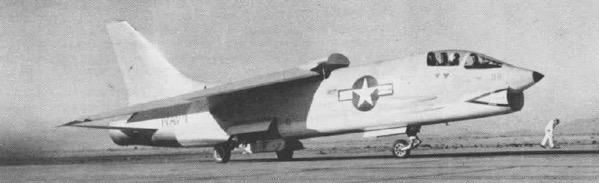
Update! What the hey, have another: the Crusader’s badass little brother, the A7 Corsair.
The LTV A-7 Corsair II is an American carrier-capable subsonic light attack aircraft designed and manufactured by Ling-Temco-Vought (LTV).
The A-7 was developed during the early 1960s as replacement for the Douglas A-4 Skyhawk. Its design was derived from the Vought F-8 Crusader; in comparison with the F-8, the A-7 is both smaller and restricted to subsonic speeds, its airframe being simpler and cheaper to produce. Following a competitive bid by Vought in response to the United States Navy’s (USN) VAL (Heavier-than-air, Attack, Light) requirement, an initial contract for the type was issued on 8 February 1964. Development was rapid, first flying on 26 September 1965 and entering squadron service with the USN on 1 February 1967. By the end of that year, A-7s were being deployed overseas for the Vietnam War.
The Corsair ended up being another multirole aircraft, rapidly developing into quite the little jack-of-all-trades, master-of-several mainstay until the F16 and F/A18 came along to elbow it unceremoniously aside. The family resemblance between the two Vought fighter/attack siblings is unmistakable.
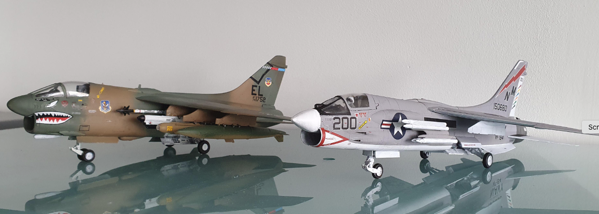
See whut I mean?











 - Entries